
Your needs, this model
Does it fit your priorities?
Is LDB6F the maker's coarse repair stone?
No. The exact LDB6F instructions describe Fine as one 600-grit surface and assign Fine and Ultra Fine to honing or polishing a finished edge. Lansky's broader suggested progression starts at its separate Medium diamond stone and then moves to Fine and Ultra Fine. The LDB6F record does not describe a coarse repair face.
Explore this need in the finder →Is the LDB6F grit value disputed like LDB6M?
The inspected current exact LDB6F page and Lansky-branded 2022 catalog copy both list Fine at 600 grit. This is a matching maker-published claim, not an independent measurement; the exact source set shows no LDB6F grit conflict.
Explore this need in the finder →Does the fine stone set a repeatable numeric angle?
No numeric angle, marked guide or adjustment range is published for LDB6F. Lansky instructs the user to observe and match the knife's existing bevel, so this is freehand benchstone work rather than a clamped or fixed-angle system.
Explore this need in the finder →This research-based review covers Lansky Diamond Benchstone Fine, exact SKU LDB6F, a current single-face diamond benchstone. The maker's exact product data list it in Knife Sharpeners and Benchstones. I have not used or tested it; this assessment reads the current exact record and instructions alongside Lansky's 2022 catalog copy and the model-matched gallery image. See Lansky's LDB6F page.
A finishing stage sold as its own stone
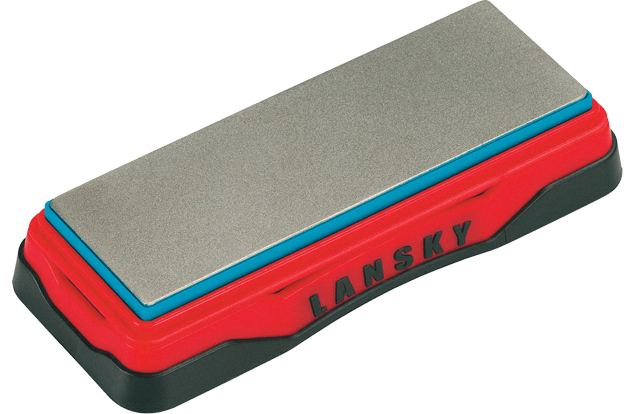
The exact LDB6F record describes a six-by-two-inch Fine diamond surface. Its body is a raised high-impact plastic storage case with a non-slip rubber frame. The gallery depicts one flat working face, not a multi-grit paddle or an angle-guided clamp. Fine 600 is the exact page's label; the same LDB6F code also appears in the 2022 Lansky-branded catalog at 600. That consistency is useful, though it remains a manufacturer specification rather than a grit measurement performed for this review.
The instructions place Fine and Ultra Fine after the Medium stage in a recommended Medium-to-Fine-to-Ultra-Fine progression and describe the fine surfaces as honing or polishing a finished edge. That makes LDB6F a finishing-stage choice, not the maker-documented coarse repair face for a badly damaged edge. If you are building a sequence, note that the Medium LDB6M and Ultra Fine LDB6E are separate model choices; this exact product record does not say they are packaged with LDB6F.
How the freehand routine works
Lansky directs the user to set the stone on a stable flat surface, observe the blade's existing bevel, and guide the edge to match it. The maker suggests a light, single-motion push across the abrasive, then repeating on one side before switching to the other. Stroke count can taper as the session progresses. This is a simple bench arrangement, but it leaves angle consistency to the person holding the knife; there is no clamp, rod or marked setting in the exact product record.
No degree setting, angle range, increment or per-side-versus-inclusive convention is published for LDB6F. The six-inch length and two-inch width describe the listed stone, not the full base footprint or maximum blade size. A broad chef's knife, a tall handle or a blade whose profile approaches the edges still deserves a clearance check on the actual work surface. A larger abrasive face does not make the bevel angle automatic.
Kitchen use is listed; specialized edges are not settled
The exact LDB6F attributes list Regular, Filet, Kitchen Blade and Woodworking/Chisels. Kitchen use is therefore documented for this model. The current exact use list does not name pocket or hunting use separately, and this review does not expand “Regular” into those narrower categories. The record also supplies no scissor procedure or serration-specific stroke sequence. A flat stone can be used for many tasks in practice, but an untested possibility is not a documented match.
For shoppers comparing the nearby stones, LDB6M carries the Medium label and an important 400-versus-280 catalog conflict; LDB6E is the 1,000-grit Ultra Fine option. All three are manual, single-face diamond benchstones with the same basic bevel-matching method, but their intended points in the maker's sequence differ. For a multi-surface bench unit rather than a single stage, the BSTR100 groups diamond, alumina-oxide and ceramic faces under one base.
Dry use, cleaning and unknown package details
The exact diamond-stone instructions say not to use lubrication of any kind on the face. They recommend wiping the stone with a damp rag after sharpening and storing it in a cool, dry place. The current product details also identify the non-slip base, storage case and optional mounting, but the source does not specify whether screws or any other mounting hardware are supplied. Check the exact offer if fixed installation is part of your plan.
The record does not confirm an included leather strop, other abrasives or seller-specific kit contents. It also does not give an overall base footprint, blade-clearance diagram or supported blade-length limit. Those are practical buying checks, not missing values that can be safely guessed from the product image. The image caption identifies the exact LDB6F model while leaving grit, fit and package details to the written source.
Who should consider LDB6F?
Consider this Fine stone if your task is a manually guided 600-grit finishing or honing step, your knife falls within the maker's listed uses, and you want a raised non-slip bench base instead of a small handheld stone. It asks you to control the bevel and follow a dry diamond-stone routine. It does not document a complete progression by itself, a numeric angle, a serration or scissor method, or a leather-strop inclusion.
In short, LDB6F occupies a narrower role than a general all-stage sharpener: it is the Fine stage in a maker-described sequence, sold here as its own exact SKU. Its stable current grit label and kitchen-use listing are strengths for matching the written task; the freehand requirement and single-surface package are the main constraints. This is a source-based assessment, not a hands-on sharpening test, a blade-specific angle recommendation, a seller-stock report or a price comparison.
Key specifications
Key details at a glance
| Power | Manual |
|---|---|
| Sharpening format | Single flat-faced fine diamond benchstone in a raised plastic storage-case base with a non-slip rubber frame; the user guides the knife by hand while matching the existing bevel. |
| Included abrasive surfaces | One full-face fine diamond benchstone surface, manufacturer-labelled 600 grit in both the current exact LDB6F data and the inspected Lansky-branded 2022 catalog copy. / The exact instructions place Fine and Ultra Fine in the honing/polishing stage for a finished edge and recommend a separate Medium-to-Fine-to-Ultra-Fine progression for best results. |
| Benchtop base included | Yes |
| Use dry (no oil or water) | Yes |
| Angle-guide positions | ° |
Use the exact model’s instructions for operating limits, supplied equipment and version differences.
Sources for this review
Sources for this assessment

Check the requirements that matter to you
Use the finder to compare documented sharpener formats and limits; an unknown capability is not treated as a match.