
Your needs, this model
Does it fit your priorities?
Does LDB6M provide a coarse repair face for a chipped or very dull knife?
The exact LDB6M instructions describe one Medium face and assign Medium to maintaining an already-sharp edge. They do not describe a separate coarse face or a repair sequence for a chipped blade. Lansky's suggested Medium-to-Fine-to-Ultra-Fine progression also uses separate grit choices, so check a multi-stage option if you need a documented restoration-to-finish sequence.
Explore this need in the finder →What is the LDB6M medium grit value?
The current exact manufacturer record and attribute list call LDB6M Medium (400), but a Lansky-branded 2022 catalog copy lists the same code at 280. Neither source explains a model-generation or package change, so the number remains an unresolved manufacturer-source conflict rather than a verified single value.
Explore this need in the finder →How do I set up and clean LDB6M?
Place the stone on a stable, flat surface, observe and match the knife's existing bevel, and use a light continuous push across the face before repeating on the other side. Lansky says to use no lubricant on the diamond surface, then wipe it with a damp rag after use and store it in a cool, dry place.
Explore this need in the finder →This research-based assessment is for Lansky's Diamond Benchstone Medium, exact US SKU LDB6M. The manufacturer lists it in Knife Sharpeners and Benchstones as a manual single-face diamond benchstone. I have not used or tested it; the assessment is based on the exact manufacturer product record, selected attributes, an earlier Lansky catalog copy and the model-matched gallery image. See Lansky's LDB6M page.
One medium surface, not a three-stage kit
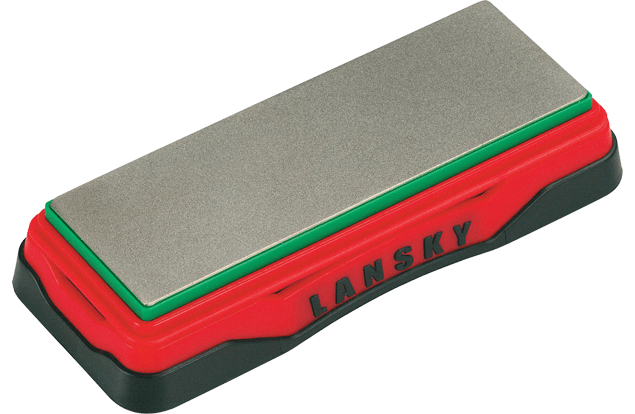
LDB6M is the Medium member of Lansky's single-face 6-by-2-inch diamond benchstone set. Its exact product record describes a full-face diamond abrasive mounted in a raised, high-impact plastic storage case with a non-slip rubber frame. The selected record is a single abrasive face; it is not the maker's two-face DB1260 or DB2860 stone, nor a package containing separate coarse, fine and ultra-fine stages.
The current exact LDB6M page calls the surface Medium, 400 grit. A Lansky-branded 2022 catalog copy prints the same LDB6M code at 280 grit. I found no source explaining that difference as a revised generation, a separate option or a packaging change. The two sources agree that the product is the medium 6-by-2 diamond benchstone, but the grit number is unresolved. This review does not turn the current 400 claim into an independently measured specification or treat the earlier 280 listing as a hidden alternate SKU. If grit number is central to your purchase, confirm the label on the exact package before relying on either figure.
Where the maker places it in a routine
The exact instruction set assigns the Medium stone to maintaining an already-sharp edge. It does not describe a coarse face, a chip-repair operation or the aggressive reprofiling role that Lansky reserves for a coarser abrasive elsewhere in its range. The same page recommends a Medium-to-Fine-to-Ultra-Fine sequence for the best results, but the Fine LDB6F and Ultra Fine LDB6E are separately identified benchstones. That progression is not an included three-surface system.
This distinction matters when translating “medium” into a task. LDB6M is a plausible stage for routine maintenance when the edge is already in reasonable shape and the user wants a diamond surface; it is not evidence that one single stone covers every repair and finishing need. If a knife is heavily damaged, or you want several stages in one purchase, compare an actual multi-surface system such as the BSTR100 or a separate coarse-to-fine package rather than assuming the LDB6M name includes more abrasives.
Freehand work and no numeric angle promise
Lansky says to place the stone on a stable, flat surface, observe the existing bevel and bring the edge to that angle. The user supplies the angle control. The instructions then call for light pressure and a single push across the face, repeating on one side and then the other. The published page provides no degree scale, adjustment range, guide positions or statement about a per-side versus inclusive angle convention. The six-inch by two-inch dimensions describe the stone; they do not establish the overall base footprint or a maximum knife length.
The manufacturer lists the exact product for Regular, Filet, Kitchen Blade and Woodworking/Chisels uses, so kitchen-blade work is directly documented. The exact current use attributes do not separately name pocket or hunting knives; the broad “Regular” label is not treated here as a substitute. I also found no LDB6M-specific scissor method or scallop-by-scallop serration procedure. The fact that a flat stone is hand-guided should not be read as proof that it suits every blade profile or edge.
Care, storage and package checks
The current instructions say not to apply any lubrication to the diamond surface. After sharpening, they call for cleaning with a damp rag and storage in a cool, dry place. The product description says the high-impact plastic case raises the stone, and the selected attributes identify a non-slip base and optional mounting. “Optional mounting” does not tell us whether mounting screws are supplied, so check the actual offer if you intend to fasten the base down.
The exact record does not confirm a leather strop, extra abrasive, separate clamp or seller-specific box contents. These are unknown package details, not evidence that every possible offer omits them. The image is an official exact-SKU gallery photograph of the LDB6M unit and its green-trimmed surface; it helps identify the pictured model but cannot prove grit, fit or package completeness.
Choosing between the related single stones
Within this exact 6-inch Lansky family, LDB6M is the medium-labelled maintenance choice, LDB6F is the fine 600-grit stone and LDB6E is the ultra-fine 1,000-grit stone. The maker places them in that Medium-to-Fine-to-Ultra-Fine order. The latter two current grit claims agree with the 2022 catalog; LDB6M's does not. All three require the user to hold the bevel, use the diamond surface dry and work from the existing edge geometry. None is a clamped angle system.
LDB6M is best considered when one documented kitchen-use diamond surface at the medium stage is the intended task, rather than as a complete multi-grit progression or a numeric-angle solution. Its key uncertainties are the 400-versus-280 grit conflict and unlisted package details. This is an evidence-based product assessment, not a hands-on performance test, recommendation of a bevel angle, current-stock statement or price report.
Key specifications
Key details at a glance
| Power | Manual |
|---|---|
| Sharpening format | Single flat-faced diamond benchstone in a raised plastic storage-case base with a non-slip rubber frame; the user guides the knife by hand while matching the existing bevel. |
| Included abrasive surfaces | One full-face diamond sharpening surface in the LDB6M package format. The current exact product data calls it Medium (400); Lansky's 2022 catalog copy lists the same SKU as 280 grit. No version bridge is established, so grit is excluded from matching tags. / The exact current instructions assign the medium stone to maintaining an already-sharp edge. Lansky recommends a progression from Medium to Fine to Ultra Fine for its diamond benchstones; the latter two are separate SKU choices, not documented included faces in this exact product record. |
| Benchtop base included | Yes |
| Use dry (no oil or water) | Yes |
| Angle-guide positions | ° |
Use the exact model’s instructions for operating limits, supplied equipment and version differences.
Sources for this review
Sources for this assessment

Check the requirements that matter to you
Use the finder to compare documented sharpener formats and limits; an unknown capability is not treated as a match.