
Your needs, this model
Does it fit your priorities?
What does Lansky document for serrated edges on the LTRIM?
The exact LTRIM directions call for placing a corner at a serration and using a gentle rolling push across its scallop while holding a consistent angle and pressure. Lansky says a pass removes burrs from the reverse side. The page does not map corner dimensions to scallop sizes, so compare the actual blade and consult its maker if fit is uncertain.
Explore this need in the finder →Can the LTRIM verify a required numeric sharpening angle?
No. Lansky's exact LTRIM instructions call for a consistent user-controlled angle but publish no degree setting or angle convention. If a specific number is essential, this exact product record does not document it; do not infer an angle from the finger rests or from another sharpener.
Explore this need in the finder →How does the maker say to clean the LTRIM ceramic surface?
The product page says to clean the alumina-ceramic rod with Lansky's Eraser Block or household cleanser when it darkens with metal particles. It does not give a numerical angle, replacement interval, strop specification, or complete seller-package list.
Explore this need in the finder →The Lansky Multi Sharpener (SKU LTRIM) is a hand-guided ceramic tool for two different knife jobs: a flat-face routine for plain edges and a corner-and-roll routine for serrations. Its manufacturer also assigns a groove to fish hooks and other pointed objects. That mix is the reason to compare it with a single-purpose hone, but it should not be mistaken for an angle-controlled jig. This assessment follows the exact Lansky product record and directions; it is not a hands-on test.
What the documented routines actually ask you to do
For a plain edge, Lansky describes a full-edge pass across a flat side of the ceramic surface. The user holds the tool and knife separately, keeps the angle and pressure steady, makes an initial few strokes on one side, then repeats on the other. The instructions say to continue as needed; they do not promise a fixed stroke count or result for every blade. The finger rests give the hand a place to hold the tool, but the manufacturer does not describe them as a numerical angle guide.
The serration method is different. The maker directs the user to set one of the tool's corners against a scallop and sweep that corner along it with a gentle rolling motion, maintaining even pressure and a consistent angle. Lansky says a pass removes a burr from the opposite side. This is a useful procedural distinction from running a flat stone down the whole edge, but the LTRIM page does not say which corner size fits a particular scallop, give a radius chart, or identify compatible knife models. Treat serration fit as a question to resolve against the actual blade rather than a guarantee based on the broad word “serrated.”
Its adjacent model is a real comparison, not an interchangeable label
The LTRIM and the related Lansky LTRSP Spyder Sharpener have several overlapping documented features: 600-grit ceramic, plain- and serrated-edge procedures, finger rests, a keychain, and a separate fish-hook groove. They remain distinct SKUs with different product records and gallery images. A practical difference is in the written serration guidance: the LTRSP page tells the user to use its smaller edge for narrow scallops and broader corners for wider ones. The LTRIM page recommends corner contact and a rolling stroke but does not provide that narrow-versus-wide mapping. Do not transfer the LTRSP's profile detail to the LTRIM just because both are in Lansky's compact sharpener range.
The maker lists the LTRIM under its pocket-sharpener and sharpening-stick categories, and the exact product record names a keychain. That is relevant carry context, not proof that every pocket, hunting, kitchen, or unusually shaped knife fits. The product-specific text names straight and serrated blades but does not identify a knife subtype or publish a blade-size limit.
What 600-grit ceramic does—and does not—tell you
“600 grit ceramic” is Lansky's stated abrasive description. It provides a documented point of comparison, not an independent surface measurement, a universal conversion to another maker's grit scale, or evidence of how quickly this tool will change a particular steel. The page describes one ceramic sharpening surface with flat faces and corners, plus the groove; it does not document a coarse-to-fine progression or a separate leather strop. If your task depends on several stages or a polished finish, choose only after checking the exact package and the knife maker's maintenance guidance.
The LTRIM directions ask for a consistent angle, but publish no degree value, adjustable range, marked angle positions, or per-side/inclusive convention. A required angle cannot be verified from this record. Nor should a user infer one from the shape of a corner, the finger rests, or the angle settings of a different Lansky product. This matters especially when restoring an existing bevel: a compact, manual format leaves the angle control to the user's technique.
Cleaning, handling, and package checks
Lansky says the alumina-ceramic rod can darken as metal particles collect and recommends its Eraser Block or household cleanser for cleaning. The exact page gives that care direction but does not publish a replacement interval. Handle both the knife and sharpener deliberately: the instructions emphasize secure grip and controlled strokes, and the manufacturer cautions that careless blade handling can cause injury. Work in a stable place where the edge cannot slide toward your fingers, and stop if you cannot control the contact.
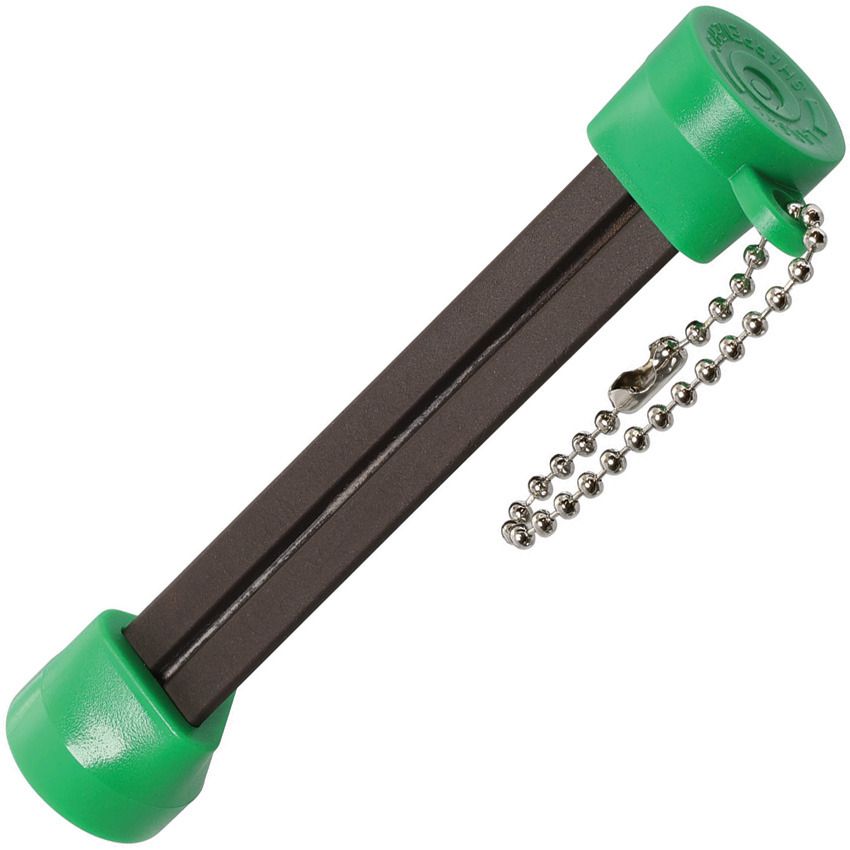
The official image shows the LTRIM tool with green end rests and an attached metal ball chain. It is not a package inventory. Before choosing a seller's offer, check that it is SKU LTRIM and confirm what is physically included; the exact manufacturer record does not establish a strop, clamp, storage case, dimensions, weight, or any seller-specific bundle. The visible carry feature also does not substitute for checking whether the tool's contact surfaces suit the blade you intend to maintain.
Who should keep comparing
The LTRIM is a plausible candidate to investigate when you want manual ceramic touch-up capability for both plain and serrated edges in one carried tool, and you are comfortable controlling the angle yourself. Its extra pointed-object groove is a separate use, not another knife-edge stage. Keep looking if your decision depends on a confirmed numeric angle, a named kitchen or pocket/hunting classification, exact scallop dimensions, scissors, or an included strop. Those are not documented for this exact configuration. Check the linked review and current manufacturer instructions against the actual knife, and do not read a match in a feature finder as proof of compatibility.
Key specifications
Key details at a glance
| Power | Manual |
|---|---|
| Sharpening format | Hand-held alumina-ceramic tool with flat faces for plain edges, a corner used with a rolling serration stroke, a separate fish-hook groove, non-slip thumb and finger rests, and a keychain |
| Included abrasive surfaces | 600-grit ceramic sharpening surface |
| Angle-guide positions | ° |
Use the exact model’s instructions for operating limits, supplied equipment and version differences.
Sources for this review
Sources for this assessment

Check the requirements that matter to you
Use the finder to compare documented sharpener formats and limits; an unknown capability is not treated as a match.