
Your needs, this model
Does it fit your priorities?
What serration shapes does Lansky describe for the LTRSP?
The LTRSP instructions assign its small edge to narrower serrations and broader corners to wider ones. They describe a gentle rolling push across an individual scallop with consistent angle and pressure. No exact radius or scallop-size range is published, so check the actual knife's edge against the tool rather than assuming every serration fits.
Explore this need in the finder →Does the LTRSP support a required numeric knife angle?
No numeric knife or serration angle appears in the exact LTRSP instructions. They ask for a consistent angle but give no degree setting or per-side/inclusive convention. If a particular number is essential, this product's documented plans do not verify it.
Explore this need in the finder →How does Lansky say to clean the LTRSP ceramic surface?
When the alumina-ceramic rod darkens with metal particles, Lansky says to use an Eraser Block or household cleanser. The exact product record does not establish a strop, replacement interval or the extra items in any seller-specific package, so check the exact offer if those matter.
Explore this need in the finder →This is a research-based assessment of Lansky’s exact Spyder Sharpener, SKU LTRSP, using its current model-specific product record and instructions. It is not a hands-on report. The useful distinction is more specific than “a small sharpener”: Lansky describes a 600-grit ceramic tool with a flat sharpening face, narrower and broader edge profiles for different serrations, and a groove for fish hooks. Its product page identifies both plain and serrated knife work, but gives no numeric knife angle or blade-fit dimensions. Lansky’s exact Spyder Sharpener page is the starting source for the package and directions.
What the exact SKU is meant to do
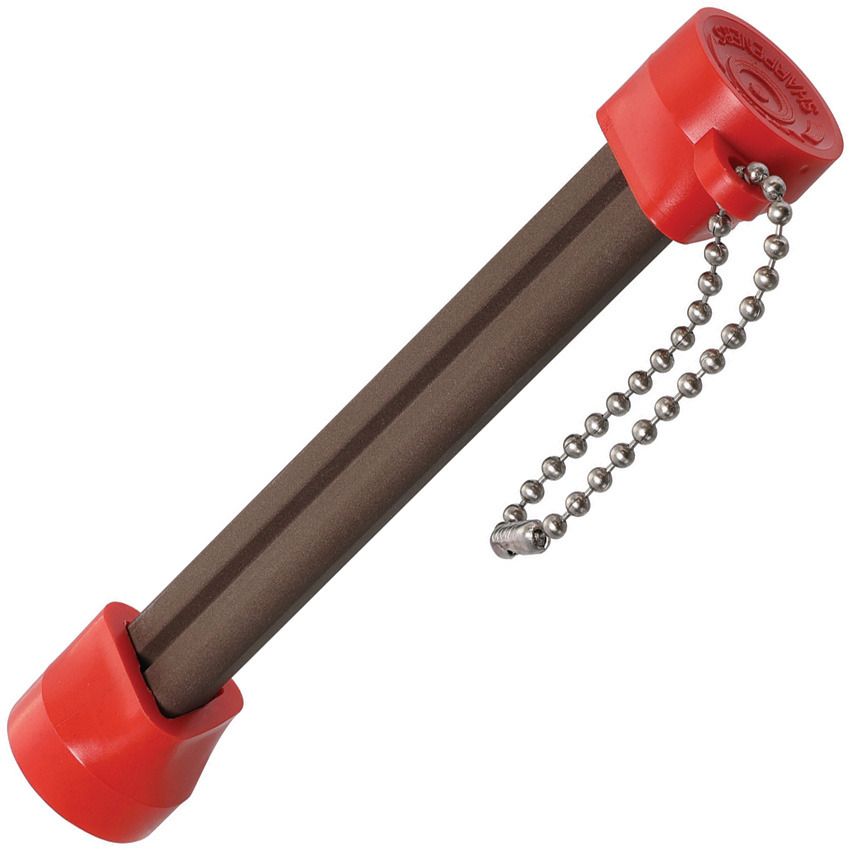
The official record calls the LTRSP a Spyder Sharpener and lists it in Lansky’s knife-sharpener, portable-sharpener and sharpening-stick categories. Its description says the ceramic abrasive is 600 grit. The maker lists non-slip thumb and finger rests plus a keychain, and says the tool can sharpen regular blades as well as serrated ones. The instructions assign the flat surfaces to regular edges and the groove to fish hooks and other pointed objects. This is a small hand-guided edge tool, not a powered machine, clamp system or angle-adjustable jig.
For serrations, the instructions distinguish the small edge for narrower serrations from broader corners for wider ones. The user is told to place the chosen corner against a scallop, keep the angle and pressure consistent, and push with a gentle rolling sweep across the individual serration. That geometry is the central reason to consider the LTRSP when a serrated edge is part of the job. It is not evidence that every tooth profile, scallop radius or blade will fit. Lansky gives no dimensions for those edges and no compatibility chart for particular knife models.
How the plain-edge and serrated routines differ
The plain-edge method uses a flat face, not one of the corners: hold the knife edge against the face and push the whole edge across it as though slicing a thin layer from the abrasive. Lansky recommends three to five strokes and then repeating on the other side, continuing as needed. For a serrated blade, the maker instead calls for the appropriate corner and a rolling movement from one side of each scallop to the other. The two methods share the need for controlled angle and pressure, but the flat-face routine is not a substitute for the serration procedure.
That distinction matters for shoppers comparing pocket tools. The Lansky TR600 is a folding tapered diamond rod with its own one-scallop-at-a-time directions and reverse-side burr pass. The LTRSP is a ceramic tool with non-slip rests, a keychain and manufacturer-described small and broader edges for different serrations. The DROD1 instead retracts into a pen-style body and uses corners on a three-sided diamond rod. All three are hand-guided and lack a published numeric serration angle, but their shapes, abrasives and specific instructions are not interchangeable.
Angle, care and limits of the evidence
The exact LTRSP instructions ask the user to keep a consistent angle; they do not supply a degree setting, a per-side versus inclusive convention, a marked guide position or a numeric range. The thumb and finger rests may help with grip, but the current instructions do not certify them as a particular-angle guide. Do not treat “Spyder” in the product name as proof of a fit for every knife with a distinctive serration pattern. If a numeric angle is essential, or if the blade maker specifies a precise edge geometry, this source does not verify the LTRSP for that requirement.
For cleaning, Lansky says to use its Eraser Block or a household cleanser when the alumina-ceramic sharpening rod darkens with metal particles. That is a more useful ownership detail than assuming a rod can simply be wiped clean. The product record does not state a strop, knife clamp, replacement schedule, dimensions, steel-specific guidance or a kitchen/pocket/hunting use classification. Those unknowns are not proof that an item is absent from every possible seller package, and this assessment does not fill them with assumptions. The model’s general plain- and serrated-blade instructions are not a guarantee that a particular handle, blade length or edge will clear the tool.
Who should compare it—and what to check
The LTRSP is worth examining if you want a manual ceramic sharpener with a dedicated way to work across individual serrations as well as a separate flat-face routine for plain edges. Its published maintenance instructions are short and task-specific, and the keychain is a documented carry feature. The trade-offs are equally concrete: the angle remains user-controlled; no degree value or compatibility chart is provided; the sharpening routine depends on choosing a corner that suits the scallop; and the available record does not document a finer finishing stage or a complete knife-maintenance kit.
Before choosing it, compare your knife’s serration shape and bevel guidance with the maker’s small-edge/broader-corner directions, and verify that the exact listing is SKU LTRSP rather than a similarly named Lansky sharpener. Check the seller’s actual package and return terms if a strop, protective cover, extra abrasive or other accessory is important; the manufacturer’s current model record does not establish those as supplied. For a plain-edge knife, confirm that a hand-guided ceramic face and an angle you control suit the edge you intend to maintain. No measured results, ownership experience or comparative performance test is claimed here; the assessment is limited to the exact maker-published details and operating plan.
Key specifications
Key details at a glance
| Power | Manual |
|---|---|
| Sharpening format | Handheld 600-grit alumina-ceramic tool with flat faces for plain edges, smaller and broader corner profiles for serrations, and a fishhook groove |
| Included abrasive surfaces | One 600-grit ceramic abrasive surface |
| Angle-guide positions | ° |
Use the exact model’s instructions for operating limits, supplied equipment and version differences.
Sources for this review
Sources for this assessment

Check the requirements that matter to you
Use the finder to compare documented sharpener formats and limits; an unknown capability is not treated as a match.