
Your needs, this model
Does it fit your priorities?
Which discrete plain-edge settings and maker-named uses are listed for MEDGE1?
The exact Lansky record gives 17° for fillet and fine slicing, 20° for slicing/butcher/paring/skinning, and 25° for hunting/camping/utility/chef's knives. The rod positions are discrete, not a continuous 17°–25° range, and the manufacturer does not clarify whether the marks are per-side or inclusive. Match the knife maker's convention before selecting one.
Explore this need in the finder →Does MEDGE1 have a separate serration routine?
Yes. Lansky lists a 3-radius triangular 600-grit ceramic rod and instructs the user to select a radius for each scallop, work each serration individually, and then lay the rod on the back of the edge to remove the burr. The source gives no scallop-size chart or numeric angle for this operation; do not transfer the plain-edge angle marks to the serration method.
Explore this need in the finder →What does the MEDGE1 two-stage method and package include?
The manual describes 10–12 strokes per rod at 20° to thin the edge, then a move to 25° for a finishing bevel. Its package description lists pairs of 600-grit medium and 1,000-grit fine ceramic round rods plus a separate 600-grit triangular rod. It does not describe a leather strop; the exact record does not confirm a strop or compound as included.
Explore this need in the finder →The Lansky Master’s Edge MEDGE1 is a manual tabletop rod system with three marked positions, two pairs of ceramic round rods and a separate three-radius rod for serrations. Its ceramic grits, use instructions and care differ from the all-diamond MEDGE1D. This is a document-based assessment of the exact manufacturer record, not a hands-on test.
Identify the ceramic MEDGE1 package
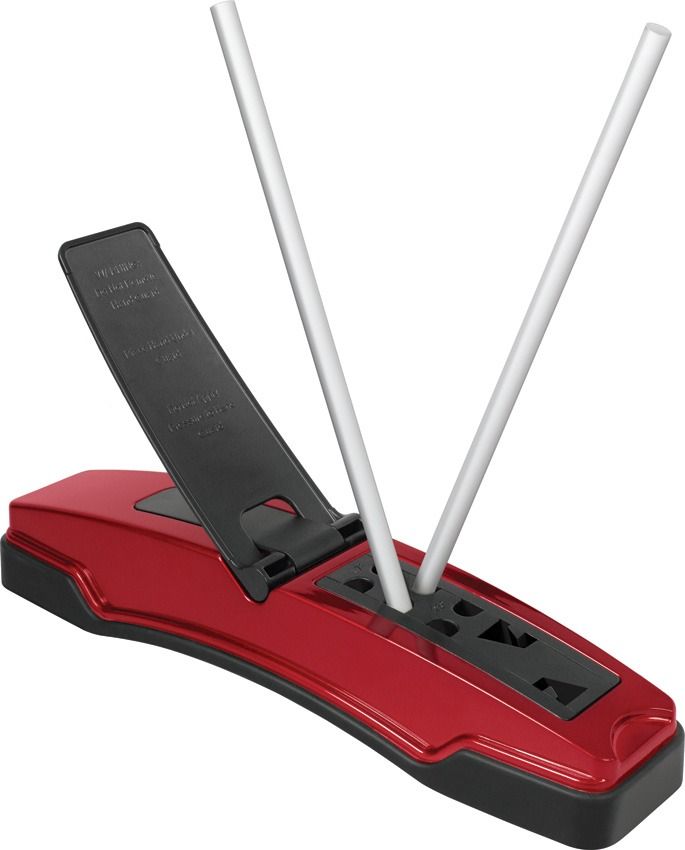
Lansky’s exact product record names this package Master’s Edge Knife Sharpener, SKU MEDGE1. It lists two medium brown ceramic round rods at 600 grit for sharpening, two fine white ceramic round rods at 1,000 grit for polishing, and a separate three-radius triangular ceramic rod listed at 600 grit. The package description also identifies a rubberized non-slip base, an integrated hand guard and snap-in rod storage. This is the ceramic configuration, not the visually similar Master’s Edge All Diamond MEDGE1D.
The product is a manual countertop arrangement. Set its base on a stable, flat surface, unfold the guard to expose the guides and select the position and rod you intend to use. The exact instructions place one hand on the base with fingers and thumb kept beneath the guard; the blade is held upright and drawn down and toward the user. The image shows the opened red base and rods, but does not prove a particular seller’s box inventory or the fit of an individual knife.
Three separate marks, not a continuous angle range
The manufacturer lists 17°, 20° and 25° rod positions and describes a different task for each: 17° for fillet knives and fine slicing; 20° for slicing, butcher, paring and skinning knives; and 25° for hunting, camping, utility and chef’s knives. The positions are discrete. A listing of the lowest and highest marks does not establish intermediate settings such as 18°, 21° or 23°.
The source does not explain whether those values are per-side angles or another measurement convention. Treat them as documented tool positions, not a recommendation for your knife. Compare the exact knife maker’s edge guidance with the sharpener’s convention before choosing a slot; an angle label by itself does not establish that a particular blade’s geometry will fit the base or guide path.
One-stage work and the 20°-to-25° sequence
For ordinary straight edges, Lansky describes holding the blade upright and drawing it down the selected round rod in a slicing-like motion, alternating sides and rods. The maker’s instructions say 10–20 strokes per side may be sufficient, but that is a manufacturer procedure—not an independently measured result or a promise for every knife condition. The page suggests light pressure and a slow hand, and warns against rolling the knife tip off a rod because that can leave the tip duller or damage it.
A separate two-stage method begins at 20° with 10–12 strokes on each rod to thin the edge, then moves the rods to 25° for the finishing stage. Lansky describes that as a compound-bevel route. It is not evidence that the sharpener offers every angle between 20° and 25°, nor does the page convert its angle convention into a universal bevel recommendation. If you do not want that specific change in position, the individual 20° and 25° paths remain distinct uses.
The triangular rod has its own serration procedure
The triangular ceramic rod is a separate tool from the round pairs. The exact instructions say to choose a radius that fits each serration and orient the rod for the left- or right-facing pattern, then work the scallops one at a time. The maker’s method finishes by laying the rod against the back of the serrated edge to address the burr. It also lists awls and fish hooks for this three-radius rod.
Do not carry the round-rod 17°, 20° or 25° numbers over to the serration operation: the exact serration instructions do not assign a numbered setting to that route. The product description names all types of serrations but supplies no scallop dimensions or fit chart. It does not list a scissors procedure. A supported hook or awl task is not evidence of scissor capability.
Ceramic care and practical limits
Lansky says to rotate the ceramic rods as dark metal-transfer marks build up, exposing unused areas. When the rods are dark all around, the page names the Lansky EraserBlock or kitchen cleanser as cleaning methods. It also cautions that the high-alumina ceramic rods can break if dropped on a hard surface. These are model-specific care and handling notes; they are not a claim about measured wear life or a tested cleaning outcome.
The exact page does not state a maximum blade length, a handle-clearance measurement, or a geometry chart. Although it names several knife types, buyers should still verify that their knife can be held upright and moved through the available space safely. The page does not list a leather strop or compound, and it does not provide a complete external seller-package inventory. If either is essential, confirm it in the exact offer rather than treating an omitted item as included.
Choosing between MEDGE1 and MEDGE1D
MEDGE1 is the ceramic package: round surfaces at 600 and 1,000 grit, plus a 600-grit triangular rod. MEDGE1D is a separate all-diamond configuration, with round rods identified at 400 and 600 grit and a triangular diamond rod whose grit the exact listing does not state. The guide positions and broad maker-described tasks are similar, but the abrasive material, grit labels and care instructions are not interchangeable. Compare the separate MEDGE1D assessment if you are deciding between these packages.
Before buying, check the SKU on the exact box or listing, verify which rod materials and grit labels are supplied, and read the matching instructions. The sources reviewed here do not establish current seller price, stock, an included strop, a universal blade-fit guarantee, or a measured sharpening result.
Evidence note: This assessment is based on Lansky’s exact MEDGE1 product record and instructions. No ownership, use, testing, measurement, performance comparison or customer experience is claimed.
Key specifications
Key details at a glance
| Power | Manual |
|---|---|
| Sharpening format | Manual tabletop rod system: set it on a stable, flat surface, open its hand guard, choose a marked 17°, 20° or 25° rod position, hold the base beneath the guard, keep the blade upright and draw it down and toward the user. the exact page includes ceramic round-rod pairs and a separate triangular serration rod. |
| Lowest angle setting | 17° |
| Highest angle setting | 25° |
| Included abrasive surfaces | Two medium brown 600-grit ceramic round rods for sharpening / Two fine white 1,000-grit ceramic round rods for polishing / One 3-radius 600-grit ceramic triangular rod for serrations, awls and fish hooks |
| Benchtop base included | Yes |
| Angle-guide positions | 17 / 20 / 25° |
Use the exact model’s instructions for operating limits, supplied equipment and version differences.
Sources for this review
Sources for this assessment

Check the requirements that matter to you
Use the finder to compare documented sharpener formats and limits; an unknown capability is not treated as a match.