
Your needs, this model
Does it fit your priorities?
What exact abrasive package distinguishes MEDGE1D from ceramic MEDGE1?
The MEDGE1D exact record lists two medium 400-grit diamond round rods, two fine 600-grit diamond round rods, and a three-radius triangular diamond rod whose grit is unstated. Ceramic MEDGE1 instead lists 600- and 1,000-grit round ceramic pairs and a 600-grit triangular ceramic rod. Similar base shape and guide positions do not make these the same package.
Explore this need in the finder →Does MEDGE1D document a serration method and numeric angle?
Yes to the separate serration tool: the exact record includes a three-radius diamond triangular rod and gives instructions to match each serration to a radius and finish on the flat back. But the maker does not assign a numbered angle to this serration path. Keep it separate from the model's 17°, 20° and 25° plain-edge rod positions.
Explore this need in the finder →How does Lansky say to care for the MEDGE1D diamond surfaces?
Its exact product instructions say not to apply oil to the diamond surfaces; clean them with water, wipe away shavings with a lint-free rag and leave them completely dry before the next use. The ceramic MEDGE1 sibling has a different cleaning note, so check the suffix and follow the correct instructions.
Explore this need in the finder →The Lansky Master’s Edge All Diamond MEDGE1D is a manual tabletop rod system with three marked plain-edge positions and a separate triangular rod for serrations. Its exact package identifies 400- and 600-grit round diamond pairs, while leaving the triangular rod’s grit unstated. This research-based assessment distinguishes it from ceramic MEDGE1; it is not a hands-on test.
What the all-diamond SKU includes
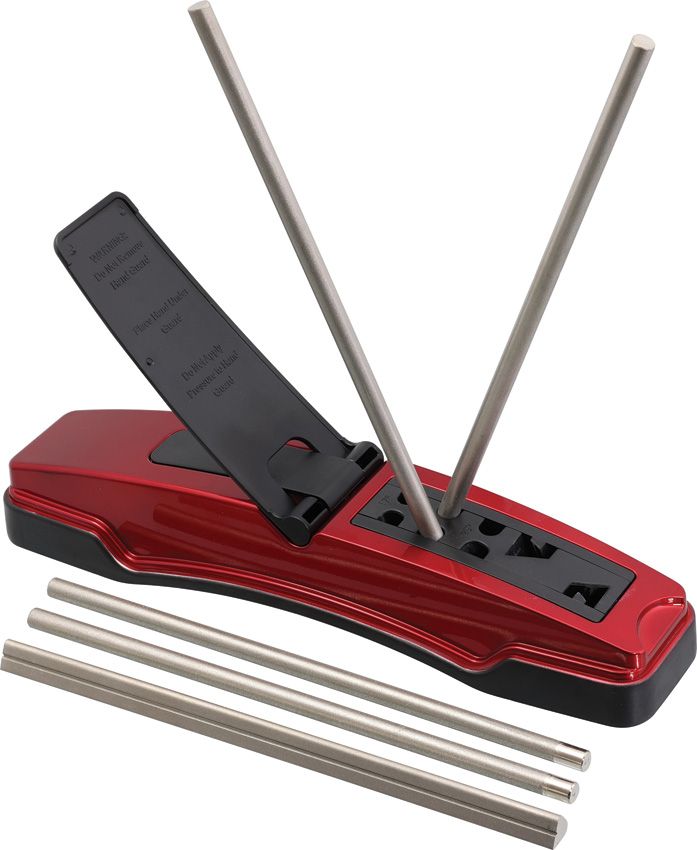
Lansky’s exact record identifies the product as Master’s Edge All Diamond Knife Sharpener, SKU MEDGE1D. Its package description lists a pair of medium 400-grit diamond round rods for sharpening, a pair of fine 600-grit diamond round rods for polishing, and a three-radius triangular diamond rod for serrations, awls and fish hooks. The exact record does not publish a grit for that triangular rod. It also identifies a rubberized non-slip base, an integrated hand guard and snap-in storage.
The package has the same broad countertop format as the ceramic MEDGE1, but it is not merely a new finish or a second name for the same set. MEDGE1 is the ceramic system with different grit values and a different cleaning note. Check the SKU and exact rod inventory before buying, especially if the abrasive material or a particular grit is important to your routine.
How to use its marked rod positions
The manual instructions call for a stable, flat working surface, opening the hand guard, and placing the chosen rods in the selected guide positions. The user holds the base with the non-dominant hand beneath the guard, keeps the knife upright and draws the blade down and toward the user along the rods. Lansky describes 10–20 strokes per side as a usual starting procedure. That figure is from the maker’s instructions; this assessment does not claim to have reproduced it or measured the resulting edge.
The exact record marks 17°, 20° and 25°. Lansky associates 17° with fillet knives and fine slicing; 20° with slicing, butcher, paring and skinning knives; and 25° with hunting, camping, utility and chef’s knives. These are three discrete points, not continuous adjustment throughout the 17°–25° span. The exact page does not tell whether the marks are per-side or inclusive. Treat them as settings the sharpener documents and check the knife maker’s angle convention rather than assuming a number is automatically appropriate.
The optional two-stage procedure is specific
The manufacturer also describes a two-stage path: use 20° for a thinning pass of 10–12 strokes on each rod, then reposition at 25° to finish the edge. The page calls the result a compound bevel. It does not claim that settings between those two marked positions exist. It also does not explicitly assign one of the diamond rod pairs to one angular stage: the round 400-grit pair is identified for sharpening and the 600-grit pair for polishing, but the article should not turn that into a more detailed progression than the instructions provide.
This makes the key decision practical rather than numerical alone: a buyer should decide whether the listed positions and maker-described sequence suit the knife’s existing edge and intended task. The angle marks do not prove that the knife’s heel, belly, tip or handle clears the base, and no blade-length limit or geometry chart is supplied. Check those details for the exact knife if its shape is unusual.
A separate three-radius route for serrations
The exact product page includes a triangular rod distinct from the two round pairs. Its instructions describe selecting a radius that fits each serration, choosing one of two guide holes for the direction of the serrations, moving through the scallops individually and then laying the rod against the back of the edge to address the burr. The maker lists the triangular rod for all types of serrations, awls and fish hooks, but it provides no dimensions for serration compatibility.
The numbered 17°, 20° and 25° positions are not assigned to this separate serration procedure in the exact instructions. Do not infer a numeric serration angle from a plain-edge rod setting. The page does not list a scissor-sharpening method either; awls and fish hooks are different non-knife tasks.
Diamond care and package unknowns
The care note is materially different from the ceramic sibling’s. For MEDGE1D, Lansky says not to apply oil to diamond surfaces: clean them with water, wipe away filings with a lint-free rag and let them dry fully before the next use. The source does not establish that any particular cleaning cloth, brush or liquid comes in the box. Follow the instructions for this exact SKU rather than transferring ceramic-rod care from MEDGE1.
The exact product description lists the base, guard and rods but does not list a leather strop or compound. It also does not provide complete seller-specific box contents or a strop confirmation. The source gives no maximum blade length, scissor support, measured results, service life or independent speed comparison. The all-diamond label alone does not establish better performance for a particular steel or a guaranteed finish.
Who should compare the two Master’s Edge versions?
MEDGE1D is worth comparing if you specifically want the listed diamond round surfaces—400 grit for the medium sharpening pair and 600 grit for the fine polishing pair—and the exact page’s dry-cleaning instructions. MEDGE1 provides ceramic rods at 600 and 1,000 grit and an explicitly 600-grit triangular rod. Both versions list the same three broad guide positions and a serration operation, but their abrasives, grit labels and care are separate. Read the ceramic MEDGE1 assessment before treating either product as a substitute for the other.
Before ordering, verify that the package is MEDGE1D, not the ceramic MEDGE1 or a replacement component. Confirm which rods and base are present in the exact seller offer, then use the diamond-specific care instructions. Price, stock and seller quality were not assessed here.
Evidence note: This assessment uses the exact Lansky MEDGE1D record, not a physical review. No ownership, hands-on sharpening, test, measurement, comparative performance claim or customer experience is claimed.
Key specifications
Key details at a glance
| Power | Manual |
|---|---|
| Sharpening format | Manual tabletop all-diamond rod system: set it on a stable, flat surface, open its hand guard, choose a marked 17°, 20° or 25° rod position, hold the base beneath the guard, keep the blade upright and draw it down and toward the user. the package lists two diamond round-rod pairs and a separate three-radius triangular diamond serration rod. |
| Lowest angle setting | 17° |
| Highest angle setting | 25° |
| Included abrasive surfaces | Two medium 400-grit diamond round rods for sharpening / Two fine 600-grit diamond round rods for polishing / One 3-radius triangular diamond rod for serrations, awls and fish hooks; the exact record does not state its grit |
| Benchtop base included | Yes |
| Angle-guide positions | 17 / 20 / 25° |
Use the exact model’s instructions for operating limits, supplied equipment and version differences.
Sources for this review
Sources for this assessment

Check the requirements that matter to you
Use the finder to compare documented sharpener formats and limits; an unknown capability is not treated as a match.