
Your needs, this model
Does it fit your priorities?
Are the TurnBox's 20° and 25° markings a continuous adjustment range?
No. TB2D2C's hardwood base has two marked rod positions, 20° and 25°. The maker describes a two-stage routine that moves between them, but that is a specific sequence, not evidence of every intermediate setting. The page does not clarify whether the marks are per-side or inclusive, so treat them as capability labels and check the knife maker's convention.
Explore this need in the finder →Which abrasive pairs are listed for TB2D2C?
The exact product page lists two 5-inch medium 400-grit diamond rods for sharpening and two 5-inch fine 1,000-grit white ceramic rods for polishing. It does not list a strop or compound in this SKU's package description; do not transfer the strop-equipped sibling's extras to this one.
Explore this need in the finder →Does the non-CL TurnBox include a leather strop?
The exact TB2D2C product record lists its four rods and hardwood base but no leather strop or compound. Lansky lists those additional finishing items for separate SKU TB2D2CL. If an included strop is essential, verify the CL model and exact seller package rather than relying on a similar TurnBox photo.
Explore this need in the finder →A preset-angle rod system, not a freehand stone
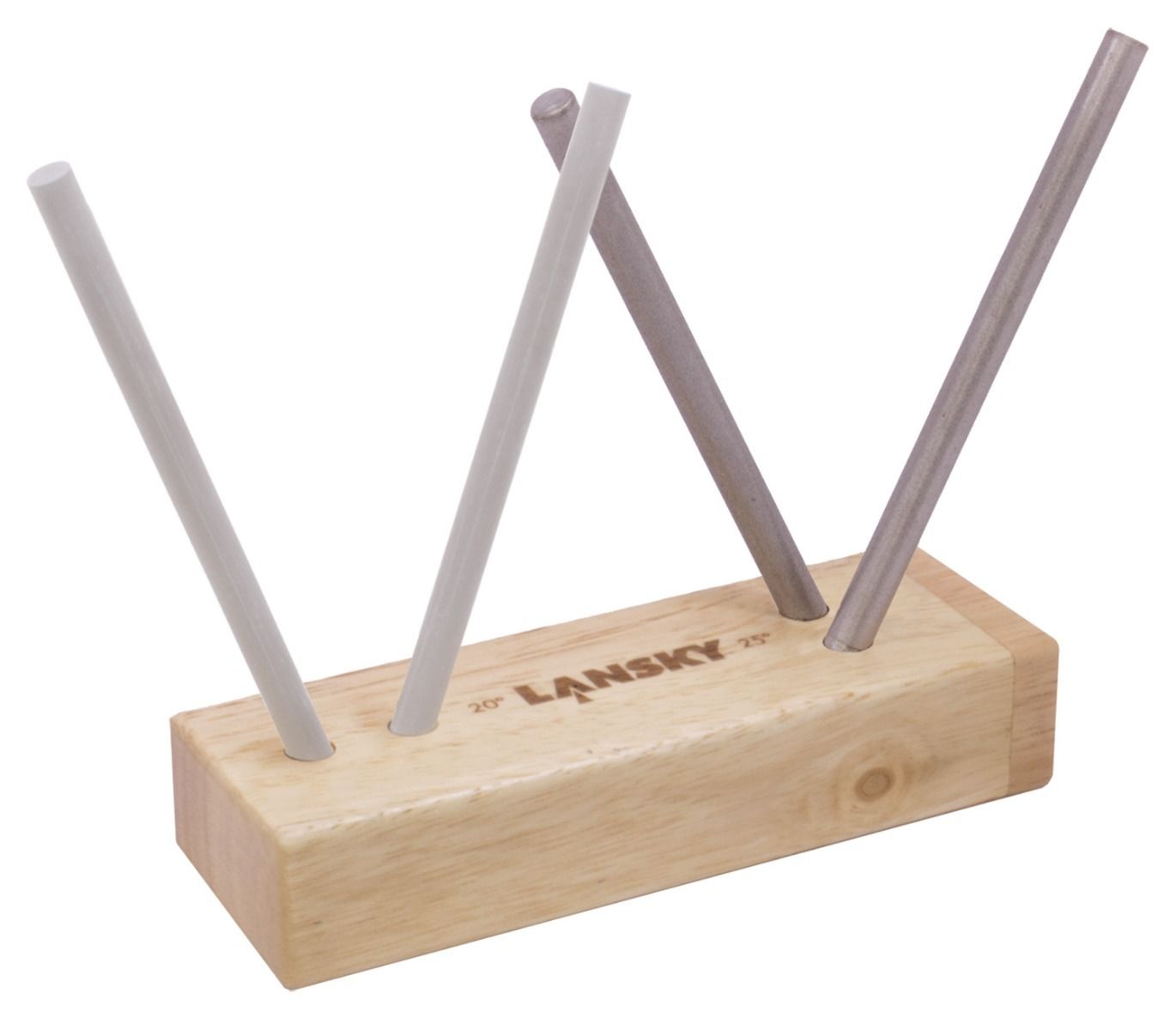
The Lansky 4-Rod Diamond/Ceramic TurnBox is a manual sharpening system built around a hardwood block, four loose rods and two marked rod positions. The product identity matters here: this is SKU TB2D2C, the package without the leather strop that appears in a separate TurnBox listing. Its basic appeal is a repeatable rod path with two different abrasive materials stored in the base. The tradeoff is that the user still guides the blade and must choose between two fixed markings; this is not a clamp that registers the knife or an adjustable angle dial.
Lansky lists two medium 400-grit diamond rods and two fine 1,000-grit ceramic rods, each five inches long. The diamond and ceramic stages have different jobs in the maker's description: the diamonds are for sharpening, while the ceramics polish the edge. That gives the kit more range than a single pair of rods, but it does not mean that every knife needs both materials each time. No grit is printed for a separate stropping compound because this SKU does not list one, and the exact package page names the rods and hardwood base without listing a leather finishing surface.
Choose one of the marked positions deliberately
The wood block has guide holes marked 20° and 25°. Lansky associates the 25° position with hunting, camping, utility and chef's knives, and describes 20° for slicing, fillet, butcher, paring and skinning knives. It also says a lower angle requires more regular maintenance. Those labels describe the manufacturer's stated use guidance, not a universal recommendation to reprofile a blade. The product page does not say whether its numbers are per-side or inclusive, so compare the convention with the knife maker's specification before treating a marked position as an exact target.
The instructions require a stable, flat work surface and ask the user to hold the base firmly. For a single-stage pass, the rods go into the holes for the chosen position. The blade is held upright, then drawn down one rod toward the user in a controlled slicing-like motion before the opposite side is worked on its partner. That is a different skill from clamping a blade and sliding a stone along it: the angle guide narrows the available path, but the user's hand still controls the blade's path, pressure and tip movement. Lansky specifically cautions against rolling the tip off the rod, which can leave the point damaged or duller than the rest of the edge. Its safety note also makes finger placement and a firm base part of setup, not optional polish.
The manufacturer also describes a two-stage route: start at the 20° holes for a limited thinning pass, then move to 25° holes to finish with a compound bevel. Its instructions specify 10–12 strokes on each rod in the first stage. This is not simply an adjustable 20°–25° range, nor does the numeric span identify how the path will meet a particular blade. The step sequence and a single-angle touch-up are different routines, so check the knife's current edge and the maker's directions before removing material.
Useful distinction between the diamond and ceramic pairs
The paired rod types let a shopper choose between a 400-grit diamond stage and a 1,000-grit ceramic stage in the same package. Lansky describes the diamond rods as the sharpening surface and the ceramic rods as a polishing surface. That is a maker-stated progression, not a measured result from this review. The exact instructions do not give a knife-length limit, handle-clearance diagram, serration method, scissor procedure or numeric angle convention. A 5-inch rod length alone does not establish that every long blade or bolster can be worked safely through the intended stroke. If a blade has unusual geometry, an asymmetric edge, tight handle clearance or serrations, seek model-specific guidance rather than assuming the straight-knife routine covers it.
Care details are also narrow. The product instructions explain how to select, use and store the rods inside the TurnBox base, but this listing does not give a special cleaning routine for the rods. Follow any included model-specific direction and avoid treating advice for another Lansky hone as if it automatically applies to these diamond and ceramic components. The product text's medium-diamond grit statement is the one used in this assessment; a seller offer should be checked against the exact SKU and package if its description gives a different grit.
Compare it with the strop-equipped sibling
The most useful comparison is Lansky's separate TB2D2CL package. It retains the four-rod TurnBox arrangement and adds a leather strop and polishing compound, with an extra finishing step described in that product's own instructions. That addition matters if a strop is essential to the planned routine; it should not be inferred from the wood base or from the fact that this version has a fine ceramic pair. TB2D2C is the simpler choice when the listed diamond-and-ceramic stages are the desired tools and an included strop is not a requirement. Read the separate TB2D2CL assessment before comparing seller listings, since similarly named TurnBox packages can differ in their included finish.
This review is a research-based reading of Lansky's exact product record and directions, not a hands-on test. The maker's category placement supports treating TB2D2C as a current catalogue reference, but it does not establish current seller stock, price or the contents of an arbitrary retail offer. Check that the package is exactly SKU TB2D2C, verify that all four intended rods and the wood base are shown or listed, and confirm the angle wording and return terms with the seller. If an included leather strop is non-negotiable, this is not the TurnBox SKU to assume will satisfy it.
Key specifications
Key details at a glance
| Power | Manual |
|---|---|
| Sharpening format | Hardwood turnbox with rod storage; select the 20° or 25° marked holes, fit either maker-described rod pair for single-stage work, hold the blade upright and draw it down the rod. the maker also describes a separate two-angle 20°-then-25° route. |
| Lowest angle setting | 20° |
| Highest angle setting | 25° |
| Included abrasive surfaces | Two 5-inch medium 400-grit diamond rods for sharpening / Two 5-inch fine 1,000-grit white ceramic rods for polishing / Hardwood rod-holder base with in-base rod storage |
| Strop included | No |
| Angle-guide positions | 20 / 25° |
Use the exact model’s instructions for operating limits, supplied equipment and version differences.
Sources for this review
Sources for this assessment

Check the requirements that matter to you
Use the finder to compare documented sharpener formats and limits; an unknown capability is not treated as a match.