
Your needs, this model
Does it fit your priorities?
What does TB2D2CL add over the standard TB2D2C TurnBox?
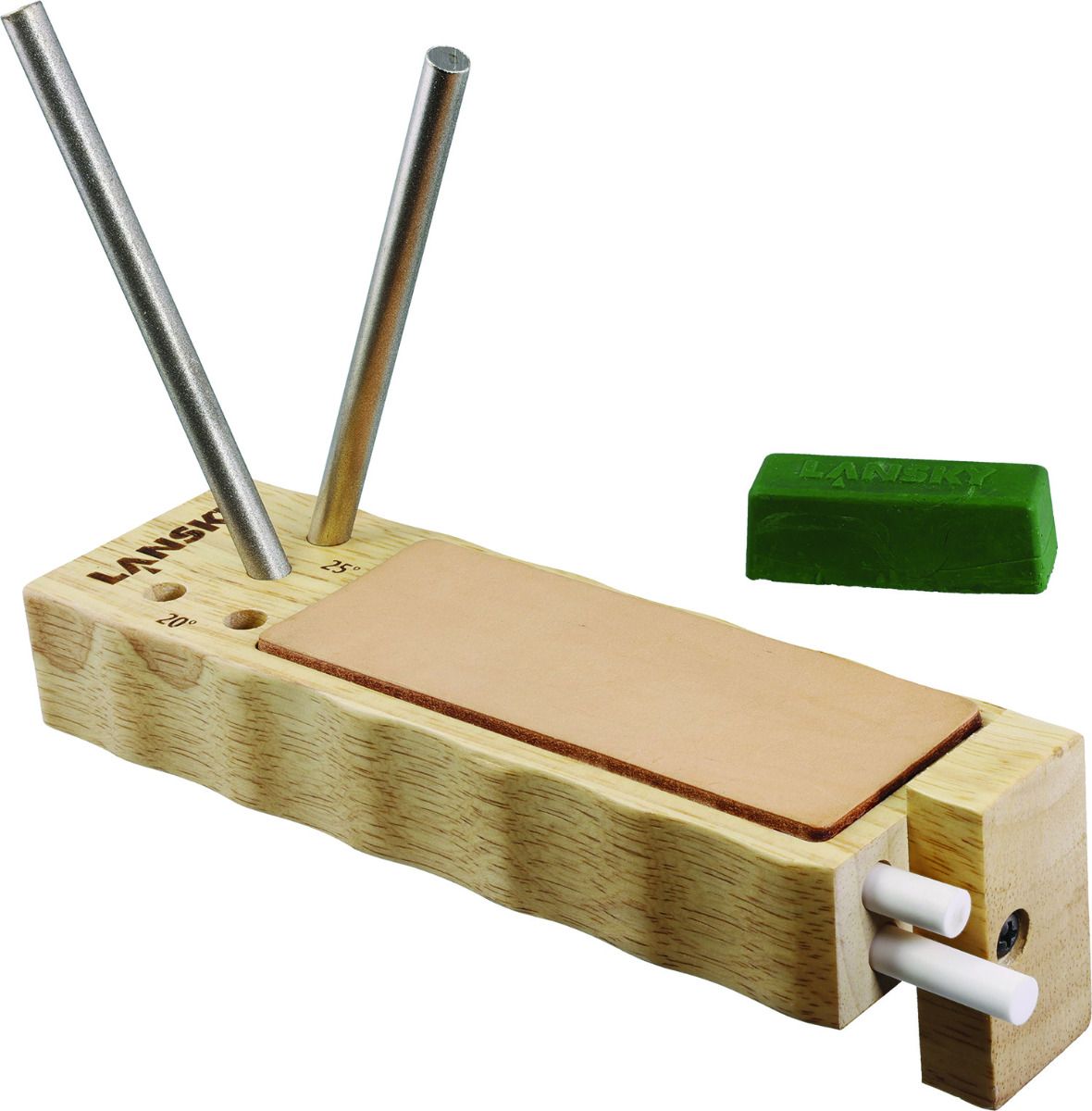
The exact TB2D2CL record lists the four diamond/ceramic rods and hardwood base plus a leather strop and compound, and its instructions add a separate polishing step. The standard TB2D2C record lists the rod set and base but not those finishing extras. Check the full SKU because the base models look related but are not the same package.
Explore this need in the finder →Does the included leather strop make 20° to 25° an adjustable range?
No. TB2D2CL's guide holes are still marked at two discrete rod positions, 20° and 25°. Its two-stage instructions use those as separate passes; the leather strop is a subsequent finishing surface with no numeric angle. The maker does not clarify per-side versus inclusive convention.
Explore this need in the finder →Does TB2D2CL document a serrated-knife or scissor method?
The exact product record describes the four rod paths and a separate leather-strop finish, but its instructions do not give a serration routine or scissor procedure. That omission does not prove the tool can never be used that way; it means this assessment does not mark those capabilities as verified for matching.
Explore this need in the finder →The TurnBox version that adds a separate leather finish
TB2D2CL is a distinct Lansky SKU: a four-rod Diamond/Ceramic TurnBox with a leather strop and polishing compound. It belongs beside, not in place of, the similarly named TB2D2C. The underlying system is still manual rod sharpening through a hardwood base marked for 20° and 25°; the strop is an additional finishing surface, not a third guide angle and not a substitute for the two abrasive pairs. That package difference is the main reason to choose the CL configuration.
The exact manufacturer listing describes two medium 400-grit diamond rods and two fine 1,000-grit ceramic rods, each five inches long, plus a leather strop and compound. Lansky assigns sharpening to the diamond rods, touch-ups to the ceramic rods, and a final polishing pass to the strop with compound. The listed compound has no grit value or complete technical specification, and the page does not give the strop's usable dimensions. Treat the finishing step as an included package feature, not a promise of a particular edge result.
Fixed positions and a user-guided stroke
The TurnBox base marks two rod positions, 20° and 25°. Lansky describes the 25° position for hunting, camping, utility and chef's knives; it names slicing, fillet, butcher, paring and skinning knives in the 20° description. Its product page says a lower angle needs more regular maintenance. These are manufacturer suggestions attached to this product's marked positions. They are not universal knife geometry rules, and the page does not clarify whether the markings mean per-side or included angles. Check the target knife's own specification and keep the angle convention consistent before relying on a number.
Setup begins with the base flat on a stable surface. The instructions ask the user to hold it securely, keep fingers away from the rods and draw the blade vertically down a rod and toward the user, then repeat on the opposite rod for the other side. This design can make angle choice easier than an unmarked freehand stone, but the user still controls the blade movement and must avoid rocking or rolling the tip past the rod. Lansky warns that letting the tip roll off can leave it duller or damage it. The system is therefore guided, not self-operating; it still calls for a slow, controlled stroke.
For a single-stage routine, the maker says to choose the rod type and one of the two positions. For its two-stage sequence, it describes a limited thinning pass at 20° followed by a finishing pass at 25°, with 10–12 strokes per rod in the first stage. The CL instructions then add polishing on the strop with compound. Those stages are not one continuous 20°–25° adjustment range, and the stropping surface has no stated angle. A capability match at 20° or 25° does not establish that the same position is appropriate for a specific knife or that a user should change its factory edge.
Why buy this package instead of TB2D2C?
The standard TB2D2C listing describes the same general four-rod format and the same maker-marked positions but does not list the leather strop or compound. TB2D2CL's additional stage is useful only if you want that step supplied in the exact package; if you already have a suitable strop or do not plan to use one, the related TB2D2C may be a closer fit. The CL product page specifically instructs a finish on leather with compound, so a fine ceramic rod should not be treated as proof that the strop is present. Compare the separate TB2D2C review and check the full SKU on the offer.
The system's limitations remain important even with the extra finishing stage. The exact instructions do not provide a serrated-edge procedure, scissor method, maximum blade length, handle-clearance diagram, compound grade or angle convention. The ordinary rod stroke should not be generalized to serrations or non-knife tools. Nor does the five-inch rod length establish that every blade can be drawn through the working path without hitting a guard or handle. If the target knife is long, unusually shaped or has a specialized edge, verify fit and method with the maker before choosing this system.
What to verify before ordering
This is a source-based assessment, not a hands-on test, and the public product record is not a seller inventory statement. Look for the exact TB2D2CL SKU, the four-rod hardwood base, the leather surface and the compound in the package description or photographs. A listing for TB2D2C may be a close visual match but does not document the CL finishing extras. Confirm that the retailer describes the same regional configuration and check its return terms before purchase. If an offer leaves the compound, strop or rod set ambiguous, treat those details as unresolved rather than assuming another TurnBox version's contents carry over.
Key specifications
Key details at a glance
| Power | Manual |
|---|---|
| Sharpening format | Hardwood turnbox with rod storage; select the 20° or 25° marked holes, fit either maker-described rod pair for rod work, then use the separate leather strop with compound as a finishing step. the maker also describes a 20°-then-25° two-stage route. |
| Lowest angle setting | 20° |
| Highest angle setting | 25° |
| Included abrasive surfaces | Two 5-inch medium 400-grit diamond rods for sharpening / Two 5-inch fine 1,000-grit white ceramic rods for touch-ups / Leather strop and compound for a separate polishing step / Hardwood rod-holder base with in-base rod storage |
| Strop included | Yes |
| Angle-guide positions | 20 / 25° |
Use the exact model’s instructions for operating limits, supplied equipment and version differences.
Sources for this review
Sources for this assessment

Check the requirements that matter to you
Use the finder to compare documented sharpener formats and limits; an unknown capability is not treated as a match.