
Your needs, this model
Does it fit your priorities?
Are the Angle Set guides continuously adjustable?
No. Work Sharp lists five separate guide points—15°, 17.5°, 20°, 22.5° and 25°. The numeric finder accepts 0.5° steps, so each named point can be entered directly; that does not make intermediate settings part of the product's documented guide.
Explore this need in the finder →How does the manual handle serrated edges?
Separately from the guided plain-edge plate routine: the box list includes a tapered ceramic rod for serrations and the user guide shows the scallop being placed on the rod, then worked with short, light strokes. No numeric serration angle is specified, so do not transfer a plain-edge guide position to that process.
Explore this need in the finder →What should I confirm on an older offer?
Confirm SKU WSBCHAGS and the five-position guide/base, both 320/600 diamond plates, fine ceramic and tapered serration rod. The manufacturer marks the model retired; the review does not establish seller stock, condition or completeness.
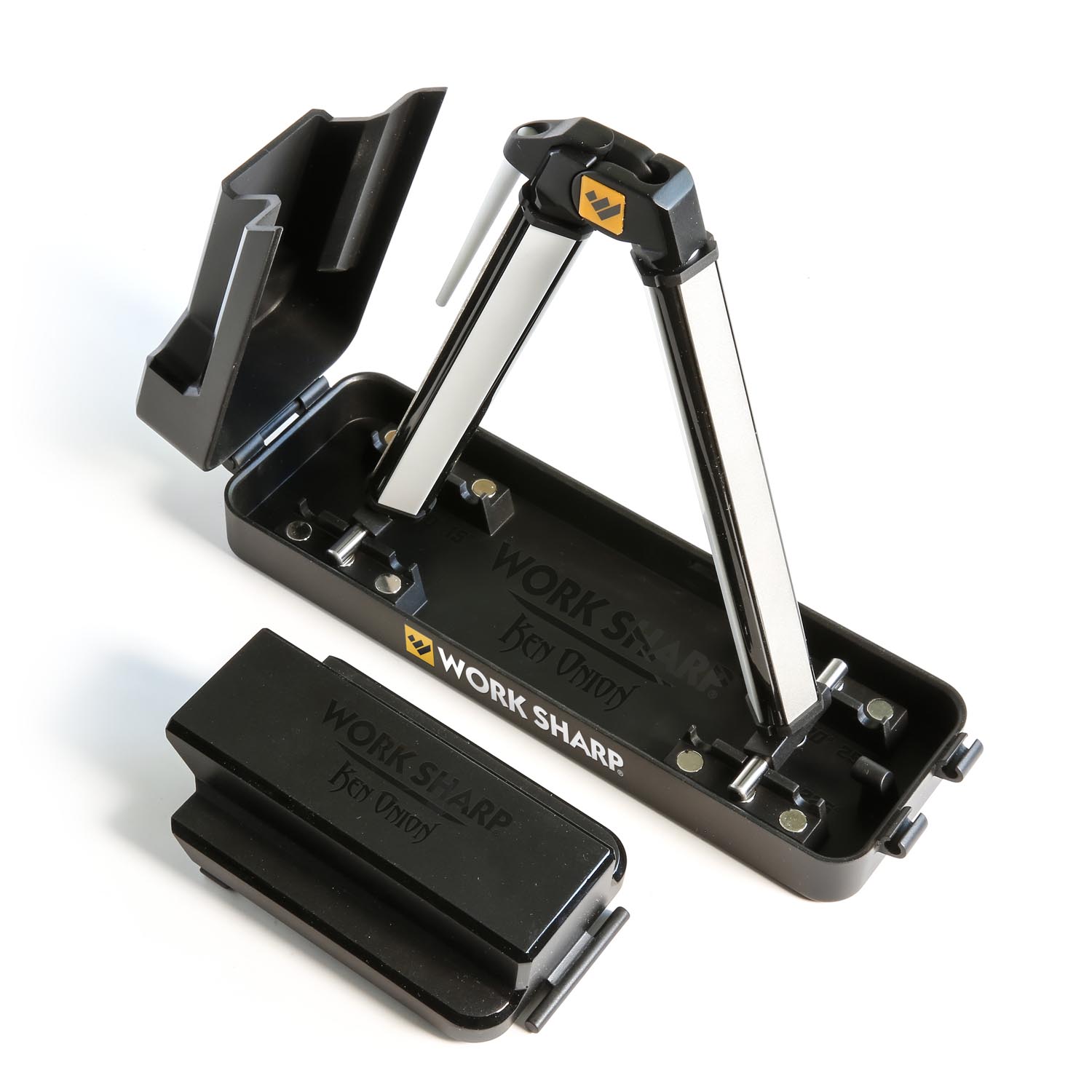
Explore this need in the finder →The Work Sharp Angle Set (WSBCHAGS) is a retired manual sharpening system built around a folding base, five discrete guide positions and separate diamond, ceramic and serration tools. The model’s defining trait is not a continuous angle dial: it has five named settings—15°, 17.5°, 20°, 22.5° and 25°—and the supplied user guide describes a separate method for a serrated edge. This assessment follows the exact manufacturer page and manual; it does not claim that the tool was used or tested.
What is in the documented WSBCHAGS package?
The manufacturer’s box list includes a 320-grit diamond plate, a 600-grit diamond plate, fine ceramic, a tapered ceramic rod for serrations, and the sharpening base/storage case. The product page calls it a compact freehand system with guide assistance. It is still a manual tool: the user holds the knife vertical at the top of the selected abrasive and moves the edge with light pressure. The numbered guide assists angle consistency, but the knife is not clamped into a powered fixture or held by a powered belt cassette.
The abrasive stages are clearly distinguished. The 320 diamond plate is the coarser shaping option; the 600 diamond plate offers a finer diamond step; the fine ceramic helps refine the edge. The instructions caution that changing the edge angle or repairing chips requires a different process. That is an important boundary: the presence of multiple abrasives does not itself establish that every heavy repair can be completed with the same few guided strokes. Work Sharp’s exact product page and manual should be consulted for setup, hand placement and safe handling.
Five settings, including two half-degree points
Work Sharp names five guide positions: 15°, 17.5°, 20°, 22.5° and 25°. These are discrete points, not every value between 15° and 25°. The public finder’s numeric control advances in half-degree steps, so it can represent each of the five labels exactly. That does not turn the settings into a continuous range: an 18° entry, for example, is not one of the documented points.
The manual tells users to hold the blade vertical while sharpening but does not expressly reconcile the number’s angle convention with a knife maker’s own measurement convention. Therefore, a guide marking is a fit filter, not a recommendation to reprofile a specific blade. If a maker specifies an angle, check that the knife and the sharpener use the same convention and consider the existing bevel and intended use before removing material.
The serration rod is its own routine
The box list also names a tapered ceramic rod for serrations. The user guide describes matching the scallop to the rod, making short light strokes, then using the flat side of the serration for a finishing movement. This is distinct from the guided diamond-plate process and is not assigned a numerical angle. Consequently, the 15°–25° plain-edge positions should not be carried over to the serration method. Work Sharp’s manufacturer page lists the product for kitchen, pocket/hunting and serrated knives; the manual’s task-specific instructions are the more useful evidence for understanding how those jobs differ.
The exact package list does not include a scissor fixture or leather strop. A tapered ceramic rod is not a leather strop, and a separate accessory listing does not establish that the accessory is in any seller’s box. If those are essential, check for a documented package that actually includes them rather than assuming the Angle Set covers the need.
Who should still compare this retired model?
The Angle Set is worth identifying if you want a compact, fold-out manual tool with plate-backed guide positions and a specific ceramic serration method. Its visual and functional distinctions matter: it is not the benchtop Guided Sharpening System, whose plate-holder guides and separate Field Hone work differently, nor is it one of Work Sharp’s clamp systems. Check an older offer for exact SKU WSBCHAGS, the folding guide/base, both diamond plates, fine ceramic and tapered serration rod, along with the condition of the abrasive faces and guide hardware.
Retirement is a significant buying limitation, but not a claim that no unit exists. No current stock, price, listing, seller condition or package completeness is verified here. The maker’s archived three-year warranty statement should not be assumed to apply to a used or old-inventory purchase without checking the actual offer’s eligibility.
Assessment
WSBCHAGS is a coherent manual kit for guided freehand sharpening when one of its separate settings matches the intended work. Its five discrete points, including two half-degree positions, are more specific than a vague “adjustable” label. Its strengths on paper are the fold-out setup, two diamond stages, fine ceramic and a distinct serration rod. Its tradeoffs are retirement, no included leather strop or scissor tool, a manual that does not state a clear angle convention, and the need to use a different approach for serious edge repair. This review is based on primary documentation and does not claim hands-on performance.
Primary references: Work Sharp Angle Set product page and its user guide.
Key specifications
Key details at a glance
| Power | Manual |
|---|---|
| Sharpening format | Fold out angle guided diamond ceramic system |
| Lowest angle setting | 15° |
| Highest angle setting | 25° |
| Included abrasive surfaces | 320-grit diamond plate / 600-grit diamond plate / fine ceramic plate / tapered ceramic serration rod |
| Strop included | No |
| Angle-guide positions | 15 / 17.5 / 20 / 22.5 / 25° |
Use the exact model’s instructions for operating limits, supplied equipment and version differences.
Sources for this review
Sources for this assessment
Check the requirements that matter to you
Use the finder to compare documented sharpener formats and limits; an unknown capability is not treated as a match.