
Your needs, this model
Does it fit your priorities?
Which angle belongs to which WSGSS procedure?
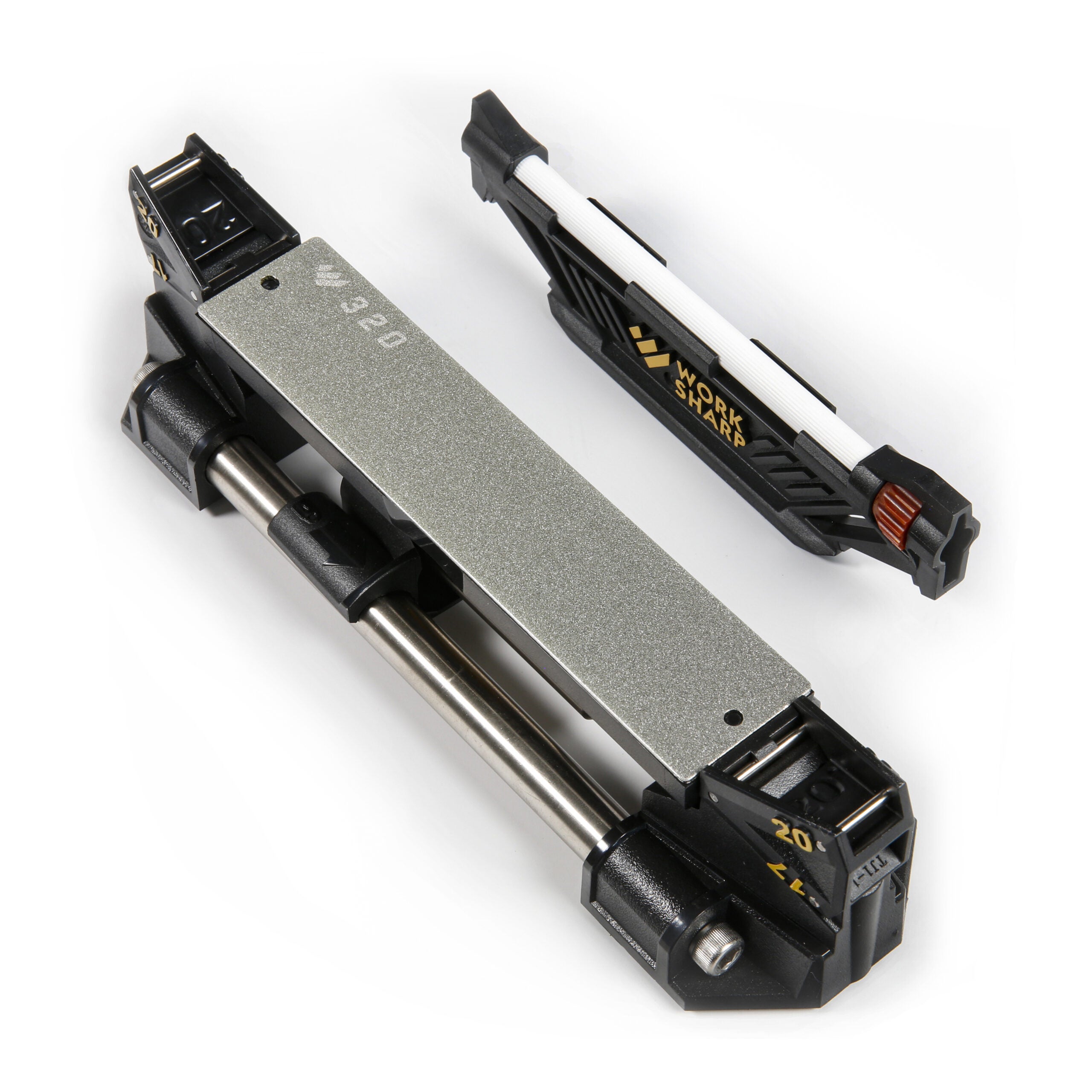
The diamond plate holder has a 17° kitchen guide and a 20° pocket/hunting guide. The separate ceramic Field Hone has a built-in 25° maintenance guide. Do not treat that hone guide as a new-bevel 25° diamond-plate setting.
Explore this need in the finder →Does the manual document scissors?
The product page displays a scissors icon, but the exact user guide does not provide a scissor sharpening method. For a task-specific comparison, this review does not treat the icon alone as a verified procedure.
Explore this need in the finder →Is an included leather strop part of the ordinary package?
No. The base product page box list names the holder, two diamond plates, angle guides and ceramic Field Hone. Its support page lists a separate upgrade kit and a separate leather strop, so verify an older seller’s actual contents rather than treating an accessory listing as included.
Explore this need in the finder →The Work Sharp Guided Sharpening System (WSGSS) is a retired manual benchtop plate-holder with Pivot-Response support, two diamond plates and a separate ceramic Field Hone. It is easy to confuse with the Guided Field Sharpener because their names are similar, but their bodies, guides and workflows are not the same. The WSGSS has two main knife-sharpening guide positions and a separate field-hone position; this review follows its exact product page and user guide and does not claim personal use or test results.
Benchtop plate work, not a guided field kit
Work Sharp lists SKU WSGSS as retired. Its standard box list names the Pivot-Response Guided Sharpening System, a 320-grit coarse diamond plate, a 600-grit fine diamond plate, 17° and 20° angle guides, and a multi-grit ceramic Field Hone. The holder is intended to follow the blade’s curve while the user moves the knife across the plate. Unlike a clamp-style system, the user remains responsible for positioning the blade against the guide and controlling the stroke.
The maker identifies 17° as the kitchen guide and 20° as the pocket/hunting guide. These are separate fixed positions rather than an adjustable range between 17° and 20°. The 320 and 600 diamond plates provide a coarse/fine pair for the plate routine. The product page says the ceramic hone can be taken into the field and used separately; the guide shows a built-in 25° guide on that hone. That 25° figure belongs to the honing tool. It is not represented here as a 25° plate-sharpening or rebevel plan.
Serrations have a separate ceramic routine
The WSGSS manual does describe a serration method: select the small, medium or large part of the ceramic rod to fit each scallop, match the serration’s existing bevel and work until the edge is restored. It does not attach a numerical angle to that task. For this reason, the diamond holder’s 17°/20° guides do not automatically apply to a serrated edge. A useful assessment should separate the two jobs rather than count every listed accessory as the same sharpening arrangement.
The product page also displays a scissors-use icon, but the exact manual reviewed here does not provide a scissor procedure. An icon alone is not enough for this review to count scissors as a documented match. This is a conservative evidence boundary, not proof that the machine could never touch a scissor edge. The page separately mentions fishhooks and tools; those tasks should likewise be matched to the proper manual steps rather than inferred from the knife-guide angles.
Accessories and package contents
Work Sharp’s standard box list does not include a leather strop. The manuals-and-guides page separately lists an upgrade kit and a leather strop accessory, so their presence in the product ecosystem does not make them standard WSGSS contents. Check an individual older offer for the holder, plate guides, both diamond plates and ceramic Field Hone, as well as any claimed optional additions. Abrasive faces and the angle-guide hardware are especially important to inspect on a retired system.
Do not transfer specifications from similarly named models. The Guided Field Sharpener is a portable field-tool family, while the Angle Set is a folding base with five discrete angle points and a tapered serration rod. The WSGSS is the benchtop holder with its own two diamond-plate guides and separate field hone.
Who might compare this retired system?
The system is most relevant to someone seeking a manual, guided plate arrangement for kitchen or pocket/hunting knives, with an additional ceramic maintenance method and a separately documented serration process. It is less compelling if you specifically need continuous angle adjustment, a clamp-held blade, an included leather strop, or verified scissor support. Since Work Sharp marks it retired, the published packaging and warranty text do not establish the condition, completeness or eligibility of any specific remaining-stock or secondhand unit.
Assessment
WSGSS’s useful distinction is the division of work: the benchtop 320/600 diamond holder establishes the 17° kitchen or 20° pocket/hunting guide, while the removable ceramic Field Hone is a separate maintenance tool and the manual’s serration method remains nonnumeric. That gives the user more than one task-specific route without making them interchangeable. Its main limitations are retirement, no standard leather strop, the lack of a scissor procedure in the reviewed guide, and the need to identify the right tool for each task. This source-based review makes no hands-on, performance, price or availability claims.
Primary references: Work Sharp Guided Sharpening System page and its user guide.
Key specifications
Key details at a glance
| Power | Manual |
|---|---|
| Sharpening format | Benchtop pivot response diamond plate and separate field hone |
| Lowest angle setting | 17° |
| Highest angle setting | 20° |
| Included abrasive surfaces | 320-grit coarse diamond plate / 600-grit diamond plate / multi-grit ceramic Field Hone |
| Strop included | No |
| Angle-guide positions | 17 / 20 / 25° |
Use the exact model’s instructions for operating limits, supplied equipment and version differences.
Sources for this review
Sources for this assessment
Check the requirements that matter to you
Use the finder to compare documented sharpener formats and limits; an unknown capability is not treated as a match.