
Your needs, this model
Does it fit your priorities?
Is this the original model or the current Ken Onion Mk.2?
The exact older SKU is WSKTS-KO; Work Sharp's current page labels this model retired and says the updated Mk.2 replaced it. The standard Mk.2 uses SKU WSKTS-KO2 and is a separate configuration. Read the model number on a specific offer rather than relying on a Ken Onion title alone, and compare the current Mk.2 assessment for the newer package.
Explore this need in the finder →What guide angles and belt progression are documented for WSKTS-KO?
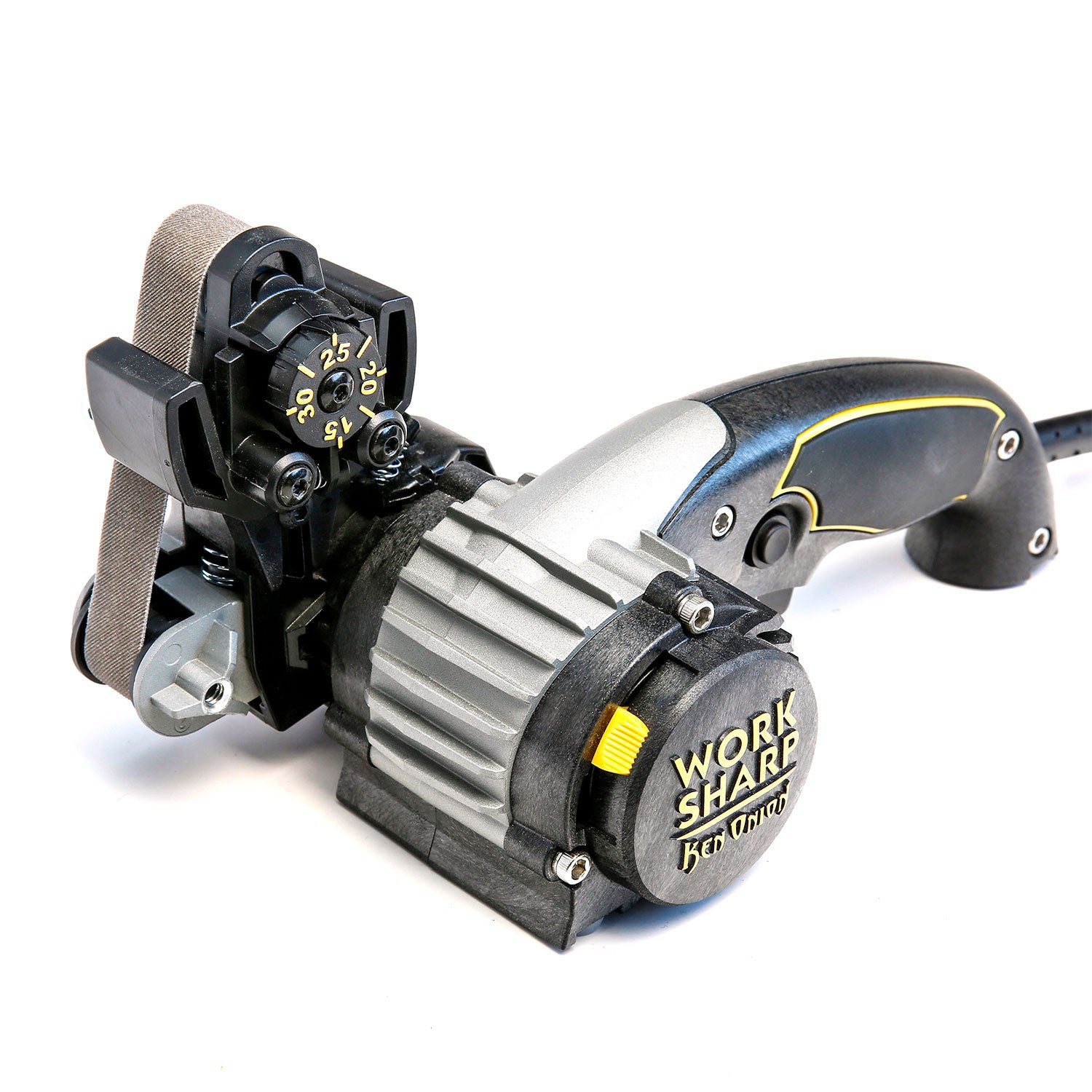
Work Sharp lists a 15°–30° adjustable guide; the exact WSKTS-KO manual specifies one-degree increments and says the dial indicates the angle per side. Its package includes P120, X65, X22, X4 and 6000-grit belts, with the manual identifying the 6000 belt as narrower than the other listed 3/4-inch belts. This older setup is not the Mk.2 half-degree cassette or the Elite's separate 10°–35° attachment.
Explore this need in the finder →Does the older package include documented scissor and serration methods?
Yes, but they are separate procedures rather than ordinary guided knife work: the exact box list names a tool cassette with a 65° scissor guide, and the manual has dedicated scissor and serration sections. For serrations it specifies the narrow 6000-grit belt and a low-speed procedure; for scissors it identifies separate belt choices and instructs the user to work only the beveled side. Check the manual for the exact edge and belt orientation.
Explore this need in the finder →Is an included leather strop or straight-razor procedure documented?
The exact WSKTS-KO package lists abrasive belts and guides, not a leather strop. Work Sharp says it does not offer or recommend leather belts for its powered sharpeners; it describes the 6000-grit belt as a way to produce a fine polished edge. The manufacturer FAQ explicitly advises against using this belt tool on a straight razor, so that blade type is not treated as a supported plan.
Explore this need in the finder →The WSKTS-KO is the original Ken Onion Edition Knife & Tool Sharpener, a powered belt machine that Work Sharp now marks as retired. It is easy to confuse with the current WSKTS-KO2 or the larger Elite package because the names overlap. This assessment is for the original SKU and its documented package only; it is a source-based review, not a claim of ownership, hands-on sharpening or measured results. Work Sharp's current product page says the Mk.2 replaced this model, while its manuals and parts pages continue to identify support materials for the older machine.
Identify the original package before comparing offers
The exact original product page identifies SKU WSKTS-KO and lists a dual-speed motor, an adjustable sharpening guide marked 15°–30°, a tool-sharpening cassette with a 65° scissor guide, and belts in P120, X65, X22, X4 and 6000 grits. The product page also says the machine is retired. Its replacement is a separate Mk.2 model, not simply a new belt set or a change to the original name. An offer titled only “Ken Onion Work Sharp” is not enough to establish which edition or included accessories it contains.
There is a speed-control wording conflict worth knowing about. The current legacy page's box list calls the motor “dual speed,” but its overview and FAQ describe variable-speed control and give low, medium and high operating references of roughly 1,200, 2,000 and 2,800 surface feet per minute. The manual also organizes recommendations around low, medium and high. I would not infer a digital seven-step control from this material: that belongs to a different Mk.2 package. On a specific used machine, inspect the nameplate, controls and actual accessories rather than assuming the wording from the product title.
Guided belts, several jobs, separate procedures
The original's central arrangement is a flexible abrasive belt running through a guided cassette. Work Sharp lists a 15°–30° guide, and the WSKTS-KO manual specifies one-degree increments and explicitly says the dial indicates the angle per side. That convention matters when comparing a knife specification; it still does not say the setting is right for every blade. The manual supplies task-specific tables for kitchen and outdoor knives rather than one universal setting. Its belt chart names P120 for extra-coarse work, X65 coarse, X22 medium, X4 fine and 6000 extra-fine. The ordinary knife belts are 3/4 inch by 12 inches; the manual identifies the included 6000 belt as narrower at 1/2 inch by 12 inches, an important detail for ordering exact replacements.
The included package supports more than the main plain-edge cassette, but those jobs should not be collapsed into a generic “sharpens everything” promise. The manual has a separate serration procedure using only the narrow 6000-grit belt, with a specified low-speed orientation; its scissor section uses the tool cassette and tells the operator to work only the beveled side. The product page identifies the separate scissor guide as 65°. These are distinct arrangements, not the 15°–30° plain-knife angle repeated across every task.
What the old machine does not establish
The manufacturer says the WSKTS-KO is for consumer applications and excludes industrial or commercial sharpening and extended continuous heavy-duty use. The product page lists a three-year warranty and a weight of 3.3 lb, but warranty coverage or eligibility should be verified for the actual age and seller condition. The manual calls for proper eye protection and cautions about dust, moving belts, belt tracking, hand placement and securing work. A motorized abrasive can remove material quickly; the provided tables and safety steps matter more than a broad promise of speed.
Work Sharp's FAQ explicitly says not to sharpen a straight razor on this machine, explaining that its thin curved blade can be damaged by uneven material removal. It also says the company does not offer or recommend leather belts for its powered sharpeners because of safety and motor concerns, and points to the 6000-grit belt as a finer, polished-edge route. The original package list contains no leather strop. A separately sold attachment or tool-grinding accessory must not be assumed included just because the product family supports attachments.
How to assess a retired unit
Because the maker labels the model retired, this belongs in a comparison for someone identifying an existing machine or inspecting a particular earlier-model offer—not an assurance that a new unit is available. Work Sharp says replacement belts, accessories and compatible attachments continue to be supported, but that statement does not verify current stock or the condition of any seller's item. Check the exact WSKTS-KO identifier, whether the cassette and 65° scissor guide are present, the included belt widths and grits, the tracking mechanism, cord/nameplate and any wear or damage. A missing 6000 belt changes the documented serration and fine-finishing package.
Do not substitute the current Ken Onion Edition Mk.2 review for this one. The Mk.2 has a different SKU and updated package; its own guide and angle adjustment details are not inherited by the original. Likewise, the Elite adds a separate Blade Grinding Attachment, and that attachment is not listed in the original WSKTS-KO box. If an offer does not identify the edition and the parts clearly, treat those facts as unknown rather than filling the gap from a sibling product.
Bottom line
The original WSKTS-KO is a distinct, retired powered sharpener with a useful documented range of consumer knife, serration and scissor procedures, but it requires careful identification and belt-specific use. Its core advantage on paper is the included adjustable guided cassette plus a separate tool cassette and five-belt ladder; the tradeoffs are motorized abrasive handling, a legacy control description that needs confirmation, and the uncertainty inherent in a used or remaining-stock offer. Compare the current Ken Onion Edition Mk.2 assessment for a separately reviewed replacement configuration, and enable earlier models in the finder only when you intend to include this retired package. No price, stock, tested performance or seller condition is asserted here.
Key specifications
Key details at a glance
| Power | Powered |
|---|---|
| Sharpening format | Powered belt with guided cassette |
| Lowest angle setting | 15° |
| Highest angle setting | 30° |
| Angle increment | 1° |
| Included abrasive surfaces | P120 extra-coarse belt / X65 coarse belt / X22 medium belt / X4 fine belt / 6000 extra-fine narrow belt |
| Strop included | No |
| Angle-guide positions | ° |
Use the exact model’s instructions for operating limits, supplied equipment and version differences.
Sources for this review
Sources for this assessment
Check the requirements that matter to you
Use the finder to compare documented sharpener formats and limits; an unknown capability is not treated as a match.