
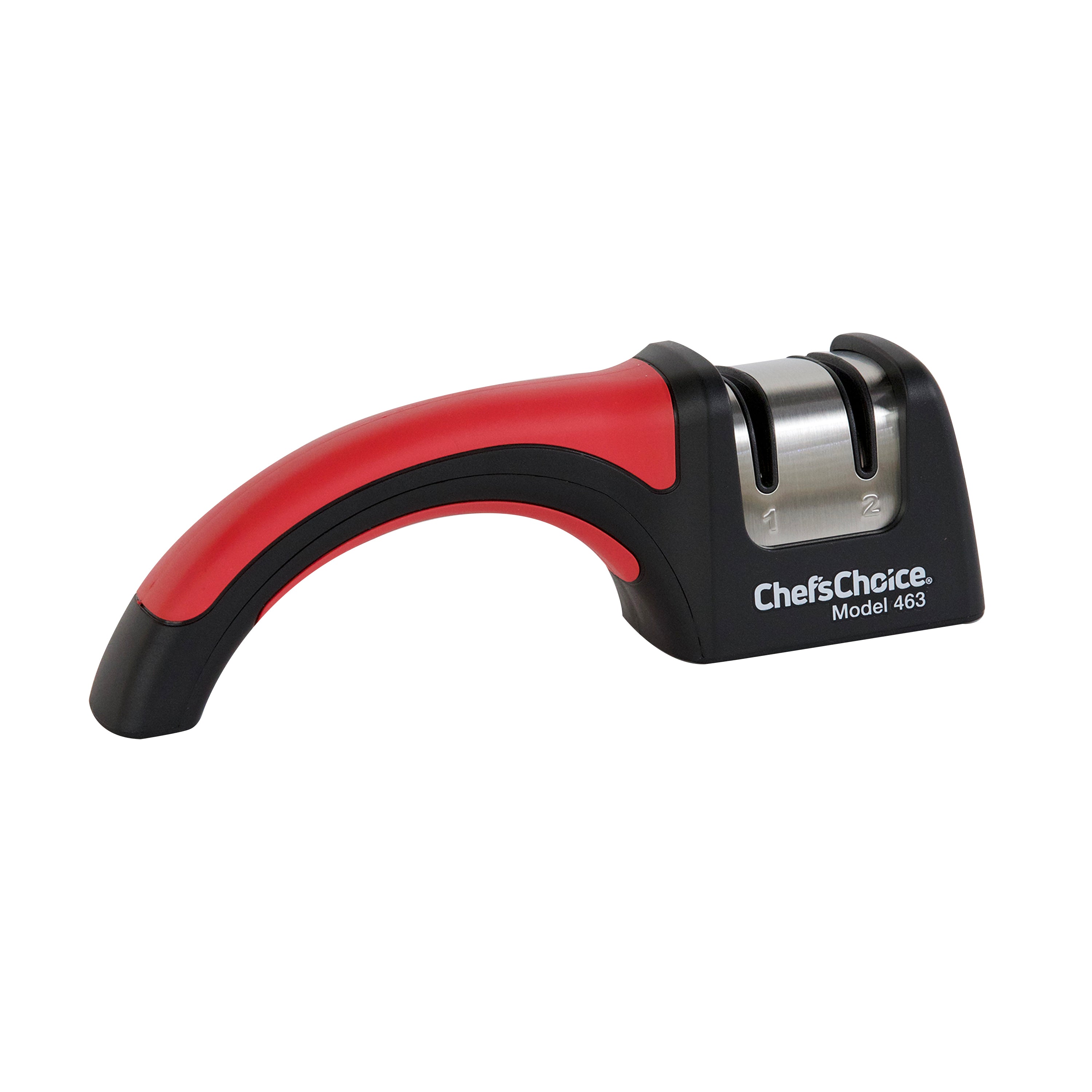
Your needs, this model
Does it fit your priorities?
Is the Model 463 a 15°-per-side sharpener, and is that setting adjustable?
Its Model 463 instructions specify a nominal 15° on each primary facet in Stage 1, or 30° total, then a separate Stage 2 bevel at a slightly larger angle that the manual does not quantify. That is a fixed two-stage routine, not an adjustment dial or a general recommendation to reprofile a knife. Check that the knife is double-bevel and that its maker's edge guidance is compatible before using it.
Explore this need in the finder →What does the exact Model 463 manual say about serrated knives?
The Model 463 manual gives serrations their own method: center the blade in Stage 2 and make five paired strokes, examining the edge before repeating; a very dull serrated blade gets two full strokes in Stage 1 followed by the Stage 2 sequence. It cautions against many Stage 1 strokes because they can remove metal quickly, and says a serrated edge will not look or cut like a straight edge. The manual does not give a numerical angle for this separate plan.
Explore this need in the finder →Will the Model 463 sharpen a single-sided sashimi knife, a ceramic knife, or scissors?
No. The Model 463 instructions say the unit sharpens both sides simultaneously and explicitly say not to use it for single-sided, single-faceted Asian blades such as sashimi-style knives. They also say it is not recommended for ceramic knives and must not be used to sharpen scissors. Its broad 15°/Santoku description should not override those exact limits.
Explore this need in the finder →What setup and care does the Model 463 require?
The manual asks the user to clean the knife first, hold the unit securely on a table, keep fingers behind the handle partition and keep the blade centered without rubbing the slot walls. It gives separate pressure directions for Stage 1 and Stage 2, then says to listen for the paired disks turning. For care it describes wiping the exterior with a damp, soft cloth, turning the unit over to tap out metal dust, and says lubricating oil is unnecessary. These are manufacturer instructions, not hands-on testing.
Explore this need in the finder →Is a leather strop included, or can the sharpening disks be replaced?
The reviewed Model 463 page and instructions do not list a complete current seller package or confirm a separate leather strop, and they do not establish replacement-disk availability. The honing/polishing stage is built into the sharpener; it is not proof of a leather strop in a seller's box. Confirm the exact SKU and package contents before treating either accessory as included.
Explore this need in the finder →Chef'sChoice identifies the US Pronto Model 463 as SKU 4630100. This review is a source-based reading of that product page and its model-specific instructions, not an account of using or testing a unit. Its central distinction is important: Model 463 sets the primary bevel differently from the 20-degree-class Pronto alternatives in this library, and its serrated-knife routine is separate from the ordinary fine-edge path.
A fixed 15-degree primary facet, not an adjustable guide
The instructions describe the Model 463's Stage 1 as forming each primary facet at a nominal 15 degrees—30 degrees across both sides together. Stage 2 then adds a second bevel at a slightly larger angle, but the manual gives no exact number for that finishing bevel. This is a fixed geometry, not a dial that can be changed to follow another knife's specification.
The product is framed around Santoku and other double-bevel Asian-style knives. The manual says the Pronto works both sides at once and explicitly warns against using it on single-sided, single-faceted Asian blades such as a sashimi knife. It also says ceramic knives are not recommended. A “15-degree” label should not be treated as permission to convert any blade: compare your knife maker's edge guidance with the Model 463 instructions before choosing a system that removes material.
Two paired-disk stages ask for a controlled stroke
Chef'sChoice describes two stages, both using diamond abrasives. In the instructions, Stage 1 uses fine diamond-coated disks to form the primary edge. The user holds the sharpener on a table, centers the blade in the slot and moves it back and forth in a sawing-like motion while keeping it level. The manual specifies about four to five pounds of downward force there and asks the user to listen for both disks turning. Those are maker directions, not measurements of what a particular user will apply or a guarantee of a result.
Stage 2 is a separate honing and polishing step that creates the slightly larger second facet. The manual specifies lighter pressure—about three to four pounds—and again asks the user to keep the blade centered, make smooth strokes and confirm that both disks rotate. Its example for a knife that is not very dull is roughly ten or fewer Stage 1 stroke pairs followed by two to five Stage 2 pairs. It describes more Stage 1 work for a very dull knife, with a paper check before moving to the finishing step. Those counts are conditional directions, not a sharpening-time claim or test result.
The serration procedure is its own task
Unlike an icon-only capability claim, the Model 463 manual gives a specific serration sequence. It directs the user to center the blade in Stage 2 for five paired strokes, inspect the edge and add another five full strokes only if needed. For a very dull serrated edge it allows two full Stage 1 strokes before Stage 2. The caution is explicit: many Stage 1 strokes can remove metal from a serrated knife quickly. The manual also says a serrated edge will not look as sharp or cut as smoothly as a straight edge. No numerical angle is attached to this separate serration plan, so the 15-degree primary-facet value is not carried over to serrations.
This boundary matters if you are comparing Pronto models. The Model 463's own manual explains a Stage 2 serration method. The Model 445 and Model 478 product grids also mark serrated use, but their linked instructions do not give that same model-specific sequence. Those claims are not interchangeable merely because the products share a brand or two-stage format.
Safety, excluded tools and maintenance
The manual shows the fingers held behind the handle's partition and emphasizes keeping them clear of the blade edge. It asks for the sharpener to remain oriented with the stage numbers facing the user. Its equal-weighted two-side action also means it is not intended for a single-sided edge. In addition to excluding those Kataba-style knives and advising against ceramic blades, the instructions expressly prohibit sharpening scissors. The maker's broader catalogue includes separate scissor sharpeners; that does not make this model a scissor tool.
For upkeep, the manual describes wiping the exterior with a damp soft cloth and periodically turning the unit over to shake out metal dust. It says lubricating oil is unnecessary. That is not the same as a complete water-compatibility statement or an explicit dry-use-only ban. The reviewed product page and manual do not confirm a separate leather strop, a complete seller-box list, a maximum blade clearance, or whether the disks can be replaced. Treat all of those as questions to verify for the exact package, not assumptions from the word “honing.” The cited materials state a one-year limited warranty subject to its terms; they do not establish terms for every used, imported or third-party offer.
Where Model 463 sits among nearby choices
For a manual sharpener, Model 463 is distinguished by its documented 15-degree-per-side primary facet and its explicit Stage 2 serration instructions. The current Model 445 and Model 478 are separate two-stage manual products whose product pages mark a 20-degree-class straight-edge capability; their manuals describe different stage use and do not provide the Model 463 serration procedure. The electric 15XV also has a maker-listed 15-degree-class path, but it is a powered three-stage machine, not a hand-guided Pronto. That comparison describes different documented configurations, not a ranking or a promise that any of their angles suit an unexamined knife.
The Model 463 is therefore a candidate to investigate when the intended blade is double-bevel, the documented 15-degree-per-side primary facet is appropriate, and a manual slot routine is acceptable—or when the separate Stage 2 serration procedure matches the task. Check the exact maker instructions and the blade's own geometry first. Do not select it for a single-sided Asian knife, ceramic blade or scissors; do not assume its Stage 2 angle, a leather strop or replacement disks are included facts.
Key specifications
Key details at a glance
| Power | Manual |
|---|---|
| Sharpening format | Manual two stage crisscross diamond disks |
| Lowest angle setting | 15° |
| Highest angle setting | 15° |
| Included abrasive surfaces | Stage 1 pair of fine diamond-coated sharpening disks / Stage 2 pair of diamond honing/polishing disks; the Model 463 manual describes micron-size diamond abrasives |
| Angle-guide positions | 15° |
Use the exact model’s instructions for operating limits, supplied equipment and version differences.
Sources for this review
Sources for this assessment
- Chef'sChoice Pronto Diamond Hone Manual Knife Sharpener, Model 463, SKU 4630100
- Chef'sChoice Pronto Diamond Hone Knife Sharpener for Asian Knives, Model 463 instructions (2019 revision, linked from the Warranty & Manuals index)
- Chef'sChoice US Manual Knife Sharpeners collection
- Chef'sChoice US Warranty & Manuals index
Check the requirements that matter to you
Use the finder to compare documented sharpener formats and limits; an unknown capability is not treated as a match.