
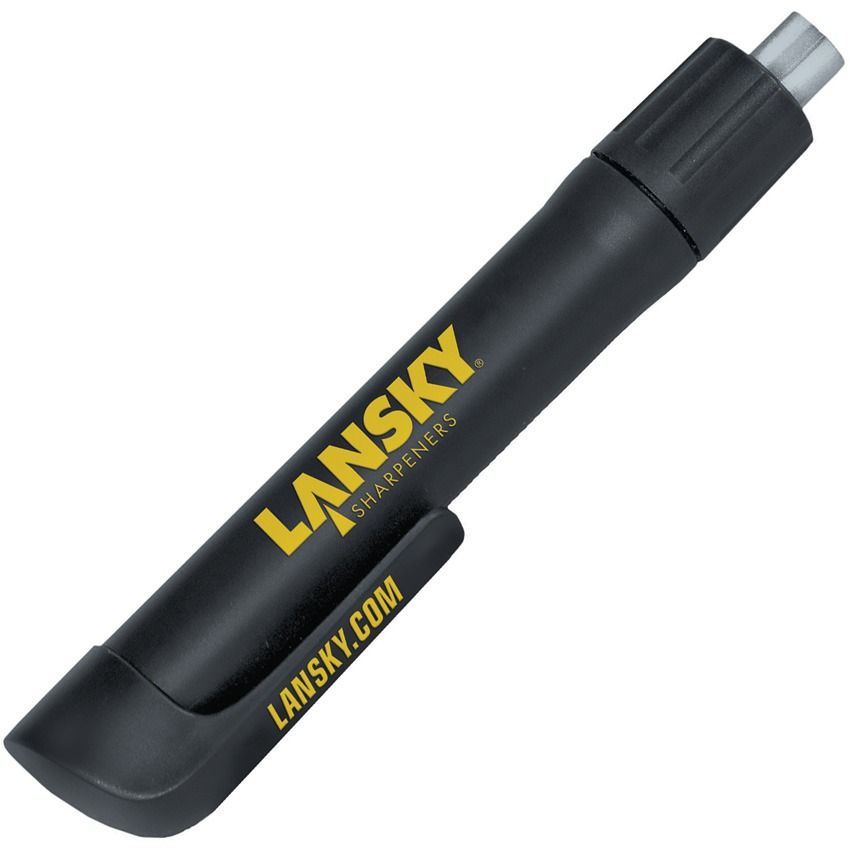
Your needs, this model
Does it fit your priorities?
Which part of the DROD1 rod is intended for a pocket knife versus serrations?
Lansky directs users to use the flat side for small pocket knives and the rod corners for serrated knives, moving the blade away from the user during the serration stroke. The source gives no numeric angle and does not claim the rod fits every scallop size.
Explore this need in the finder →Can the Diamond Pen sharpen fish hooks?
Yes. The exact instructions identify three V-shaped grooves on the rod for fish hooks: choose a suitable notch and move the hook back and forth. That is a distinct pointed-tool operation, not evidence of scissor support.
Explore this need in the finder →Does DROD1 lock a pocket knife to a numeric sharpening angle?
No numeric angle is published. The exact manual asks the user to maintain a consistent angle for the small-pocket-knife strokes; the pen-style case stores the 600-grit rod and is secured by its cap, but it is not a clamp or angle guide.
Explore this need in the finder →This assessment uses Lansky’s exact DROD1 product record and instructions, not a personal use test. The Retractable Diamond Pen Sharpener is a small manual tool with one fine 600-grit diamond rod and three distinct contact features. The manufacturer’s directions assign them separately: a flat side for small pocket knives, the rod’s corners for serrations, and three V-shaped grooves for fish hooks.
A retractable rod with three useful surfaces
The 600-grit sharpening rod stores inside a lightweight plastic casing with a clip. To deploy it, Lansky says to loosen the cap, pull the rod into position and tighten the cap. The exact product page calls out small pocket knives rather than promising compatibility with every blade size. On a plain pocket knife, it directs the user to work with the flat side of the rod, using light-to-moderate strokes, then repeat on the opposite side while keeping the blade moving away from the user.
The rod’s three-sided shape is more than a visual detail. Lansky points users to its corners when working serrations, sliding the rod across the scallops and moving the blade away. It also provides three V-shaped notches to contact fish hooks. Those are separate operations: a serration does not use the same groove arrangement as a hook, and fish-hook support is not evidence of scissors support. Nor does the product page give a numeric angle setting for either knife procedure. The maker asks for a consistent angle on the pocket-knife stroke but leaves it to the user.
Portability, with a deliberately narrow abrasive range
The pen-like storage arrangement is the main reason to consider DROD1 instead of a wider stone or clamp system. Its single 600-grit fine diamond surface reduces the number of parts to carry, and the retractable rod is protected inside its casing between uses. But one fine surface is not a coarse-to-fine progression. If the blade is badly damaged or needs substantial reshaping, the source does not establish a coarse stage or tell you that this tool is enough for that repair. Treat it as a focused pocket-knife and edge-maintenance option, not a universal workshop station.
The casing is not a clamp or fixed-angle guide. The user has to hold the small knife and the pen-style sharpener separately, maintain the edge angle, and follow the blade-direction caution. If the knife has an unusual grind, thick handle, large blade or serrations whose geometry may exceed the rod corners, verify fit before relying on the product description alone. Lansky’s instructions name a use case; they do not state a full compatibility chart.
Care and the fish-hook detail
For fish hooks, the maker says to choose one of the three V-shaped grooves, place the hook in that notch and move it back and forth until sharp. For cleaning, Lansky recommends water followed by a dry rag or soft-bristled brush, with the rod fully dry before the next use. To stow it, loosen the cap, push the rod back into the casing and tighten the cap. These directions give a clear ownership routine without claiming a replacement interval or a particular sharpening result.
The exact product data lists a length of five inches but does not make clear whether that is the stored or extended dimension. This review does not turn that ambiguous field into an assured working length. The same page does not provide a rod diameter, numeric knife angle, strop listing or replacement interval. Confirm the physical package and exact instructions rather than assuming an accessory or size from another pen sharpener.
Compare the actual rod designs
The TR600 is another 600-grit diamond rod, but it folds into a handle and its maker gives a one-scallop-at-a-time serration procedure, including a reverse-grind burr-removal step. DROD1 instead uses its rod corners for serrations and stores in a pen casing; it has dedicated hook grooves that the TR600 page does not describe. The LCD02 adds a carbide slot preset at 22.5° per side, but its diamond rod is a separate freehand path. The folding FP2860 offers a broader two-face medium/fine stone but no maker-documented serration method. These differences are more useful than calling all of them portable diamond sharpeners.
Choose DROD1 when the documented work is a small pocket knife, serrations reachable by its corners, or fish hooks. Look elsewhere if a numeric angle, more aggressive grit, clamp, power or scissor support is essential. Verify the listing says SKU DROD1 and follow the exact instructions for extension, blade direction, drying and storage. Manufacturer catalogue presence establishes a current reference model, not the state or exact package of any particular retailer offer.
Key specifications
Key details at a glance
| Power | Manual |
|---|---|
| Sharpening format | Pocket-size retractable three-sided fine diamond pen sharpener |
| Included abrasive surfaces | Retractable three-sided 600-grit diamond rod |
| Angle-guide positions | ° |
Use the exact model’s instructions for operating limits, supplied equipment and version differences.
Sources for this review
Sources for this assessment

Check the requirements that matter to you
Use the finder to compare documented sharpener formats and limits; an unknown capability is not treated as a match.