
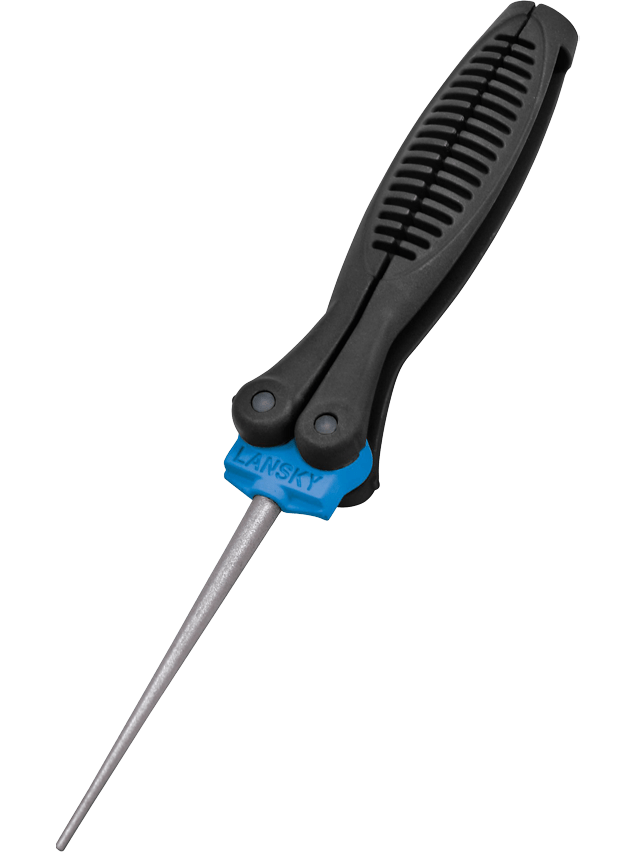
Your needs, this model
Does it fit your priorities?
How does Lansky describe sharpening serrations with the TR600?
The maker says to work one serration at a time, match the serration's angle to the tapered rod, and then hold the rod flat along the reverse grind to remove any burr. No numeric angle is stated, and this method is not a blanket guarantee that every serration size fits the rod.
Explore this need in the finder →Does the TR600 have a marked angle setting?
No. Lansky's exact instructions say to maintain a proper, consistent angle for a plain edge and to match the individual serration angle, but provide no numeric setting or range. It requires hand control rather than a fixed slot or clamp.
Explore this need in the finder →What non-knife tasks does Lansky list for TR600?
The product page identifies fish hooks and gut hooks, along with knives and other tools. It does not establish a scissor setup; the fishhook and gut-hook use should not be expanded into a general non-knife-tool claim.
Explore this need in the finder →This assessment follows Lansky’s exact TR600 product record and instructions; it is not based on using the rod. The Folding Diamond Tapered Rod is a manual, 600-grit diamond tool that stores by folding its rod into the handles. Its important distinction is not a selectable angle or multiple abrasive progression, but its tapered shape and a manufacturer-written procedure for individual serrations.
A single fine diamond rod with a fold-away handle
Lansky describes the TR600 as a fine 600-grit diamond rod for knives and other tools, and lists it in both the portable-sharpener and sharpening-rod categories. The exact page says to open the plastic handles and lock them together before use. For a plain edge, the user holds the blade and sharpener separately, places the end on a stable surface, and draws the edge along the rod at a proper, consistent angle. The instructions suggest three or four strokes with light-to-moderate pressure before repeating on the other side.
That is a portable freehand routine, not a clamp or a fixed-angle slot. Lansky does not supply a numeric angle for this SKU. It is therefore a poor match if the non-negotiable requirement is a verified 20°, 22.5° or other stated guide setting. It may still be considered for manual field maintenance when the user can control the knife’s geometry, but the source does not establish a specific maximum blade length, rod diameter or compatibility with every edge shape.
The serration procedure is unusually specific
For serrated edges, Lansky instructs the user to sharpen one serration at a time, matching that scallop’s own angle to the tapered rod. The rod is drawn against the serration until sharp, then held flat along the reverse grind to remove burrs that may have formed. This is materially different from a general promise that a tool “works on serrations”: it gives an individual method, while leaving the exact fit dependent on serration size and rod taper. The product page publishes no diameter range for matching each recess, so check that geometry rather than assuming every scallop can be reached.
The maker also names fish hooks and gut hooks, among other tools. Those tasks use the same tapered abrasive but are not a reason to infer scissor compatibility or a numeric knife angle. Use the separate instructions for each tool instead of transferring the plain-edge stroke blindly.
One grit is a focused setup, not a full progression
The package’s documented abrasive is one 600-grit diamond surface. It avoids having to select or carry multiple stones, but it does not provide the coarse/medium face choices of the folding FP1260 and FP2860. Those broader paddles leave the user in control of the angle and do not have the TR600’s written one-serration-at-a-time method. The TR600’s tapered rod makes it the clearer of those products when serration work is the task, while the paddle pair gives more grit choice for plain-edge work.
Another useful comparison is the compact DROD1. It too uses a 600-grit diamond rod and has instructions for serrations and fish hooks, but it is a retractable three-sided pen: Lansky assigns its rod corners to serrations and three V-shaped grooves to hooks. TR600 instead opens into a folding tapered rod. The LCD02 is different again, pairing a 22.5°-per-side carbide slot with a separate freehand diamond rod. These distinctions are functional; they are not presumed interchangeable because all four fit a pocket or field category.
Cleaning and buying checks
Lansky explicitly says not to use lubrication on diamond sharpeners and tells users to clean the TR600 with water, wipe metal shavings off with a lint-free rag, and let it dry completely before use or storage. After the serration procedure, the reverse-side pass is intended to remove burrs; the source does not say that one can skip it. The exact product record does not provide an included strop, replacement schedule, or a numeric sharpness result.
Choose the TR600 when a manual, folding, fine diamond taper and individually treated serrations are the documented requirements. Do not choose it for a powered cycle, a locked angle, or a multi-grit progression. Confirm that an offer names SKU TR600 and follow the actual instructions around blade direction and stable support. A current manufacturer listing identifies the reference configuration; it is not an availability promise or proof that a particular marketplace package is complete.
Key specifications
Key details at a glance
| Power | Manual |
|---|---|
| Sharpening format | Folding, hand-guided fine diamond tapered rod |
| Included abrasive surfaces | Fine 600-grit diamond tapered rod |
| Angle-guide positions | ° |
Use the exact model’s instructions for operating limits, supplied equipment and version differences.
Sources for this review
Sources for this assessment

Check the requirements that matter to you
Use the finder to compare documented sharpener formats and limits; an unknown capability is not treated as a match.