
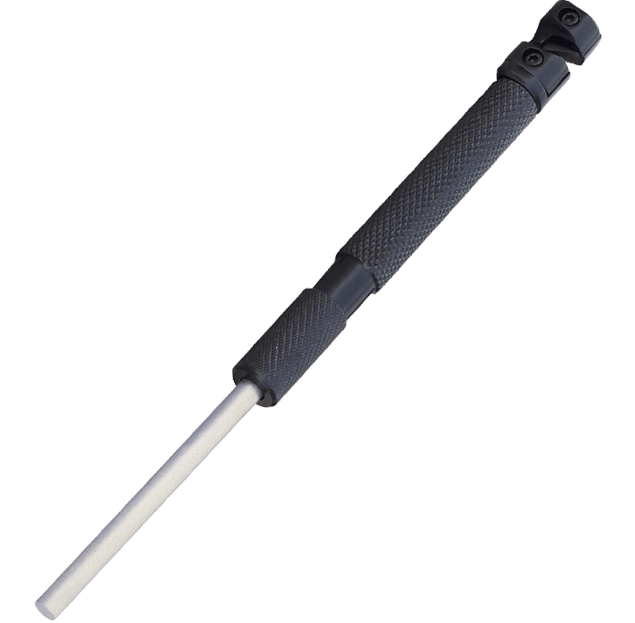
Your needs, this model
Does it fit your priorities?
What exact angle does the LCD02 carbide slot use?
Lansky states that the tungsten-carbide slot is preset at 22.5° per side, producing a 45° inclusive edge. That setting belongs to the carbide pull-through path; it is not a numeric angle for the retractable diamond rod.
Explore this need in the finder →Does LCD02's retractable diamond rod use the same fixed angle?
No numeric rod setting is stated. Lansky describes the 600-grit diamond surface as a separate manual operation: extend and lock it, rest the end on a stable surface, and guide the blade at a consistent angle. The 22.5°-per-side figure is expressly tied to the carbide slot.
Explore this need in the finder →What sequence and care does Lansky describe for the two LCD02 surfaces?
The product instructions use three to four strokes through the tungsten-carbide slot for edge setting, then separately deploy and lock the diamond rod for light-to-moderate strokes on each side. The maker says not to oil the diamond surface; clean it with water, wipe it with a lint-free rag, and dry it fully before storage or the next use.
Explore this need in the finder →This is an evidence-based assessment of Lansky’s exact LCD02 product record, not a hands-on test. The Tactical Sharpening Rod combines two manual sharpening operations in one portable tool: a tungsten-carbide V-slot for edge setting and a retractable 600-grit diamond rod for refinement or routine maintenance. Its most important buying detail is that only one of those operations has a numeric angle.
The carbide slot is fixed at 22.5° per side
Lansky states that the tungsten-carbide slot is preset at 22.5 degrees per side, which it describes as a 45-degree inclusive angle. The instructions call for three or four draws through the slot to sharpen the blade. The manufacturer positions carbide as a quick edge-setting method for a severely dull or damaged blade, not as a fine finishing surface. Because the slot is fixed, this is a clear fit only when that geometry suits the knife and the owner is prepared to use a carbide pull-through.
The angle wording matters. A requirement for 22.5° per side is not the same as an included 22.5° edge, and the tool cannot be adjusted to another mark. The exact LCD02 page removes that ambiguity by giving both the per-side and inclusive descriptions. It does not, however, prove that this is the right bevel for a particular knife. If a knife maker gives a different angle or cautions against carbide, follow that guidance rather than treating the sharpener’s fixed slot as a recommendation to reprofile an edge.
The diamond rod is a different plan
For ordinary maintenance, Lansky says the 600-grit diamond rod alone is sufficient. It is not another fixed-angle slot. The exact instructions say to twist the end of the casing counter-clockwise, extend the rod fully, lock it by twisting clockwise, then place its end on a stable surface and draw the knife along it at a consistent angle. The maker’s suggested three or four light-to-moderate strokes per side are an instruction for this hand-guided path, not a guarantee of a particular result.
That division gives LCD02 more than one tool function, but it also limits what the finder can honestly promise. A 22.5° numeric answer corresponds only to the carbide plan; a visitor who wants a precise 22.5° diamond-rod setting is not supported by the documentation. The two surfaces should not be combined into a fictional continuously adjustable range, and the existence of a carbide slot does not make the rod angle numeric.
Portable use, with careful edges and care
Lansky lists LCD02 among its knife, portable and sharpening-rod products and describes it as a compact tool intended to be kept at hand. It is a manual field-style format rather than a bench clamp. The manufacturer page does not specify an overall length, a strop, a serration routine or a scissor operation for this SKU. Keep the blade direction and stability instructions in view, and do not assume the rod protects the hand or holds a blade in place.
The care instructions are explicit for the diamond rod: do not apply oil; clean the abrasive with water, wipe away shavings with a lint-free cloth, and let it dry completely before the next use. The source describes carbide first and the rod afterward as an edge-setting/refining sequence, while also saying the diamond rod alone is enough for regular maintenance. That leaves a meaningful choice: a damaged edge may be a different job from a knife that only needs ongoing care. It does not mean that every session requires both steps.
How it compares with other portable formats
The folding FP1260 offers broad 120/600 diamond faces but no preset angle. Its sibling FP2860 substitutes a 280-grit medium face for FP1260’s coarse 120-grit face; both leave bevel control to the user. The TR600 is a tapered 600-grit rod with maker instructions for individual serrations, while LCD02’s page gives no serration-specific routine. The pen-style DROD1 has separate instructions for a flat face, serration corners and fish-hook grooves, but no fixed knife angle. LCD02’s defining difference is the combination of a carbide angle slot and a separate retractable rod.
Choose LCD02 when that two-stage style and the documented fixed carbide geometry fit the knife and job. Avoid treating it as a variable-angle system, a dedicated serration tool or a substitute for a multi-grit clamp kit. Before ordering, verify the exact SKU and read the manufacturer’s directions for the fixed slot and deploying rod; a category listing does not establish the condition or contents of an individual seller’s offer.
Key specifications
Key details at a glance
| Power | Manual |
|---|---|
| Sharpening format | Portable manual sharpener combining a fixed-angle tungsten-carbide v-slot and a retractable freehand diamond rod |
| Lowest angle setting | 22.5° |
| Highest angle setting | 22.5° |
| Included abrasive surfaces | Tungsten-carbide pull-through slot / 600-grit retractable diamond rod |
| Angle-guide positions | 22.5° |
Use the exact model’s instructions for operating limits, supplied equipment and version differences.
Sources for this review
Sources for this assessment

Check the requirements that matter to you
Use the finder to compare documented sharpener formats and limits; an unknown capability is not treated as a match.