
Your needs, this model
Does it fit your priorities?
What does the LCDOG maker say about its intended knife and method?
Lansky describes the exact LCDOG as a pocket knife sharpener and gives a manual full-edge stroke on its ceramic rod. Hold a consistent angle and use even pressure; the maker offers no dimensions or named knife-model chart, so compare your blade's bevel and available clearance before assuming fit.
Explore this need in the finder →Does LCDOG provide a numeric sharpening angle?
No numeric setting is stated. Lansky calls the finger guard an angle guide, while the procedure says only to maintain a consistent angle. No degrees, marks, interval, or per-side versus total-angle convention is published, so a fixed numeric requirement is not verified.
Explore this need in the finder →How does LCDOG differ from the Fine Mini Dog Bone?
The exact Medium SKU LCDOG is listed with 600-grit ceramic; its separately listed Fine sibling LCDOGF states 1,000-grit ceramic. The pages show the same broad single-rod stroke and angle-control language, but do not prescribe a two-tool progression or quantify a performance difference. Check the suffix and seller package.
Explore this need in the finder →This is a source-based assessment of the Lansky Mini Dog Bone Sharpener Medium, exact SKU LCDOG, not a hands-on review. Lansky describes it as a compact pocket-knife sharpener built around a 600-grit alumina-ceramic rod, with finger guards and a keychain. Its instructions show a simple full-edge stroke; they do not provide a serration-specific routine or a numeric bevel setting. The exact LCDOG manufacturer page is the controlling source for identity and operating guidance.
What the exact Medium version offers
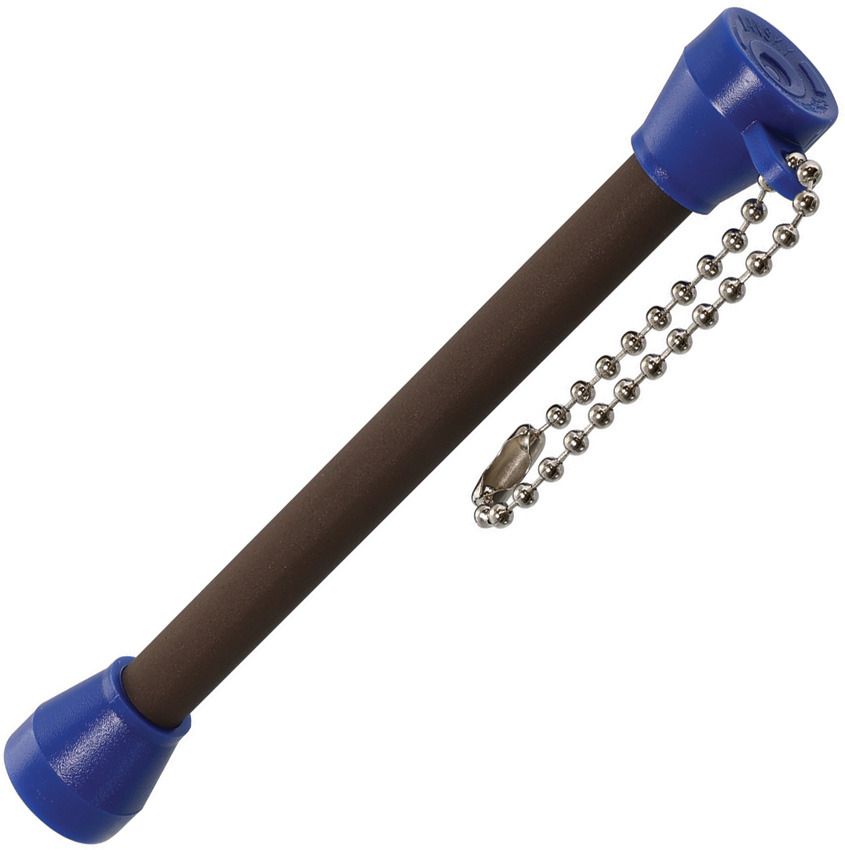
The US catalogue record names this configuration Mini Dog Bone Sharpener Medium, SKU LCDOG, and lists it under the knife, portable-sharpener and sharpening-rod categories. Lansky calls it a pocket knife sharpener and describes the rod as 600 grit. The page mentions colorful finger guards and a keychain; it does not give the tool's dimensions or a compatibility list for particular pocket knives. That makes the intended carry-oriented form clear, but it is not a promise that every blade, handle or bevel will fit the working area.
LCDOG is a separate choice from the Fine Mini Dog Bone, SKU LCDOGF. The exact LCDOGF page states 1,000-grit ceramic, while LCDOG is 600 grit. The color and rod appearance in their separate gallery images are useful for checking the model label, not proof of an exact package or sharpening result. The manufacturer does not specify a required progression between the two models, say they should be bought as a set, or quantify a performance difference. Confirm the SKU rather than shopping from the shared “Mini Dog Bone” name alone.
The maker's one-rod routine
Lansky's directions place the blade edge against the rod and call for a gentle, even-pressure push that carries the full edge across in one stroke, likened to slicing a thin layer from the rod. The instructions say to make three to five strokes, repeat the process on the reverse side, and continue as needed. This is a user-guided operation: the rod does not hold the knife in a clamp, and the person sharpening still controls the angle and pressure.
The instructions describe one general whole-edge procedure. They do not name a separate corner, groove, serration hone or scissors attachment. For contrast, Lansky's exact CS Knife Sharpener Medium (LTRCS) and CS Knife Sharpener Fine (LTRCSF) records have explicit corner and mini-serration groove instructions. Those are different models and surfaces; do not assume that their serration method transfers to LCDOG just because all are handheld ceramic tools.
“Angle guide” is not a degree setting
The LCDOG product copy says its finger guard acts as an angle guide. The operating steps, however, only tell the user to maintain a consistent angle. The exact source gives no degree value, indexed positions, range or increment, and it does not say whether any angle is per-side or an inclusive total. The guard wording is therefore a useful qualitative feature, not enough evidence for a buyer who needs a verified 15°, 20° or other exact setting.
Match the bevel guidance for the actual knife instead of choosing an arbitrary number from a different sharpener's guide. The LCDOG page does not map the ceramic rod to a named blade model, blade thickness, edge profile or clearance dimension. A known numeric angle requirement remains unverified for this exact package even though the manufacturer uses the phrase “angle guide.”
Where the evidence supports a fit—and where it stops
The named “pocket knife sharpener” purpose supports comparing LCDOG for a pocket-knife maintenance task when one rod and hand-guided strokes make sense. It does not separately establish a hunting-knife, kitchen-knife or scissor use. Nor does the page say how small or large a blade can be, how much handle clearance is needed, or which steel types it suits. These are not reasons to assume incompatibility; they are gaps to check against the knife maker's instructions and the physical dimensions of the exact offer.
The stated 600-grit number distinguishes the Medium rod from LCDOGF's 1,000-grit Fine rod, but there is no LCDOG-specific grit progression chart or measured sharpness outcome in the product record. If the starting edge is damaged, the needed repair depth and suitable abrasive are not resolved by the product name alone. Avoid reading “Medium” as a quantified speed, aggression or final edge quality claim; the maker does not publish such comparative tests for this pairing.
Cleaning, handling and exact-package checks
Lansky instructs the user to clean the alumina-ceramic rod with an Eraser Block or household cleanser when it darkens with metal particles. The same record cautions that careless handling of a blade or pointed object can cause injury. Use the actual manufacturer directions and keep the blade controlled; this assessment does not claim to have performed the strokes or evaluated their feel.
The exact record names the tool features but does not provide a complete seller-box list, weight, dimensions, replacement interval, strop or clamp status. The gallery photograph shows one rod, guards and a chain, but it is not a package inventory. Before ordering, verify SKU LCDOG, confirm the seller's exact contents and return terms if an accessory matters, and check that your knife's bevel and clearance work with the stated routine.
Bottom line
LCDOG is the 600-grit Medium Mini Dog Bone: a compact manual ceramic rod whose maker describes pocket-knife use and gives a straightforward whole-edge stroke. Its finger-guard angle-guide claim does not supply the exact angle data needed for a numerical match, and the product page does not settle serration, kitchen, scissor, size or seller-package questions. It is most defensible as a model-specific option to compare for a pocket knife whose geometry and sharpening instructions suit the described hand-guided routine—not as a universal pocket sharpener or a tested performance winner.
Key specifications
Key details at a glance
| Power | Manual |
|---|---|
| Sharpening format | Compact hand-guided 600-grit alumina-ceramic rod with finger guards and a keychain; maker describes whole-edge strokes across the rod |
| Included abrasive surfaces | One 600-grit alumina-ceramic rod |
| Angle-guide positions | ° |
Use the exact model’s instructions for operating limits, supplied equipment and version differences.
Sources for this review
Sources for this assessment

Check the requirements that matter to you
Use the finder to compare documented sharpener formats and limits; an unknown capability is not treated as a match.