
Your needs, this model
Does it fit your priorities?
How does the LTRCSF handle mini serrations?
Lansky directs the user to align mini serrations with the tool’s specialty grooved panel, maintain a consistent angle and pressure, and repeat the stroke three to four times. No tooth dimensions or compatible-knife list is published; compare the real edge shape before assuming fit.
Explore this need in the finder →Can the LTRCSF hold a particular numeric bevel?
The maker asks the user to maintain a consistent angle but does not state a degree setting, adjustment range, marked position or per-side/inclusive convention. The Fine name and ceramic grit do not substitute for a numeric angle guide.
Explore this need in the finder →Is the 800-grit LTRCSF a documented finishing stage after LTRCS?
The manufacturer states 800-grit ceramic for the Fine SKU and 600-grit ceramic for the Medium LTRCS, but the two product records do not prescribe a sequence or make a quantified finish claim. Treat them as distinct retail models and confirm whether an actual seller offer includes one tool or more.
Explore this need in the finder →This assessment covers Lansky’s exact CS Knife Sharpener Fine, SKU LTRCSF, using the current model-specific manufacturer record and instructions. It is a research summary, not a use report. The product is a manual ceramic rod with a corner for serrations, a groove panel for mini serrations and a flat surface for plain edges. Its stated abrasive value is 800 grit. That fact distinguishes it from the separately listed 600-grit CS Knife Sharpener Medium (LTRCS), but the maker does not publish a quantified performance comparison or an order in which the two should be used. The exact Fine product page provides the model-specific procedure and maintenance information.
Identify the Fine SKU before comparing it
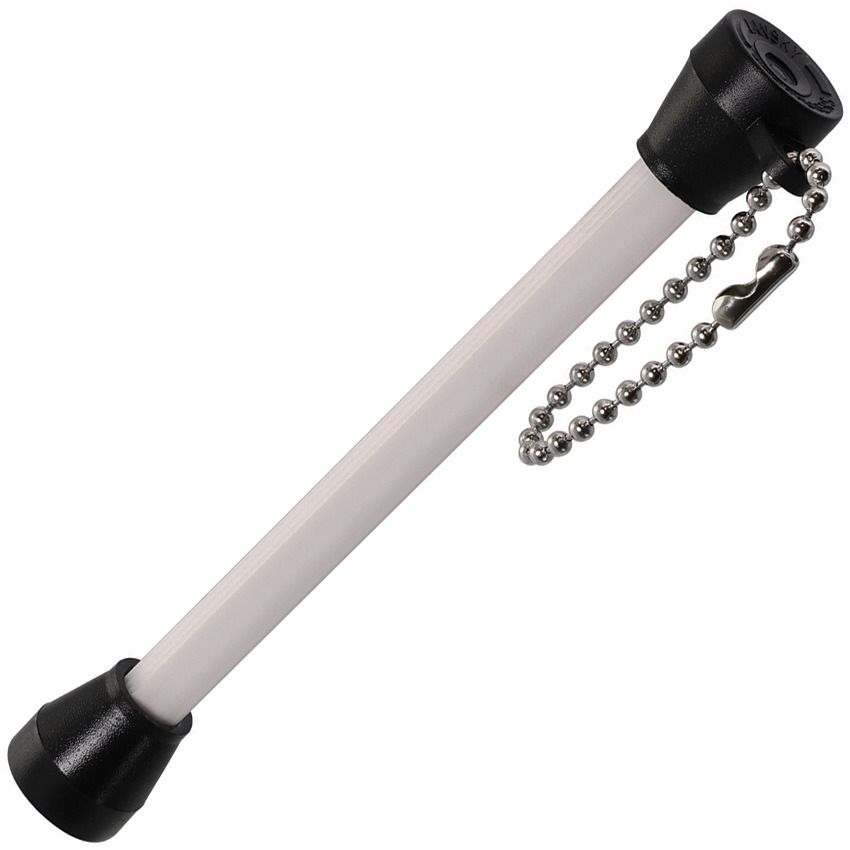
The LTRCSF appears in Lansky’s knife-sharpener, portable-sharpener and sharpening-stick categories. Its description calls it a pocket-size tool designed around serrations on folding and fixed-blade knives and lists safety thumb rests and a keychain. The Fine version is not just a name for a different color: the manufacturer’s description explicitly states 800-grit ceramic, whereas the LTRCS page states 600 grit. The source material does not tell the reader to combine them, does not promise a specific finish from either grit and does not present a set or package progression.
The product’s compact format also should not be mistaken for an angle guide. Nothing in the Fine page assigns a degree setting to the rod. Its use depends on the user holding a consistent angle while moving the sharpener against the edge. Anyone selecting a sharpener to reproduce a known bevel should look for a documented angle method elsewhere rather than translating the word “Fine” into a sharpening result.
Match the edge to the right contact surface
Lansky’s standard-serration instructions bring the rod’s corner to an individual scallop. The user maintains even pressure and a consistent angle while making a controlled rolling push across the curve. The maker states that one pass removes a burr on the reverse side. That is a different routine from work on mini serrations: for those, the page directs the user to align the edge with the specialty grooved panel, push the small serrations into its grooves and repeat three or four times. The instructions name no tooth-radius range or maximum scallop size, so this is a cue to compare the actual knife geometry—not a guarantee that any serrated blade will fit.
The flat side is reserved for a plain edge. Lansky describes a full-edge push, three to five strokes, and repetition on the opposite side before continuing as necessary. These directions show that the exact product has more than a serration function, but its marketing emphasizes serrated folding and fixed blades. They do not establish a separate kitchen-knife fit chart, blade-length limit or clearance specification.
How it differs from the Medium and other compact tools
For shoppers comparing the two CS versions, the documented difference is exact and narrow: LTRCS is 600-grit ceramic, while LTRCSF is 800-grit ceramic; both records describe the corner, mini-groove and flat-side operations. The available maker pages do not say whether one should follow the other, how much metal either removes, or what finish a particular steel will show. Keep the SKUs distinct in a listing and do not infer a paired package.
The LTRCS Medium review discusses the 600-grit version. Other ceramic portable tools have different layouts: the LTRSP Spyder Sharpener describes smaller and broader profiles for different scallops, while the LTRIM Multi Sharpener assigns a groove to fish hooks and other pointed objects. These comparisons are about the manufacturer-documented geometry only. The Fine page does not borrow their purpose, fishhook capability or corner dimensions.
Angle, care and what remains unknown
The instructions ask for a steady angle, but they state no numerical value, range, incremental positions or angle convention. The thumb rests and chain are documented features, not proof of angle control or blade compatibility. The page gives no named scallop measurements, steel-specific recommendation or exact knife-model list. If the blade manufacturer specifies a bevel, use that source to decide whether a manual rod is appropriate; do not assume the tool’s description overrides it.
For care, Lansky says to clean the alumina-ceramic sharpening rod with its Eraser Block or household cleanser when metal particles darken the surface. The page does not specify a cleaning frequency, replacement schedule or maintenance interval. It also does not establish an included strop, clamp, protective case, dimensions, weight or every retailer’s package contents. The exact product image shows a rod, end pieces and a chain; it is not a package inventory.
Who should consider it
The LTRCSF is a plausible comparison when a shopper wants a hand-guided ceramic tool, needs its stated 800-grit grade and can use a corner or specialty panel for the serration shape at hand. The maker also supplies a plain-edge method. Its limits are practical: the user supplies the angle control; the source gives no geometry chart or numeric setting; and the relationship between the Fine and Medium models is not stated as a required progression. Before choosing it, verify the exact LTRCSF SKU and seller package, compare the scallops with the directions, and confirm the knife’s bevel and handling requirements. No hands-on test, ownership experience, measured performance, rating or stock claim is made.
Key specifications
Key details at a glance
| Power | Manual |
|---|---|
| Sharpening format | Handheld 800-grit ceramic rod with a corner for ordinary serrations, a grooved panel for mini serrations, and a flat face for plain-edge strokes |
| Included abrasive surfaces | One 800-grit ceramic sharpening rod |
| Angle-guide positions | ° |
Use the exact model’s instructions for operating limits, supplied equipment and version differences.
Sources for this review
Sources for this assessment

Check the requirements that matter to you
Use the finder to compare documented sharpener formats and limits; an unknown capability is not treated as a match.