
Your needs, this model
Does it fit your priorities?
Is the Mini Crock Stick set up for fine manual maintenance rather than a powered sharpening cycle?
Yes. Lansky identifies two fine 1,000-grit alumina-ceramic rods and gives a manual pull-through procedure. Its two knife openings have a fixed 22.5°-per-side geometry (45° inclusive), so this is not a variable-angle system or a coarse-to-fine progression.
Explore this need in the finder →Can the rods be used for fishhooks as well as knives?
The product page describes a separate fishhook, dart and pointed-object task: remove and reposition the rods side-by-side in the provided groove, following the maker’s directions. That is not the same operating plan as the fixed-angle knife openings, and the page gives no numeric angle for pointed-tool work.
Explore this need in the finder →Does the Mini Crock Stick document scissor or serrated-knife sharpening?
The exact instructions document plain-knife openings and a separate pointed-object arrangement, but not a scissor or serration-specific procedure. Do not treat fishhook support as evidence that it fits every non-knife tool or serrated edge.
Explore this need in the finder →This assessment uses Lansky’s exact LCKEY product description and instructions; it is not based on handling or testing the sharpener. The Mini Crock Stick is a small manual knife tool with a second, distinct use for pointed objects. Those two jobs should not be blended into one assumed angle or sharpening routine.
A pocket-sized pair of ceramic rods
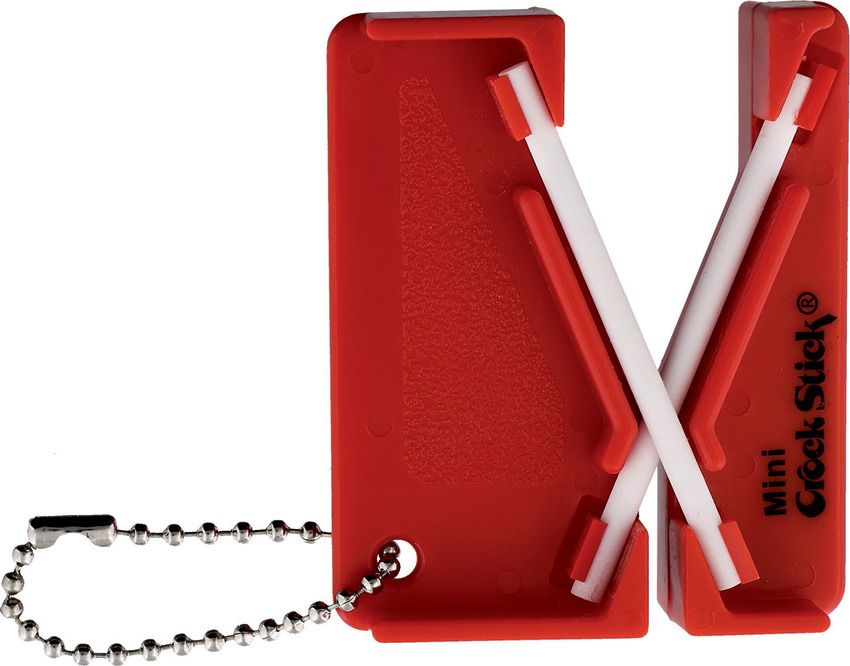
The exact product is SKU LCKEY. Lansky describes two removable alumina-ceramic rods in a compact, lightweight sharpener with a keychain. The fine rods are rated at 1,000 grit. Their crossed arrangement creates large and small blade openings for pull-through sharpening, while the rods can be removed and repositioned for another task. The manufacturer’s current categories place the same SKU in Knife Sharpeners, Portable Sharpeners and Sharpening Rods; those overlapping category listings do not make three products or three package configurations.
On the knife path, the product page gives a preset 22.5° per side, or 45° inclusive. The angle is fixed, not a range that can be adjusted to match another bevel. The page does not provide a maximum blade length, dimensions, weight, or a compatibility list by knife material. The fixed geometry is therefore a concrete selection condition, not a guarantee that every pocket blade will fit the openings or suit that bevel.
What a fine-only setup is good for
A 1,000-grit ceramic pair gives this sharpener a narrower documented role than a kit with several grit stages. The exact source calls the rods fine, but does not list a coarser abrasive in the LCKEY package. It is reasonable to consider it for routine maintenance or a modest edge refresh on a compatible plain-edge pocket knife; that is a conservative inference from the stated grit and one-grade package, not a measured claim about how quickly it sharpens. A chipped, badly dulled or damaged edge may call for a more substantial abrasive progression.
To set up the maker’s knife routine, place the sharpener on a solid, flat surface, ensure the rods are held by their clips, and hold the base with fingers away from the blade. Lansky describes holding the blade upright, as if slicing bread, then drawing it down and across one rod and repeating on the opposite side. The page says that right- or left-hand operation makes no difference. Use the actual product instructions rather than assuming that the other Crock Stick models, replacement rods or similarly named sets share every package detail.
The pointed-object arrangement is a separate plan
Lansky also describes using the rods for fishhooks, darts and other pointed objects. For that task, the rods are placed side by side in a groove in the body and held manually. The source cautions “don’t hurry” and frames pointed-object sharpening as hazardous. No numeric angle is supplied for this mode. The knife opening’s 22.5° figure must not be carried over to a hook or dart, and a documented fishhook use is not evidence of scissor compatibility.
The rods can be rotated to expose clean surfaces when black lines from blade steel appear. Lansky says to clean them with a Crock Stick EraserBlock or kitchen cleanser when all sides are darkened. That maintenance guidance is useful because the sharpener’s small package relies on its two rods rather than a set of replaceable grit hones. The exact product description does not publish a replacement interval or claim that discoloration means the abrasive is worn out.
Where it fits against nearby designs
The Mini Crock Stick may suit a buyer who values a compact ceramic tool and wants the documented hook/dart option. Its limitation is the same one that makes the choice easy to describe: two fine rods and one fixed knife geometry. The Lansky Roadie review compares a different kind of portable tool: it has a single fixed carbide slot and combines that with other carry functions, rather than adding ceramic rods. The Blademedic review covers a more varied portable package with separate carbide, ceramic, serration and tapered-diamond operations. None should be treated as an interchangeable version of LCKEY.
For a kitchen knife collection or for restoring a more damaged edge, compare a complete system whose instructions explicitly cover the blade type and include a suitable progression. For serrations, scissors or a specific bevel, the LCKEY page is not enough evidence; choose a product with a dedicated, documented method for that task.
Bottom line
The LCKEY Mini Crock Stick is a manual, fixed-angle ceramic sharpener with a useful second pointed-tool arrangement. It is a focused choice for compatible plain-edge pocket knives and fishhooks, not a variable-angle station or a universal workshop sharpener. Before choosing it, confirm the fixed 22.5°-per-side knife path suits the blade, and keep the fishhook procedure separate from the knife-angle specification. Current product-page presence identifies a current-reference SKU, not a promise of seller stock or the contents of an individual listing.
Key specifications
Key details at a glance
| Power | Manual |
|---|---|
| Sharpening format | Compact manual pull-through sharpener with two removable fine ceramic rods and an alternate pointed-tool groove arrangement |
| Lowest angle setting | 22.5° |
| Highest angle setting | 22.5° |
| Included abrasive surfaces | Two fine 1,000-grit alumina-ceramic rods |
| Angle-guide positions | 22.5° |
Use the exact model’s instructions for operating limits, supplied equipment and version differences.
Sources for this review
Sources for this assessment

Check the requirements that matter to you
Use the finder to compare documented sharpener formats and limits; an unknown capability is not treated as a match.