
Your needs, this model
Does it fit your priorities?
Is the Roadie adjustable if my pocket knife needs a different guide angle?
No adjustment range is documented. Lansky describes one tungsten-carbide slot preset at 22.5° per side, or 45° inclusive. Treat that as a fixed capability, not advice to change a knife’s bevel; check that the slot is appropriate for the exact blade before using it.
Explore this need in the finder →Does the ROAD1 combine sharpening with other carry tools?
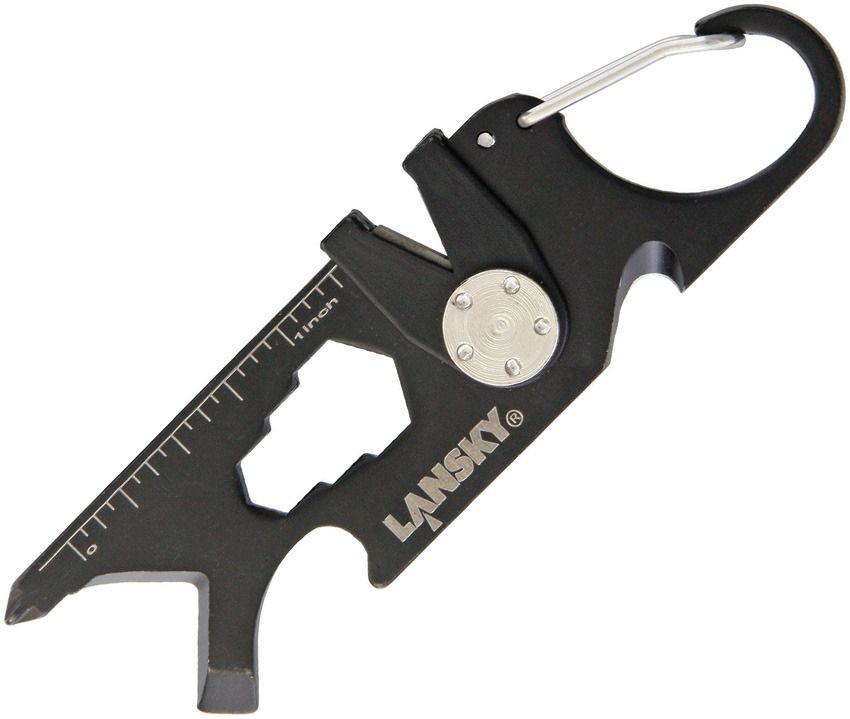
Yes. The manufacturer lists a carbide sharpener, two screwdrivers, a variable hex wrench, bottle opener, pry tool, line cutter, carabiner and ruler. The carabiner is only a carry attachment: Lansky explicitly warns not to use it for climbing or load-bearing.
Explore this need in the finder →Can I use the Roadie as a serrated-knife or fine-finishing system?
The exact product description documents a single carbide slot and does not identify a serration-specific element or a second finishing abrasive. Do not assume the slot sharpens serrations or reproduces the separate ceramic, serration and diamond tasks of Lansky’s Blademedic.
Explore this need in the finder →This assessment is based on Lansky’s current ROAD1 product record and instructions, not a hands-on test. The Roadie is unusual because its sharpening feature is one part of a small carry multi-tool, rather than a dedicated bench or clamp system.
What the ROAD1 combines
Lansky calls the Roadie a 9-in-1 keychain knife sharpener. The published list includes a tungsten-carbide sharpening slot, flat-head and Phillips screwdrivers, a variable hex wrench, bottle opener, pry tool, line cutter, carabiner and ruler. That combination is the product’s most distinctive proposition: it pairs a basic sharpening operation with several other carry functions. The page describes lightweight metal construction but does not provide dimensions or a weight, so this assessment does not assign it a measured size or mass.
The carabiner is for attaching the tool to a keychain or pack, not for safety or climbing use. Lansky explicitly warns that it is not to be used for climbing or load-bearing. The point matters because a compact tool can invite assumptions about hardware that the maker specifically rules out.
One fixed carbide slot sets the sharpening brief
The Roadie has a single sharpening path: a tungsten-carbide pull-through slot set at 22.5° per side, which the manufacturer describes as a 45° inclusive angle. It is a fixed geometry, not an adjustable guide or a choice among multiple bevel positions. The public product instructions say to set the sharpener on a solid, flat surface, hold it firmly, keep fingers away from the edge, draw the knife through the grey slot three or four times with moderate pressure, and then clean the edge.
That is enough information to understand the intended routine, but not to promise compatibility with every pocket knife. The maker does not publish a blade-length limit or a material-by-material compatibility chart on the exact product record. A knife’s existing bevel and shape still matter; the displayed 22.5° is a capability description, not a recommendation to change a blade to that angle. In particular, do not infer that a narrow or unusually shaped blade will sit properly in the slot just because the category says portable.
The source identifies carbide but does not specify its grit or pair it with a finer finishing abrasive. Buyers looking for a controlled coarse-to-fine progression, a separate ceramic stage, a dedicated serration tool or multiple angle settings should not read those capabilities into the ROAD1. Its official feature list describes one slot. The page does not provide a serration-specific method, either.
Who may value the combination
The Roadie is most compelling on paper for a carry-focused task: someone wants an available way to draw a compatible plain edge through a fixed carbide slot and also values the listed screwdriver, wrench, opener, pry, line-cutter and ruler functions. Its manual operation avoids a motor and electrical setup. The trade is that the sharpener itself is not a broad sharpening system: no angle adjustment, additional abrasive stages, case, clamp or guide-rod arrangement is documented for this SKU.
For a sharper distinction, the Lansky Blademedic assessment covers a different portable design. PSMED01 includes separate carbide and ceramic pull-through operations, plus a serration element and tapered diamond rod; those extra elements do not belong to the Roadie. A guided three-stone system is a more involved home workflow, with a clamp, guide rods and several abrasives, rather than a keychain tool. These comparisons are about documented arrangements and supplied parts, not comparative performance testing.
Read the instructions as a safety checklist
The Roadie’s instructions are deliberately brief, so the buyer should treat the setup steps as part of the product choice. Use a stable, flat surface; hold the sharpener securely; keep fingers clear; and use the moderate pressure Lansky specifies rather than forcing the blade. The manual’s three-to-four pass direction is specific to the carbide slot. It does not establish a general stroke count for other sharpeners, blades or abrasive methods.
The maker’s product page also stops short of specifying an included case, blade-clearance range, fine finishing routine or care interval. If one of those is essential, verify the exact package or choose a design whose own documentation explicitly supplies it. A compact all-in-one tool may reduce the number of objects carried, but it does not remove the need to check the fixed slot against the particular knife.
Bottom line
The Lansky Roadie is best understood as a carry multi-tool with a simple, fixed-angle carbide knife slot—not as a small version of a complete sharpening kit. Consider it when the extra tools and one preset sharpening path meet the job. Look elsewhere when a knife requires a different angle, a finer progression, documented serration care or a more controlled home setup. The exact identifier to check is ROAD1; current catalogue presence is not a claim about a seller’s stock or the condition of a particular offer.
Key specifications
Key details at a glance
| Power | Manual |
|---|---|
| Sharpening format | Manual keychain multi-tool with one fixed tungsten-carbide pull-through sharpening slot |
| Lowest angle setting | 22.5° |
| Highest angle setting | 22.5° |
| Included abrasive surfaces | One tungsten-carbide sharpening slot; grit not stated |
| Benchtop base included | No |
| Angle-guide positions | 22.5° |
Use the exact model’s instructions for operating limits, supplied equipment and version differences.
Sources for this review
Sources for this assessment

Check the requirements that matter to you
Use the finder to compare documented sharpener formats and limits; an unknown capability is not treated as a match.