
Your needs, this model
Does it fit your priorities?
Is the LDPST a coarse/fine two-grit stone because it has two faces?
No. The exact page describes a fine 600-grit diamond sharpening surface on both sides. It does not assign different grits to the two faces or document a coarse-to-fine sequence; the two sides provide working surface, not evidence of two abrasive stages.
Explore this need in the finder →Should oil or water be used on the Diamond Pocket Stone?
The exact LDPST directions say lubrication is not recommended with this diamond stone. Follow that model-specific instruction rather than transferring the oil directions of the separate LSAPS natural Arkansas stone. The product page does not specify an alternate wet method.
Explore this need in the finder →Does its groove establish serrated-knife compatibility?
No. The exact page assigns its groove to fish hooks or other pointed objects, and separately describes a flat-face full-edge blade stroke. It gives no serration, scissors, knife-type or named-blade compatibility procedure; the pocket name alone is not treated as proof of a pocket-knife use class.
Explore this need in the finder →This research-based assessment covers Lansky's exact U.S. Diamond Pocket Stone, SKU LDPST, from its own manufacturer description and directions. The page calls it a 1 × 3-inch sharpener with a fine 600-grit diamond surface across both sides, a groove for hooks or other pointed objects, and a leather carrying pouch. The maker directs the user to guide the edge by hand and says lubrication is not recommended. The exact LDPST page supplies those model-specific details. The assessment does not claim to own, test or measure the stone.
Two working faces, one stated abrasive grade
The page describes the diamond surface on both sides as Fine 600 grit. Two faces therefore do not make a coarse/fine pair: Lansky assigns neither side a different grade nor a required progression. The product page's 1 × 3-inch description does not clarify whether those numbers refer to the full body or exposed abrasive face. A second gallery image labelled “Dimensions” is an unlabeled outline and adds no numerical clarification.
The LDPST name includes “Pocket,” but its exact product description does not name pocket knives or hunting knives. The instructions refer to a blade edge and describe a full-edge stroke without specifying a knife class, blade thickness or clearance. This review therefore treats pocket as a portable format label, not a documented pocket/hunting compatibility promise. It is an individual stone, not a clamp, angle-guide system or multi-hone kit. A knife with an essential specified bevel setting requires other evidence than this page provides.
Hand-guided use and lubrication
For the knife procedure, Lansky tells the user to set the blade edge against the stone's flat side, maintain a consistent angle and even pressure, and gently push across the full edge in a single stroke. The maker suggests three to five strokes and repeating on the blade's reverse side, then continuing until sharp. The angle remains in the user's hands: no degrees, marked guide, adjustable position, increment or per-side/inclusive convention appears in the exact record. Those instructions tell you how the manufacturer describes the motion, not how long a particular knife will take or what edge it will produce.
The product has a different pointed-object route: use its sharpening groove for fish hooks or other pointed objects. The product text does not map the groove to a size or describe sharpening scalloped serrations. Nor does it provide a scissors procedure. That distinction matters because a slot for hooks is not evidence of a guided serration technique, and the flat-face knife stroke should not be generalized to every edge geometry. For safety, keep the blade under deliberate control and follow the maker's caution that a careless blade can injure the user.
The manufacturer specifically says that lubrication is not recommended with its diamond stones. That is the relevant care note for LDPST; it differs from the oil direction for the separate natural-stone LSAPS Pocket Arkansas Stone. Do not transfer one model's care steps to the other merely because both are small pocket-format products. The LDPST listing says it comes with a leather pouch; a pouch is not a leather strop, and the page does not give a complete seller-specific package inventory.
What the fine diamond format does—and does not—establish
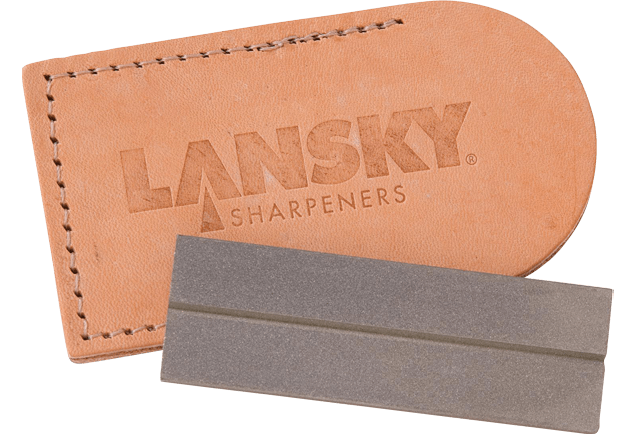
Lansky calls the abrasive Fine 600 grit. The product page does not state a second grit, a sharpening schedule, a recommended progression with another model, or a comparative cutting-rate test. It also does not identify a steel-hardness range, edge-damage threshold or a named blade model. A buyer can compare the documented configuration—both faces are the same stated grade—but should not turn that information into a guaranteed finish or time saving. The image shows a dark rectangular stone and branded pouch, not the exact dimensions, package completeness or compatibility with an individual knife.
The contrast with LSAPS is practical rather than a claim of superiority: LSAPS is natural Arkansas novaculite listed at 200–350 grit and its directions specify honing oil; LDPST is a diamond stone listed at Fine 600 grit and its instructions do not recommend lubrication. The maker gives LDPST a full diamond surface on both faces, while LSAPS describes a flat blade face plus two grooves. Both leave the bevel angle to the user and provide a separate groove task for pointed objects, but their materials, stated grit descriptions and care instructions are not interchangeable.
Buying checks
Confirm the exact LDPST SKU and the maker-listed Fine 600-grit version rather than a similarly named stone. If 1 × 3 inches is critical for a case or workspace, ask the seller or consult a clearer exact-model dimension source: the product text does not distinguish body dimensions from active-face dimensions. If your task requires a named kitchen or hunting knife, a specific numeric angle, serration work, scissors, or an included strop, the source record does not verify that condition. Check the actual seller's offer and return terms when the pouch or any other package item matters; the manufacturer's image is not a retailer box checklist.
For an angle-controlled workflow, Lansky's separate LK3DM 3-Stone Standard Diamond System is a clamp-and-guide package, not an LDPST accessory. For a freehand natural-stone alternative, compare the LSAPS assessment and its oil step; neither comparison establishes which abrasive works better on a particular knife.
Bottom line
LDPST is a pocket-format, manual diamond stone with two working faces of the same stated Fine 600-grit grade, a groove for hooks or other pointed objects, and a stated leather pouch. Its exact use routine leaves angle and pressure to the user, and lubrication is not recommended. The strongest reasons to compare it are the double-sided full diamond surface and the maker's explicit single-grade/care description. Important gaps remain around named knife type, exact angle, clearance, serrations, scissors and the basis for its listed dimensions. Treat those as unknowns rather than filling them with assumptions from another Lansky product. No hands-on results, seller availability, price, ranking or customer report is asserted.
Key specifications
Key details at a glance
| Power | Manual |
|---|---|
| Sharpening format | Hand-held freehand 1 × 3-inch fine diamond stone with full diamond coverage on both sides, a separate pointed-object groove, and user-controlled angle |
| Included abrasive surfaces | Fine 600-grit diamond surface on both sides of the stone / One groove for fish hooks or other pointed objects |
| Angle-guide positions | ° |
Use the exact model’s instructions for operating limits, supplied equipment and version differences.
Sources for this review
Sources for this assessment

Check the requirements that matter to you
Use the finder to compare documented sharpener formats and limits; an unknown capability is not treated as a match.