
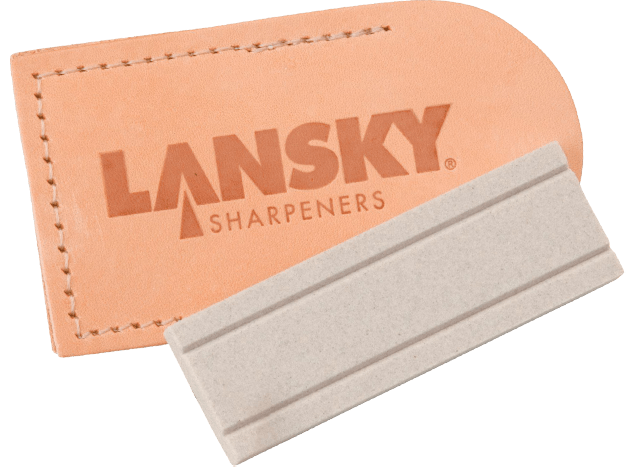
Your needs, this model
Does it fit your priorities?
Does the Pocket Arkansas Stone set or preserve a numeric bevel angle?
No numeric angle, marked position or range appears in the exact instructions. The user is told to keep a consistent angle and even pressure during a full-edge stroke, so a specific degree requirement is not supported by this source.
Explore this need in the finder →What preparation does Lansky specify for the Arkansas surface?
Its exact instructions say to apply a few drops of Nathan's Honing Oil to the stone surface before sharpening. The product record does not say that a bottle of oil is included, name an alternate lubricant, or give a seller's package inventory; the stated leather pouch is a carrying pouch, not a honing oil or leather strop.
Explore this need in the finder →Are the two grooves a serration sharpener?
The exact page assigns the two grooves to fish hooks or other pointed objects and describes a separate flat-face blade stroke. It does not supply a serration, scissors or non-knife-tool procedure beyond those pointed objects, and the word pocket does not itself establish a pocket-knife compatibility class.
Explore this need in the finder →This research-based assessment covers the exact U.S. Lansky Pocket Arkansas Stone, SKU LSAPS, using its own product description and instructions. It is a hand-guided natural-stone tool, not one of Lansky's clamp-and-guide systems. The manufacturer describes an Arkansas novaculite stone, states a 200–350-grit range, identifies two grooves for fish hooks or other pointed objects, and says a leather pouch is supplied. Those attributes make it distinct from the similarly named Diamond Pocket Stone, LDPST. The exact LSAPS product page is the primary source for the configuration and routine. This is a source-based assessment, not a report of ownership, sharpening trials or measured results.
One natural stone, not a staged system
The product record names the stone as Arkansas novaculite and gives the range as 200–350 grit. It does not break that range into separate hones, define a required progression, or describe a second abrasive stage. A shopper comparing this with a multi-hone kit should therefore think in terms of one stone and one hand-controlled face, rather than assume the kit's coarse-to-fine sequence transfers. Lansky's separate LKNAT Natural Arkansas System is a clamped kit with several hones and marked guide positions; it is a different product and does not give LSAPS a numeric angle guide.
The phrase “Pocket Arkansas Stone” is also not enough, on its own, to classify the stone for a particular pocket or hunting knife. The exact instructions refer generically to a blade and a full-edge stroke. They do not name pocket knives, hunting knives or a blade-clearance limit. The compact product name and pouch speak to format, not a guarantee that every folding knife can be presented safely or at its existing bevel. The quiz's pocket/hunting category is deliberately not inferred from the product name alone.
What the maker's instructions actually ask you to do
For the blade task, the manufacturer says to put a few drops of Nathan's Honing Oil on the stone, place the blade edge against the flat side, and make a gentle push that travels across the whole edge in one stroke. The instruction compares the motion to slicing a thin layer from the side of the stone. It calls for three to five strokes and repeating on the reverse side, then continuing as needed. The user—not a clamp or marked angle slot—must keep the angle consistent and pressure even. If reproducing a numbered bevel is essential, this page offers no degree value, range, increment or explanation of whether an angle is per side or inclusive.
The pointed-object operation is separate. Lansky says to use the hollow line to sharpen fish hooks or other pointed objects. The description says there are two special grooves on one face; it does not map either groove to a hook size or offer a serrated-blade/scissors procedure. A groove for a pointed object should not be treated as a scallop guide. The included pouch is useful as an identified carrying accessory, but it is not a leather stropping hone. No strop is listed in the product description, and the exact record does not give a complete retailer-specific box inventory or say that oil is included.
Where its limitations matter
This format puts several judgments on the user: choosing the existing bevel, controlling the movement, applying the stated oil, and deciding whether a single maker-stated 200–350-grit stone suits the edge's condition. The listing provides no numeric angle, adjustment mechanism, clamping fixture, blade-size chart or knife-specific technique. A second gallery image is labelled as dimensional but presents an unlabeled outline, so it establishes no numeric stone size.
The 200–350 figure is the manufacturer's grit range, not a measured removal rate or a promise of a particular finish. The product page does not give a comparison test against a diamond abrasive. It does say to use honing oil; the separate LDPST Diamond Pocket Stone has different care advice and should not inherit LSAPS's oil step. Its exact record calls it a fine 600-grit diamond stone, with full diamond surface on both sides and lubrication not recommended. Neither model's number should be translated into a claimed sharpening time or result without evidence.
Practical checks before choosing it
First compare the knife's own edge guidance with LSAPS's freehand method: there is no fixed setting to reproduce the bevel for you. Next confirm that the maker-stated oil routine is workable and that the exact offer includes any pouch or accessories you expect; a product photo is not a complete seller-package list. If a defined knife category, serrated procedure, scissor capability, exact angle, or numeric fit clearance is non-negotiable, the published LSAPS record leaves that need unanswered rather than proving a match.
For a contrast within the pocket-stone format, the LDPST is a double-sided diamond stone with one stated Fine 600-grit grade and no recommended lubrication; LSAPS instead is the natural Arkansas stone with the 200–350 range and an oil instruction. The LKNAT is the relevant comparison when a shopper is looking for Lansky's different multi-hone guided system. These distinctions are about documented materials, setup and care—not a ranking or claim that one will sharpen faster.
Bottom line
LSAPS is a compact, manual Arkansas stone whose exact record supports a user-guided full-edge blade stroke and a separate fish-hook/pointed-object groove task. The one product-specific care instruction that stands out is to apply a few drops of honing oil. Its tradeoffs are equally concrete: no numeric angle setting, no documented knife-use class beyond the generic blade directions, no published size in text, and no separate serration or scissor procedure. It may suit someone seeking a small freehand stone who accepts those limits, but the source does not establish fit for every pocket knife or a particular edge. No hands-on performance, seller availability, price, ratings or customer experience is claimed here.
Key specifications
Key details at a glance
| Power | Manual |
|---|---|
| Sharpening format | Hand-held freehand arkansas stone: use its flat face for a full-edge blade stroke and two separate grooves for hooks or other pointed objects; the user controls the angle |
| Included abrasive surfaces | One Arkansas novaculite stone; the manufacturer states a 200–350-grit range / Two grooves for fish hooks or other pointed objects |
| Angle-guide positions | ° |
Use the exact model’s instructions for operating limits, supplied equipment and version differences.
Sources for this review
Sources for this assessment

Check the requirements that matter to you
Use the finder to compare documented sharpener formats and limits; an unknown capability is not treated as a match.