
Your needs, this model
Does it fit your priorities?
Does the Folding Field Sharpener have a 20° sharpening guide?
Yes. Its exact package lists a 400-grit diamond plate with 20° sharpening guides and a fine ceramic face with separate 25° honing guides. These are discrete positions, not a continuous numeric range.
Explore this need in the finder →Does the package include a leather strop or replaceable abrasive faces?
No. The current box list names only the diamond plate, ceramic plate and pocket clip; the manufacturer FAQ says the abrasive surfaces are permanently adhered and identifies the clip as the replaceable part. A buyer who needs a strop or replaceable plates should compare another package.
Explore this need in the finder →Does Work Sharp identify the Folding Field Sharpener for scissors?
Its product FAQ says the tool can be used on scissors, while the one-page user guide explains a knife sharpening sequence rather than a detailed scissor setup. Confirm tool geometry and safe handling with the manufacturer if scissors are the main job.
Explore this need in the finder →A folding two-surface field tool
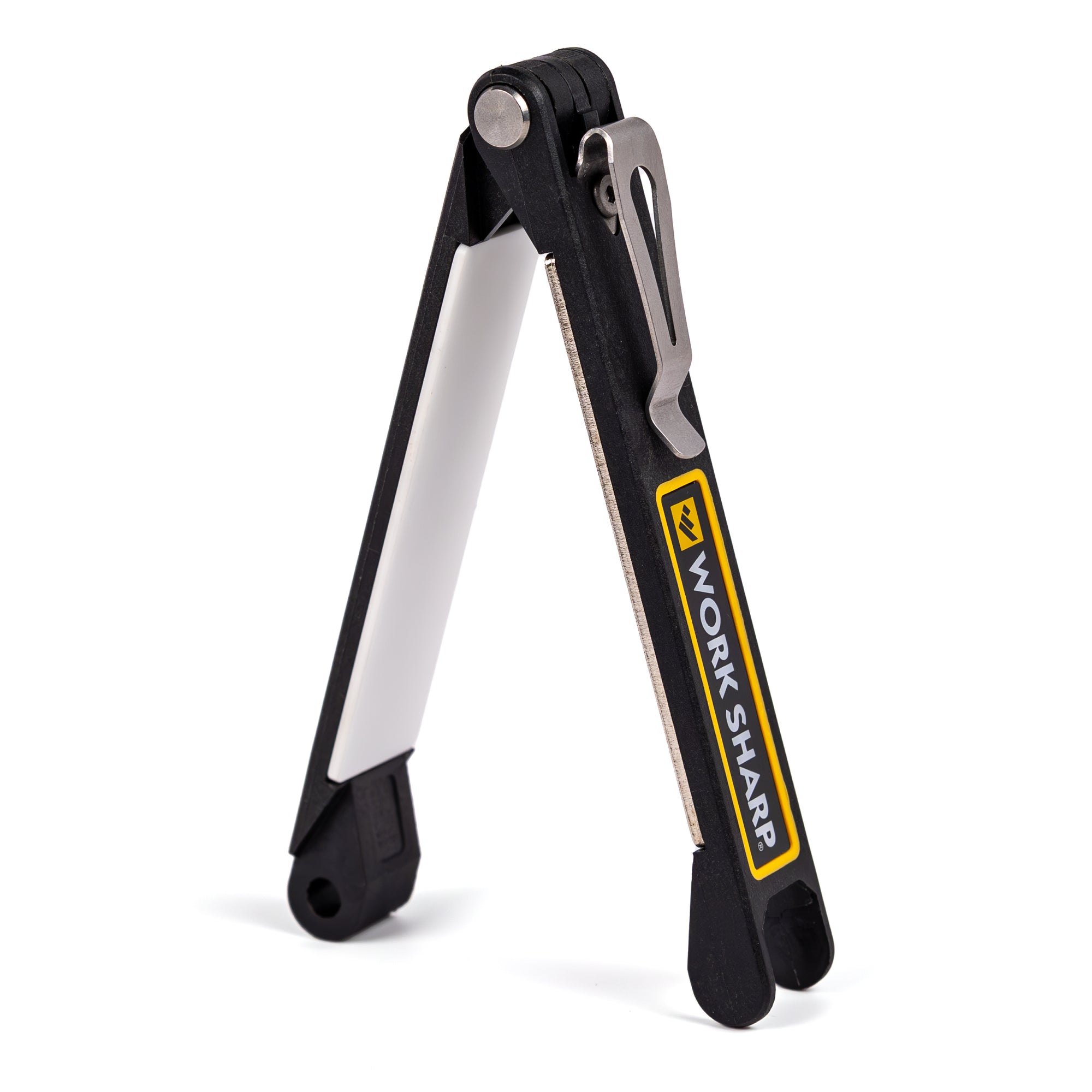
The Work Sharp Folding Field Sharpener (SKU WSEDCFFS) uses a hinged body and pocket clip to carry a small diamond plate and a fine ceramic plate together. The current manufacturer box list names a 400-grit diamond plate with 20° sharpening guides, a fine ceramic face with 25° honing guides and the clip. This is a different proposition from the larger Guided Field Sharpener: it folds for carry, but its exact package does not list a leather strop, separate serration rod, several diamond grits or a carry case.
Its appeal is the small, ready-to-pack format and a simple progression from a diamond plate to a ceramic hone. The same compact layout also limits what it can do. There are only two abrasive surfaces, and the official FAQ says the diamond and ceramic are permanently adhered; it identifies only the pocket clip as replaceable. A buyer who expects to refresh the abrasive faces independently should treat that as a significant ownership tradeoff.
20° sharpening and 25° honing are separate positions
The product listing specifies a 20° guide for sharpening on the 400-grit diamond and a 25° guide for honing on the ceramic face. The one-page instructions show alternating strokes and warn against excessive pressure when drawing the blade toward the user. The two guide marks are discrete; they are not a dial or a continuous 20°–25° range. Our numeric finder leaves this model out when a shopper requires an exact numerical setting because the generic range rule cannot safely represent two distinct positions or identify the different task attached to each position.
That conservative limitation is separate from the manufacturer's supported-use claims. The official product page is oriented to pocket, hunting and field carry and its FAQ says the tool can be used on kitchen knives and scissors as well. The instructions explain a knife-sharpening method, not a detailed scissor setup, so anyone planning scissor work should consult the manufacturer for the exact tool geometry rather than assuming the knife-guide labels carry over to scissors.
What it does not bring along
The standard Folding Field Sharpener package does not list a leather strop, powered motor, clamp, serration-specific rod, replacement diamond plate or replacement ceramic plate. The manual shows a diamond-to-ceramic knife sequence; the product FAQ extends use to scissors and other bladed or pointed tools such as garden shears, fishhooks and broadheads, but the one-page instructions do not give a separate process for each of those tools. The broadest FAQ claim should not be read as proof that every blade profile or condition is a good candidate.
The absence of a serration method matters if your main task is scalloped blades. A flat diamond plate or ceramic face may contact part of a serrated edge, but the reviewed exact package does not document a dedicated rod or procedure for following the scallops. The finder therefore does not match this model to an essential serrated-use request. Likewise, it will not meet a requirement for a leather strop included in the exact package; the manufacturer lists no strop in the box.
Care and safe handling
Work Sharp's instructions say the ceramic plate can be cleaned with warm water and dish soap. The product page describes using the ceramic hone without water or oil during sharpening, which should not be confused with cleaning after use. The manual directs the user to hold the opposite handle while sharpening on either side, use light pressure on strokes coming back toward the body and maintain full control of the blade. Read those instructions before use, particularly because a compact tool can put the user's hands close to the cutting edge.
Because the abrasives are fixed to the folding body, there is no rotating face or grit change to stretch the kit into a broad progression. The 400-grit diamond can restore an edge according to the maker's directions, while the ceramic plate refines or maintains it; neither description means that an unskilled user should remove substantial steel from an unfamiliar blade. Check the existing bevel and knife maker's advice before changing geometry.
Who should compare this model
Consider WSEDCFFS if an ultra-compact manual tool, two marked guide positions and pocket carry matter more than a replaceable abrasive set or a multi-stage kit. Compare it with the Guided Field Sharpener for a strop and serration rod, or with the Benchstone if a bench base and separately replaceable faces are important. Check the exact SKU and package before purchase, and do not treat its 20°/25° marks as a substitute for a verified range or knife-specific angle advice.
Key specifications
Key details at a glance
| Power | Manual |
|---|---|
| Sharpening format | Manual folding diamond ceramic plate |
| Included abrasive surfaces | 400-grit diamond plate / fine ceramic plate |
| Strop included | No |
| Use dry (no oil or water) | No |
| Angle-guide positions | 20 / 25° |
Use the exact model’s instructions for operating limits, supplied equipment and version differences.
Sources for this review
Sources for this assessment
Check the requirements that matter to you
Use the finder to compare documented sharpener formats and limits; an unknown capability is not treated as a match.