
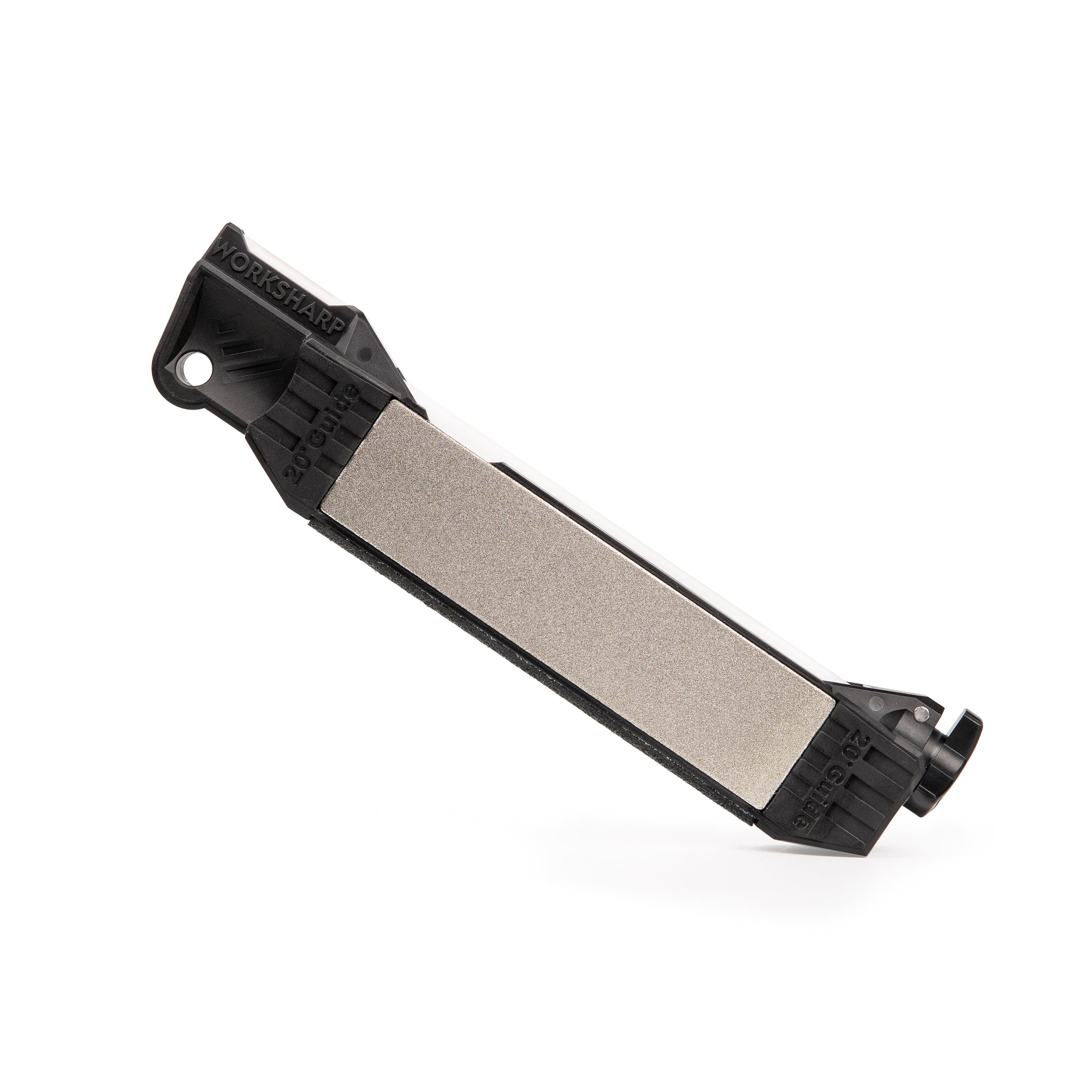
Your needs, this model
Does it fit your priorities?
Is the Blackout a different functional sharpening system from WSGFS221?
The SKU page calls out the black finish, and its box list names the same standard 220/600 diamond plates, ceramic rods and leather strop. The reviewed sources do not document a different angle guide, mechanism or abrasive progression; compare WSGFS221 if finish is not important.
Explore this need in the finder →Does the Blackout's page title guarantee the GFS Elite package?
No. The exact Blackout SKU is WSGFS221-BLK, and its in-box list does not include the Elite's separate 400/800 diamond plates or zippered case. Confirm the exact SKU and listed pieces instead of relying on the contradictory phrase “Elite Blackout Edition.”
Explore this need in the finder →Can I set the Blackout to any angle between 20° and 25°?
The product lists 20° and 25° guides for different sharpening and finishing tasks. These are discrete positions, not evidence of intermediate settings, so the numeric finder leaves exact angle support unknown.
Explore this need in the finder →What WSGFS221-BLK actually changes
Work Sharp lists this version as Guided Field Sharpener Blackout | Reserve Series, SKU WSGFS221-BLK. Its box contents are the same named functional parts as the standard WSGFS221: coarse 220- and fine 600-grit diamond plates, a fine ceramic rod with a hook groove, a ceramic serration rod, a leather strop and a broadhead wrench. The visible difference is the black finish. The reviewed sources do not document a different motor, sharpening mechanism, angle guide, abrasive progression or serration attachment.
That distinction is worth making because the product page also contains copy calling it an “Elite Blackout Edition,” while the exact SKU page's own box list does not include the Elite kit's added 400- and 800-grit plates or zippered case. For package matching, the SKU and the in-box list are more specific than the stray family-level marketing phrase. Check the seller's exact label and included parts if the offer uses “Elite,” “Reserve” or “Blackout” loosely.
The basic operating decision is unchanged
Like the standard model, the Blackout is manually held or placed on a stable surface rather than clamping the knife. The manufacturer's shared user guide describes a 20° diamond sharpening guide, a 25° guide for honing and stropping, and a separate ceramic-rod method for serrations. These are discrete operations and positions, not a continuously adjustable 20°–25° angle range. Our numeric matcher does not translate those marks into a numeric range, so an exact-angle requirement is not claimed for this product.
For serrated blades, the manual directs the user to choose an appropriate ceramic rod size, match the bevel and work each serration with short strokes. That is different from sliding the whole serrated edge across the flat diamond plate. The page's broad field-use claims should not replace the manual's route-specific procedure. Nor does the supplied broadhead wrench establish that the package sharpens every hunting tool or point.
Same set of stages, same maintenance responsibilities
The package keeps the standard field sharpener's combination of 220/600 diamond, ceramic and leather. Work Sharp's guide advises using the coarse diamond for chips, changing the bevel or sharpening tools, with finer surfaces for honing and touch-ups. This is a manufacturer plan, not a universal grit prescription. One sentence on the shared product page says “200” grit, but its exact box list and manual say 220; confirm the package marking if that discrepancy matters to your replacement-plate order.
Ownership chores are the same as the standard version: keep the ceramic and body clean as instructed, remove and clean the diamond plates according to the guide, and keep the leather strop clean and lightly oiled when it dries. The manual recommends holding the tool by its handle or using a flat, stable surface and warns about controlling the knife, especially on a stroke toward the user. There is no clamp to take over that responsibility.
How to compare it with nearby versions
For functional capability, compare WSGFS221-BLK directly with the standard Guided Field Sharpener. The reviewed package evidence points to the same sharpening arrangement; the black colorway is not a reason to expect a different edge angle or abrasive result. If you need a broader plate progression and a protective case, the Guided Field Sharpener Elite is the functional step-up in the documented family, with separate 400- and 800-grit plates and a zippered case. If you want a smaller folding tool with just a diamond plate and ceramic face, compare the Folding Field Sharpener; its package omits both this kit's strop and serration rod.
The Reserve Series label and black finish may matter to a buyer who values appearance or matching gear, but the source records do not establish an upgrade to the working system. Avoid paying for a supposed abrasive or guide change unless the specific seller package actually shows it. The current product page's box list is a better cross-check than a title fragment copied from a different version.
Fit depends on the knife and the way you work
Consider this model when you want the standard manual field-sharpener feature set in an all-black body. It is a poor substitute for a guided clamp if you require a blade held in a fixed jig, and it cannot satisfy a hard need for a documented continuous numeric angle range. A maker's angle mark only answers which guide position is built into the tool; it does not prove the knife should be reshaped to that geometry. Check the exact SKU, box list, replacement abrasive availability and knife-specific instructions before selecting the Blackout over the standard product.
Key specifications
Key details at a glance
| Power | Manual |
|---|---|
| Sharpening format | Manual portable diamond ceramic field system |
| Included abrasive surfaces | 220-grit coarse diamond plate / 600-grit fine diamond plate / three-position ceramic rod / ceramic serration rod / leather strop |
| Strop included | Yes |
| Use dry (no oil or water) | No |
| Angle-guide positions | 20 / 25° |
Use the exact model’s instructions for operating limits, supplied equipment and version differences.
Sources for this review
Sources for this assessment
Check the requirements that matter to you
Use the finder to compare documented sharpener formats and limits; an unknown capability is not treated as a match.