
Your needs, this model
Does it fit your priorities?
How do the Model 4643's 15° and 20° paths work?
The manual assigns a double-bevel 15°-class knife to Stage 1 and then Stage 3; a 20°-class knife starts in Stage 2 and also finishes in Stage 3. It warns against using the other sharpening slot for each path. Those are distinct maker-labelled fixed paths, not a continuous dial range. The exact secondary bevel at Stage 3 and whether the angle labels mean per-side or total angle are not made explicit, so compare the exact manual with the knife maker's edge instructions before using an abrasive system.
Explore this need in the finder →Can Model 4643 sharpen serrated knives?
Yes, its own manual assigns serrated blades to the Stage 3 Polishing & Serrated slot. For ordinary use it gives five back-and-forth stroke pairs, followed by inspection and at most another five if needed. For a very dull serrated blade it calls for two pairs in Stage 2 before Stage 3; it cautions that repeated Stage 2 work can quickly remove metal. This procedure has no numeric angle, and the manual says a serrated edge will not look or cut just like a straight edge. Do not transfer its 15°/20° plain-edge labels to serrations.
Explore this need in the finder →What knife types and tools are outside the Model 4643 instructions?
The instructions say not to use the ProntoPro on a single-sided, single-faceted Asian knife such as a sashimi blade, say it is not recommended for ceramic knives and expressly prohibit scissors. The product and manual identify it for ordinary double-bevel kitchen knives, pocket knives and most sporting knives, but the available sources state no maximum blade length, width, thickness or bolster clearance. Confirm those physical details for the exact knife instead of inferring universal fit from the broad model description.
Explore this need in the finder →What package and ownership details should I verify?
The official Model 4643 page and its linked manual identify the sharpener and its three stages, but they do not establish a complete seller-specific box list, an included leather strop or replacement-disk availability. Stage 3 honing is part of the sharpener, not evidence of a separate leather strop. The manual describes wiping the exterior with a damp soft cloth, periodically tapping out metal dust and using no lubricating oil; it does not establish every wet/dry-use condition. Check the exact SKU, seller condition, return terms and warranty eligibility, especially if a particular accessory or maintenance option is essential.
Explore this need in the finder →Chef'sChoice's current US product page identifies the AngleSelect Professional Manual Knife Sharpener as Model 4643, SKU 4643009. This is a source-based assessment of that exact configuration and its linked instructions, not a report of ownership or hands-on use. Its main distinction is a three-slot body that separates the maker-labelled 15°-class and 20°-class straight-edge routines, then uses a shared third stage for finishing. A serrated blade has a different procedure again.
Three marked slots, but not three passes for every knife
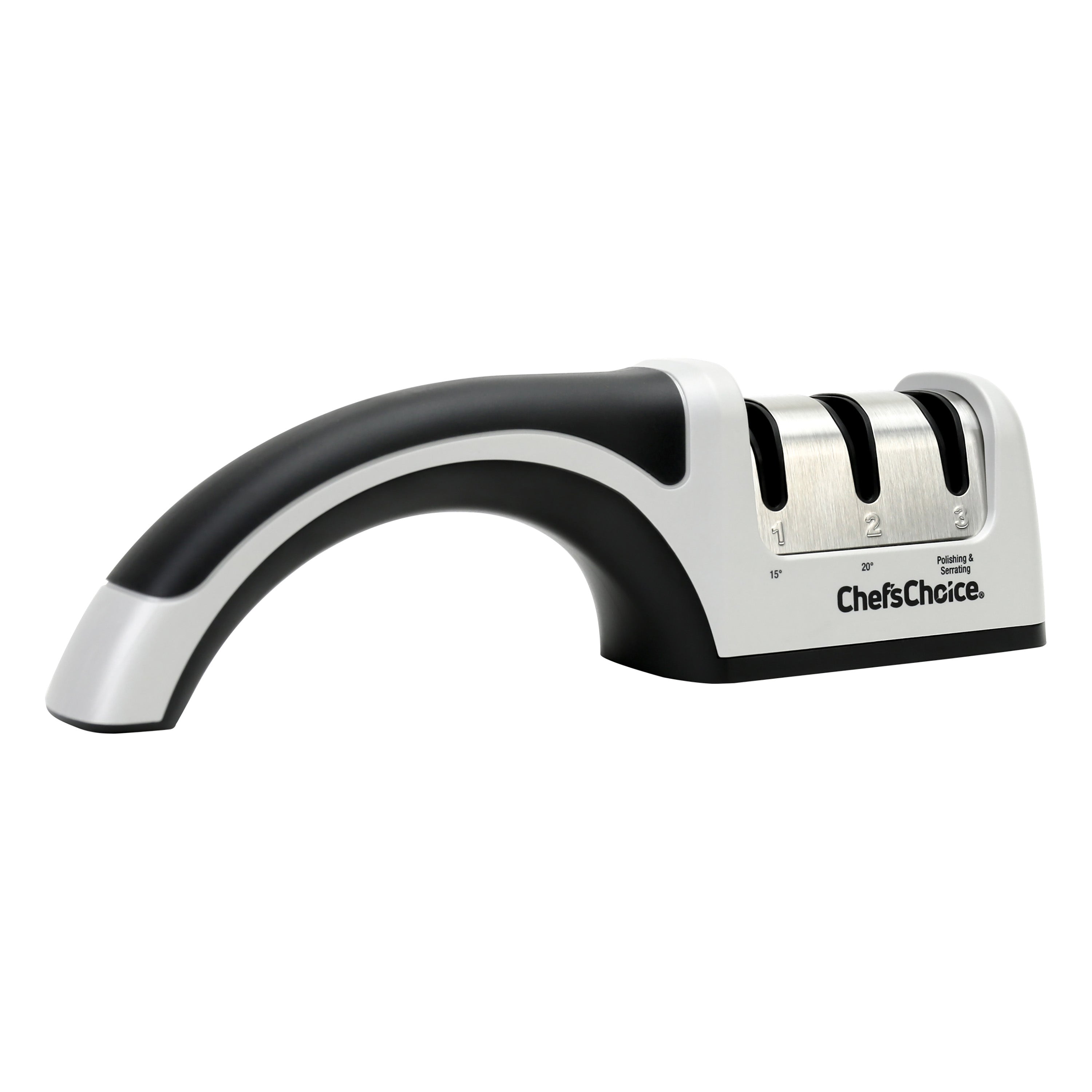
The Model 4643 is easy to misread as one routine that runs through every slot. Its manual instead assigns different entry stages to different edge classes. The 15°-class double-bevel path begins in Stage 1, marked Asian; the 20°-class path begins in Stage 2, marked Euro/American. Both then use Stage 3 for honing and polishing. The manual specifically says not to put a 15° knife through Stage 2, and not to start a 20° knife in Stage 1. That routing—not merely the presence of three openings—is the core purchasing decision.
Both sharpening stages use paired diamond-coated disks, and the instructions say that both sides of the edge are shaped together. Stage 3 adds a small second bevel, but the manual does not give it an exact angle. The maker's manual and product page consistently describe separate 15° and 20° classes, yet do not plainly state whether these numbers are measured per side or as the total included angle. A knife owner should not infer that convention from another sharpener, a product image or the word “AngleSelect.” Check the knife maker's own edge guidance before removing material.
What the hand-guided routine asks of the user
The instructions ask the user to hold the sharpener on a table, center and level the blade, and move it in a controlled sawing motion. They specify about four to five pounds of downward force in Stages 1 and 2, lighter pressure in Stage 3, and listening for the disks to turn. Those are maker directions, not a prediction of a particular person's comfort or result.
Stroke counts are conditional examples, not guarantees. A knife that is not very dull may need about ten or fewer pairs in its assigned sharpening stage; a very dull one may need twenty or more while its old edge is reshaped. A paper check precedes Stage 3 finishing. Consider whether you are comfortable choosing the right slot and maintaining a consistent stroke, rather than treating these examples as a quick-result promise.
Serrations use a separate path
Stage 3 is also marked for polishing and serrations. For a serrated edge, the Model 4643 manual calls for five paired strokes in that slot, inspection, and another five only if needed. Its sequence for a very dull serrated blade starts with two pairs in Stage 2 before Stage 3. The manual warns that excessive Stage 2 strokes can remove metal quickly and notes that serrations will not look or cut exactly like a straight edge. This task has no numerical angle specified; neither the 15° nor 20° straight-edge label should be carried over to it.
This is a meaningful difference from the adjacent Pronto Model 463. The Model 463 has a fixed 15°-per-side primary-facet procedure and gives its serrations a Stage 2 routine, whereas Model 4643 separates its plain-edge work between 15°-class Stage 1 and 20°-class Stage 2, with serrations at Stage 3. The similar brand and slot format do not mean their work sequences are interchangeable. Read the manual for the exact model in hand.
Check edge geometry and excluded tools
The Model 4643 product page and manual describe conventional double-bevel kitchen cutlery, pocket knives and sporting knives. The manual expressly says not to use it on single-sided, single-faceted Asian blades such as sashimi knives. It also says the tool is not recommended for ceramic knives and prohibits scissors. Those are real limits, not caveats to wave away because the product page has a broad “most knives” description.
The sources give no maximum blade length, width, spine thickness, bolster clearance or handle clearance. For an unusually broad, thick, flexible or obstructed blade, ask the maker about the exact geometry rather than assuming a general “knife” label confirms physical fit.
Maintenance, package and lifecycle checks
The instructions call for wiping the exterior with a damp soft cloth, tapping out metal dust periodically and using no lubricating oil; they do not establish every wet/dry condition. Stage 3 honing is built in, not proof of a separate leather strop in the seller's box. A complete package list, replacement-disk availability and strop inclusion remain unconfirmed. Check the exact SKU and seller terms; the cited maker page states a one-year limited warranty, but an individual offer may differ.
The product page and manual-category listing identify Model 4643 as a consumer manual sharpener; the maker's Warranty & Manuals index places it in the manual-sharpener section. That establishes a current-reference identity, not a claim about a particular seller's inventory or condition. Keep it distinct from Model 463, the Model 445 and 478 fixed-slot products, and commercial Model 465.
Who should compare it
Compare the Model 4643 when a hand-guided diamond sharpener with separate 15°-class and 20°-class double-bevel paths is useful, or when its documented Stage 3 serration method fits the task. The included three-slot architecture puts the 15° and 20° sharpening routes together, but they remain discrete choices rather than an adjustable continuous range. For comparison, the Pronto Model 463 is a smaller fixed-15°-per-side discussion with a different serration sequence; the Model 445 and Model 478 are separate 20°-class manual models; and the electric Model 1520 is a powered design, not a manual slot system. These comparisons describe documented operating plans, not a performance ranking.
Before buying or using one, verify that the exact Model 4643 package is offered, that its fixed slot labels correspond to your knife maker's advice, and that your blade's geometry is compatible. Do not use it for a single-sided Asian knife or scissors; take the ceramic-knife warning seriously; and do not treat the serration procedure as a numerical angle match. The most useful shortlist is the one that fits the blade you actually intend to maintain.
Key specifications
Key details at a glance
| Power | Manual |
|---|---|
| Sharpening format | Manual three stage diamond disks |
| Lowest angle setting | 15° |
| Highest angle setting | 20° |
| Included abrasive surfaces | Stage 1: paired diamond-coated sharpening disks for the maker-labelled 15° knife path / Stage 2: paired diamond-coated sharpening disks for the maker-labelled 20° knife path / Stage 3: paired diamond finishing disks for honing/polishing and the serrated-knife procedure |
| Angle-guide positions | 15 / 20° |
Use the exact model’s instructions for operating limits, supplied equipment and version differences.
Sources for this review
Sources for this assessment
Check the requirements that matter to you
Use the finder to compare documented sharpener formats and limits; an unknown capability is not treated as a match.