
Your needs, this model
Does it fit your priorities?
What is the practical difference between the FP1260 faces?
Lansky identifies a 120-grit coarse diamond side and a 600-grit fine side. That is a meaningful two-surface choice compared with the FP2860's 280/600 pair. The page does not require a particular stage order, so use the exact instructions and the knife's condition rather than assuming every session needs both faces.
Explore this need in the finder →Does FP1260 set a numeric knife angle?
No numeric guide angle is published for FP1260. Lansky's instructions tell the user to draw the edge at a proper, consistent angle, so the operator must control the bevel rather than rely on a built-in slot or clamp.
Explore this need in the finder →How does Lansky say to clean the FP1260 diamond faces?
The exact page says not to put oil on the diamond surface. It directs users to clean the diamond hone with water, wipe away shavings with a lint-free rag, and let the surface dry completely before the next use.
Explore this need in the finder →This assessment is based on Lansky’s exact FP1260 product record and instructions, not on handling or testing the paddle. The FP1260 is the Coarse/Fine member of the brand’s folding double-sided diamond-paddle line. Its SKU matters: FP2860 looks like the same family, but pairs a different first grit with the same fine face.
Two faces, with a real coarse-to-fine distinction
Lansky identifies the FP1260’s two diamond faces as coarse 120 grit and fine 600 grit. The 120-grit side is the more aggressive of these two listed surfaces; the 600-grit side is labeled for finer work. That makes this configuration meaningfully different from FP2860’s 280/600-grit pair. A buyer who specifically wants a coarse surface for edge work has a concrete reason to compare the SKU labels rather than choosing by product name alone.
The manufacturer does not prescribe a compulsory sequence or publish a measured rate of steel removal, finished sharpness or edge life for FP1260. It is sensible to think of the two faces as different stages, but the right choice depends on the knife’s condition and the maker’s instructions. A coarse surface should not become a default touch-up step simply because the package includes one. If the knife needs only a light maintenance pass, determine whether the fine face and your technique are appropriate; if an edge is chipped or badly worn, verify that this small paddle is the right method rather than assuming a two-grit tool is a repair system.
Portable format, not a guided-angle system
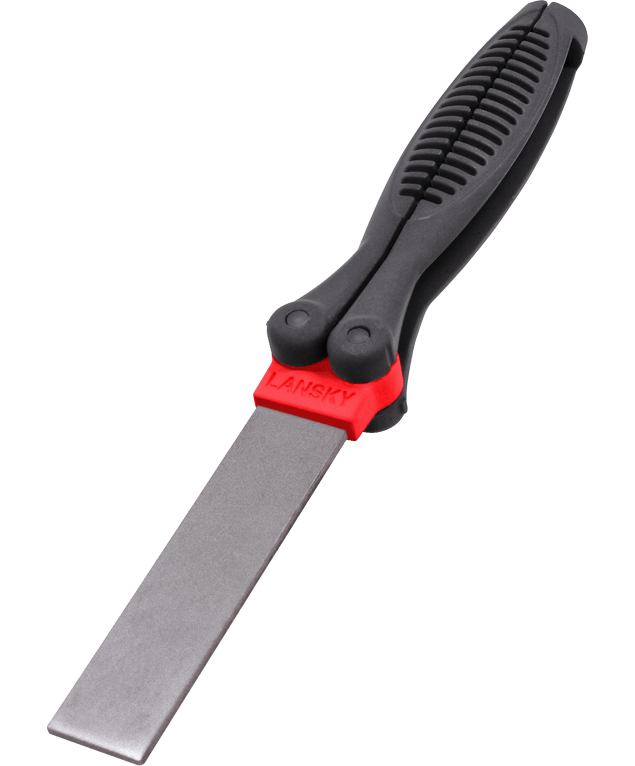
The double-sided paddle folds into its own ergonomic nylon handle. The documented sharpening surface is 3.625 by 0.8125 inches; that is the abrasive area, not an overall opened or folded dimension. The maker describes this model for field knife maintenance and also refers to knives and tools generally. Its folding layout is the reason to consider it when a compact hand tool and two grit choices matter.
The tradeoff is that the FP1260 does not clamp the blade or set a numeric angle. Lansky’s instructions ask the user to open the handles, place an end of the sharpener on a stable surface, hold the paddle and knife separately, and draw the edge at a proper, consistent angle. The listed motion is three or four strokes with light-to-moderate pressure, repeated on the other side of the blade. That is a hand-guided routine, not a fixed-angle slot or a substitute for a clamp system. If exact bevel replication is essential, the maker’s documentation here does not verify a setting for the finder’s numeric angle filter.
Care is specific to the diamond surface
Lansky explicitly says not to apply oil to this diamond surface. Its care note calls for water to clean the hone, a lint-free rag to remove shavings, and complete drying before the next use. That is a practical ownership distinction from some oil stones; do not transfer a different Lansky abrasive’s lubrication directions to this paddle. The product record does not give a replacement interval, a box-by-box accessory list, or a claim about how long its diamond coating will last, so those are not sensible grounds for a performance promise.
Compare the exact neighboring tools
The FP2860 keeps the same folding footprint, 600-grit fine face and user-controlled angle, but changes the coarse-side option to 280 grit medium. The TR600 is a different tapered rod: its maker gives it an individual-serration method, while FP1260’s broad paddle instructions do not document a serration routine. The DROD1 has a retractable three-sided rod with separate directions for small pocket knives, serrations and fish hooks. The LCD02 adds a fixed 22.5°-per-side carbide slot, but its separate diamond rod is still hand-guided. Those are distinct operating plans, not interchangeable handles for the same feature set.
For a plain field knife, the FP1260 is easiest to justify when its coarse/fine pairing is specifically useful and the user is comfortable controlling the bevel. It is less suitable when the must-have is a verified numeric angle, a dedicated serration method, a clamp, or a documented scissor arrangement. The exact offer should be checked for model FP1260 rather than the medium/fine FP2860, and the manual should be consulted before contact with a valuable edge. Category listing establishes the current-reference identity; it does not establish a seller’s stock or the exact contents of an individual listing.
Key specifications
Key details at a glance
| Power | Manual |
|---|---|
| Sharpening format | Hand-guided, folding double-sided diamond paddle |
| Included abrasive surfaces | Coarse 120-grit diamond surface / Fine 600-grit diamond surface |
| Angle-guide positions | ° |
Use the exact model’s instructions for operating limits, supplied equipment and version differences.
Sources for this review
Sources for this assessment

Check the requirements that matter to you
Use the finder to compare documented sharpener formats and limits; an unknown capability is not treated as a match.