
Your needs, this model
Does it fit your priorities?
What hook-size range does Lansky document for the LDFHS?
The exact LDFHS page identifies three different-size grooves and says they sharpen hooks up to size 14/0. The three grooves are not a published fit chart for every hook shape or smaller intermediate size, so check the hook against the actual groove rather than treating 14/0 as a guarantee of universal compatibility.
Explore this need in the finder →Does the LDFHS set a knife angle?
No numeric knife angle or per-side/inclusive convention appears in the exact Lansky product record. It names knife sharpening but does not provide an angle guide, so the user must control the angle by hand; this is not a match for an essential numeric setting.
Explore this need in the finder →What does Lansky claim about carrying and saltwater exposure?
Lansky says the sharpener folds to fit in a pocket or tackle box and that its plastics are marine grade and will not discolor in saltwater applications. Those are maker claims about carry format and discoloration, not proof of corrosion immunity, a durability test, a cleaning procedure or a warranty outcome.
Explore this need in the finder →This assessment is based on Lansky’s exact product record for SKU LDFHS, not on using the tool. The Folding Diamond Knife & Hook Sharpener combines a 600-grit diamond surface with three differently sized grooves for fish hooks. The manufacturer also says it can sharpen knives and folds for pocket or tackle-box carry. Its strongest distinction is this combination of knife sharpening and hook work in a compact manual tool—not a selectable angle, a multi-grit edge progression, or a general-purpose guided system.
A focused tool for two different jobs
Lansky’s exact listing describes a fine 600-grit diamond sharpener with three different-size grooves for hooks up to size 14/0. It also states that the tool can sharpen both hooks and knives. Those are two distinct tasks: a knife edge is guided by hand along the diamond surface, while a hook is handled in a groove chosen to suit its shape and size. The product page gives no hook-by-hook fit chart or instructions that establish the geometry of every groove, so the 14/0 claim should not be treated as a promise that every hook profile fits.
The difference matters if you are choosing between this and a simple knife-only sharpener. For a fishing kit, having a hook-specific feature in the same compact tool may reduce the number of separate items to carry. If hooks are not part of the job, that feature does not replace useful knife-sharpener capabilities such as angle control, a coarser repair abrasive or a finishing stage. Lansky documents only one 600-grit surface here; it does not describe a sequence of abrasives or a separate polishing operation.
Knife use is hand-guided, with no published angle
The maker’s product record says “knives,” but it does not name a knife type, give a supported blade-length range, show a clamp, or publish an angle setting. It also does not state whether any angle is per side or inclusive. This is therefore an unassisted manual task: the user must control the contact and preserve an angle appropriate to the knife. If a precise setting is essential, or if you are trying to reproduce an existing bevel without freehand control, this product page does not document the feature you need.
That restraint is also why I would not equate the LDFHS with the much more angle-specific LCD02. LCD02 includes a fixed 22.5-degree-per-side carbide slot as one operation and a separate freehand diamond rod as another; its numeric slot does not transfer to the LDFHS. Likewise, the TR600 is a folding tapered rod for which Lansky publishes a separate serration procedure. The LDFHS listing does not claim serrated-edge support, so its hook grooves should not be interpreted as a serration feature.
Portability and marine-material language need careful reading
Lansky describes overmolded handles, marine-grade plastics, and a folding form that fits in a pocket or tackle box. It says the plastics will not discolor in saltwater applications. Those statements support a compact carry format and a maker-stated resistance to discoloration; they are not a corrosion test, a durability rating, or a guarantee of long-term saltwater exposure. The source does not specify the rod’s overall dimensions, the exact handle material, a cleaning routine, or whether a particular sale package contains anything beyond the sharpener.
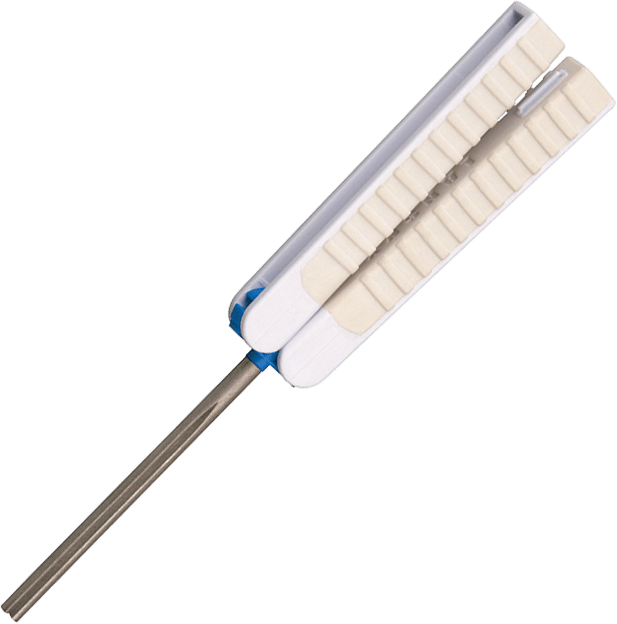
The gallery’s manufacturer image shows the LDFHS open, with the white grip and diamond rod visible. It is useful for identifying the product shape, but the listing’s exact SKU is the safer way to distinguish it from the separate Lansky hook-only sharpener and other portable rods. Confirm that the offer names LDFHS and inspect its package description rather than relying on a similar-looking photograph alone.
Who should consider it—and what to verify
The best-supported use case is narrow: a buyer who wants one manual field tool for fish hooks and hand-guided knife-edge work, and who values a folding handle. A requirement for hook support up to 14/0 is directly relevant, but hook shape still needs to match the actual grooves. If the priority is a documented serration method, see a product with that exact procedure, such as the TR600 or the DROD1; those models have different rod geometries and should not be assumed interchangeable.
Skip the LDFHS if your decision depends on a particular numeric knife angle, a clamp, known blade-size limits, a coarse-to-fine progression, a leather strop, or verified scissor or serration support. The available exact product record does not establish those features. Before buying, check the precise model code, package contents, the fit of your hooks against the three grooves, and the blade geometry you will sharpen. No performance test, ownership, stock status or seller-package guarantee is implied by this evidence-based assessment.
Key specifications
Key details at a glance
| Power | Manual |
|---|---|
| Sharpening format | Folding, hand-held 600-grit diamond hook-and-knife sharpener; no clamp or numeric angle guide is documented |
| Included abrasive surfaces | One fine 600-grit diamond sharpening surface |
| Angle-guide positions | ° |
Use the exact model’s instructions for operating limits, supplied equipment and version differences.
Sources for this review
Sources for this assessment

Check the requirements that matter to you
Use the finder to compare documented sharpener formats and limits; an unknown capability is not treated as a match.