
Your needs, this model
Does it fit your priorities?
Is this a complete sharpener for a very dull knife?
No. Work Sharp's exact user guide says the rod is an edge-maintenance tool, not a complete sharpener. Use it to maintain an established edge; choose a separate sharpening system or service if the knife needs significant material removal or repair.
Explore this need in the finder →What is the intended maintenance motion?
The manual says to stand the rod upright with its rubber tip on a stable surface, place the knife against either built-in guide, maintain that guide angle, and slide the knife down the rod. It suggests 10–20 alternating strokes, with more only if needed, and cautions against letting the knife reach a countertop.
Explore this need in the finder →What care does the manufacturer give for the ceramic surface?
Work Sharp says to wipe the rod with a damp cloth; grey marks are normal and do not affect performance, and an eraser can remove buildup. That is rod-specific guidance and should not be transferred to another ceramic or diamond abrasive.
Explore this need in the finder →Research-based review · current US model WSKTNCHR · checked 29 October 2026
The Work Sharp Ceramic Honing Rod is a maintenance tool, not a complete sharpening system. That is the most important fact in its own user guide: the rod is meant to maintain a cutting edge between fuller sharpening sessions, not to repair a damaged knife or establish a new bevel from a very dull one. The product page uses broader language about restoring or re-sharpening, but this assessment follows the narrower operating instruction in the exact manual.
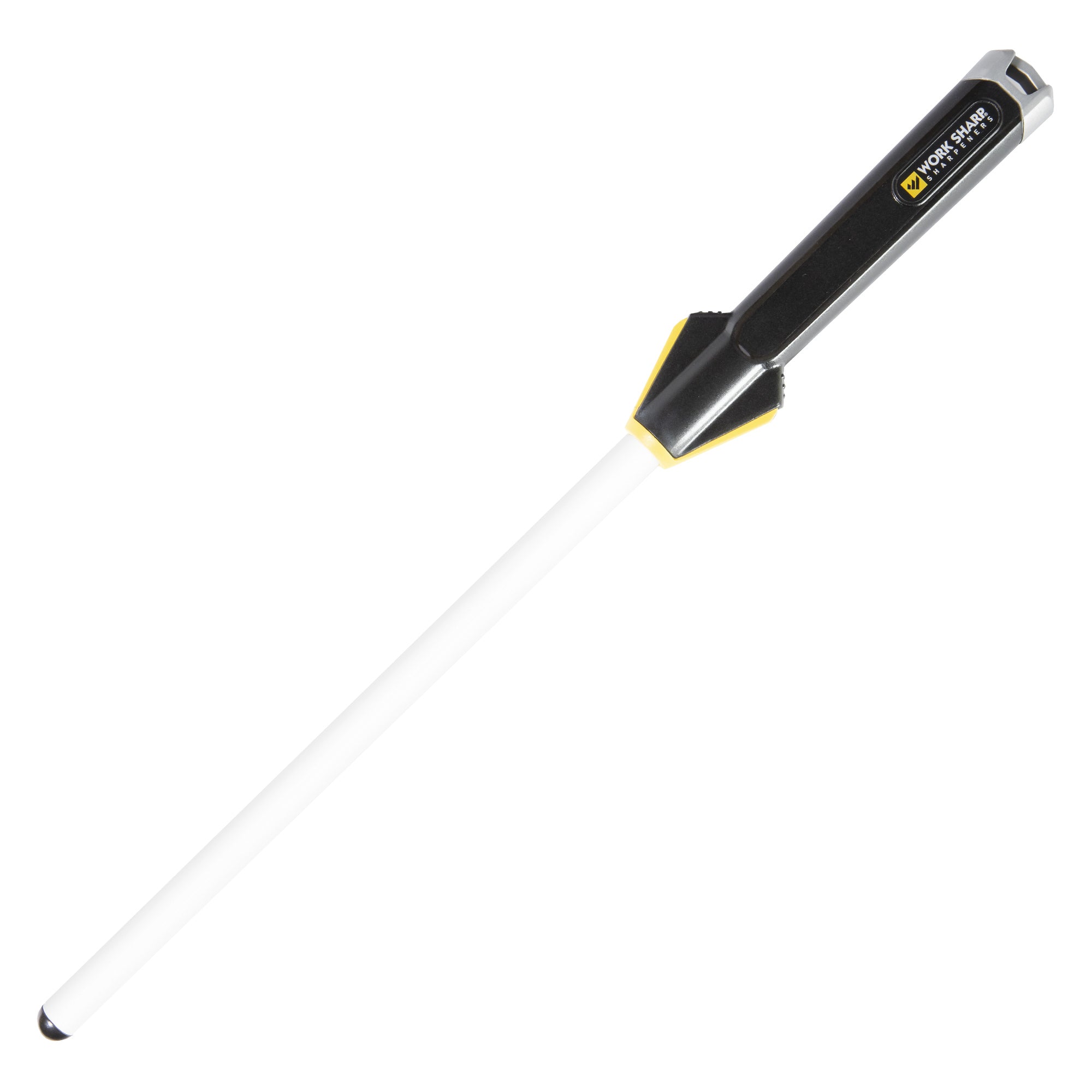
The package is a single fine-ceramic rod with two built-in angle guides, a rubber tip and lanyard pommel. Work Sharp lists a 20° guide, a 9-inch ceramic surface, a half-inch rod width, 0.8-pound weight and three-year warranty. Those are the maker’s published values, not independent measurements. Its intended role is everyday kitchen-knife upkeep rather than a portable field system or full abrasive progression.
A guided maintenance stroke
The manual keeps the routine simple: hold the rod vertically with its rubber tip on a stable surface, place the knife against either guide and slide the blade down the rod while maintaining that guide angle. It suggests alternating between guides for 10–20 strokes and repeating if a knife needs more. The safety reminder is practical: do not let the knife travel into a countertop, and clean the blade carefully before it returns to food preparation.
Built-in guides can make the motion easier to understand than freehand rod honing, but they do not remove the need to control a sharp blade or keep the stroke aligned. The 20° label describes the guide geometry; the reviewed product page and short manual do not say whether it is per-side or included. Do not compare that number directly with another system’s convention, or use it as a recommendation to reprofile a knife whose maker specifies something else.
One fine ceramic surface has a limited job
The appeal is its low-complexity maintenance role: there is no clamp to assemble, abrasive set to select or water-stone preparation described in the manual. Work Sharp says the rod can be wiped with a damp cloth; grey marks are normal and do not indicate a problem, and an eraser may remove buildup. That care advice is specific to this model and should not be carried over to diamond plates or other ceramic surfaces.
Its limitation is equally clear. There is one fine ceramic surface and no coarse stage, adjustable guide or manual procedure for significant edge damage. The manual does not document serrated-knife care, scissors or pocket/hunting use, so those capabilities are not assumed here. A user whose blade is chipped, badly dull or at an angle far from the fixed guide needs a separate sharpener or a qualified service. Buying this rod alone does not solve that problem.
Why the distinction matters in a finder
The rod can match a broad manual, kitchen-use requirement because the manufacturer documents a hand-operated kitchen-edge maintenance plan. That is not the same as saying it will restore every kitchen knife. A result should be read alongside the exact condition of the edge: maintenance and sharpening are related tasks, but they are not interchangeable. If you need a complete progression, compare a stone or guided system such as the Work Sharp Whetstone, Benchstone or Precision Adjust. Each asks for a different setup and care routine.
The product page also describes its ceramic as roughly 1200 grit, while noting that a ceramic rod is not measured in exactly the same way as diamond plates. That figure is a manufacturer comparison, not a universal grit equivalence. The manual’s core instruction is about guided maintenance strokes, not about choosing an abrasive from a cross-material grit chart.
Who should consider it—and who should not
Consider WSKTNCHR when you already have a serviceable plain-edge kitchen knife and want a fixed-guide ceramic routine for regular upkeep. Its simple package and instructions may suit someone who prefers a controlled standing rod over freehand honing. Do not treat it as a substitute for a sharpener if your knife needs repair, a new edge geometry or substantial material removal. The appropriate comparison is with other maintenance methods, not with powered belt machines or a full stone progression.
There is no hands-on sharpening or edge-retention test in this assessment. Before choosing the rod, verify that the fixed guide matches the maintenance convention you intend to keep and that your blade length can be handled safely on a 9-inch surface. If that cannot be confirmed, a more adjustable or professionally serviced route is the cautious choice.
Sources checked: Work Sharp product page, Ceramic Kitchen Honing Rod guide, and model documentation index.
Key specifications
Key details at a glance
| Power | Manual |
|---|---|
| Sharpening format | Guided ceramic honing rod |
| Lowest angle setting | 20° |
| Highest angle setting | 20° |
| Included abrasive surfaces | fine ceramic honing rod |
| Strop included | No |
| Angle-guide positions | 20° |
Use the exact model’s instructions for operating limits, supplied equipment and version differences.
Sources for this review
Sources for this assessment
Check the requirements that matter to you
Use the finder to compare documented sharpener formats and limits; an unknown capability is not treated as a match.