
Your needs, this model
Does it fit your priorities?
How should I identify the original version?
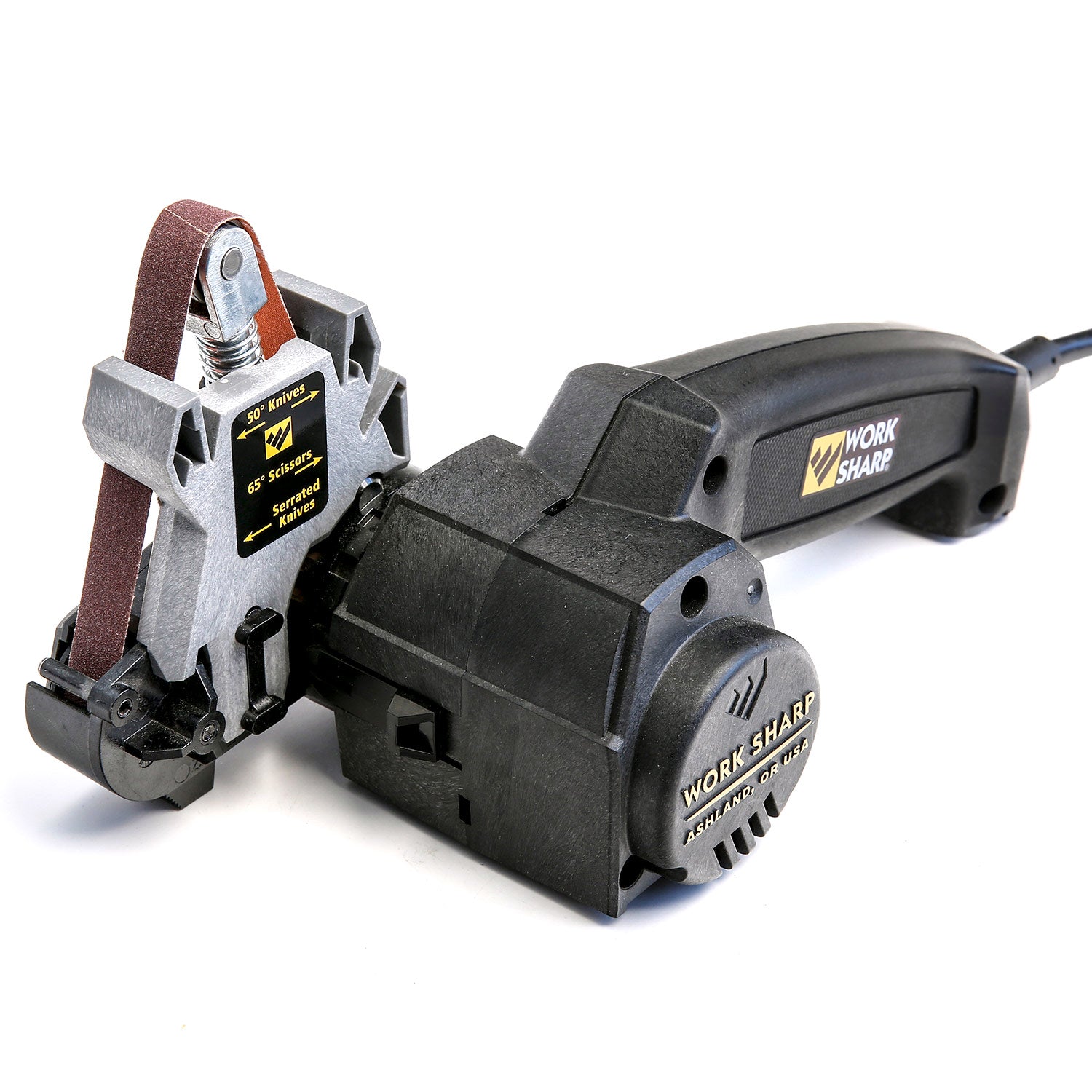
Look for the exact WSKTS marking. Work Sharp marks it retired; it is not the Knife & Tool Mk.2 (WSKTS2) and not the original Ken Onion WSKTS-KO. The older package lists a separate 65° scissor cassette and three types of belt.
Explore this need in the finder →Are the 20°/25° product-page guide values reconciled with the manual?
No. The product page lists the guide values as 20° and 25°, while the WSKTS user guide labels the corresponding knife guides 40° and 50°. The archived sources do not reconcile those numbers or provide an explicit angle convention for this comparison, so do not convert one into the other by assumption.
Explore this need in the finder →Does the knife cassette handle serrations and scissors in the same way?
No. The user guide gives separate powered serration and scissor sections, and the product page lists a separate tool cassette with a 65° scissor guide. Follow the exact procedure and belt orientation for the edge or tool; the knife guide value is not a numeric scissor setting.
Explore this need in the finder →The original Work Sharp Knife & Tool Sharpener is the retired WSKTS, not the later Knife & Tool Mk.2 (WSKTS2) and not either Ken Onion model. That exact model distinction matters: the manufacturer page lists its own 20°/25° knife guide, separate tool cassette and a belt package, while the matching manual shows procedures and guide labels that are not identical to the current page’s simplified description. This is a source-based assessment of the documented configuration, not a hands-on test or an endorsement of any particular used offer.
What the original WSKTS package lists
Work Sharp identifies the unit as SKU WSKTS and marks it retired. Its box list names the powered Knife & Tool Sharpener, a 20°/25° sharpening guide, a tool-sharpening cassette with a separate 65° scissor guide, and two belts each in P80 coarse, P220 medium and 6000 fine. That is a task-specific package rather than a single universal knife slot: the guide uses one arrangement for knives and another cassette for scissors and tools. A retailer’s title alone does not establish that all these removable pieces or consumables are present in a particular offer.
The three belt colors correspond to different levels of work in the instructions. The manual assigns the coarse P80 belt to grinding and tool sharpening, the P220 to knife and scissor sharpening, and the purple 6000 belt to honing knives. Its knife sections describe separate kitchen and outdoor routines, and its serration section gives its own setup. Those distinctions are more useful than treating the six belts as an interchangeable stack or assuming that every edge should begin at the coarsest abrasive.
An unresolved angle-label discrepancy
The most important documentation wrinkle is numerical. The current WSKTS product page lists “20° & 25°” for its sharpening guide. The matching user guide, however, labels its kitchen guide 40° and outdoor guide 50°. The sources available for this exact retired model do not explain whether the values use different conventions, nor do they reconcile each product-page value with each guide label. The review therefore records both statements without converting one into the other. Do not read the finder’s 20° and 25° entries as proof that a particular knife’s stated bevel uses the same convention; compare the actual guide, exact manual and knife-maker instructions first.
The machine is powered and the original manual shows a three-position power switch. It should not be mistaken for a Ken Onion power unit, with its separate variable-speed and attachment specifications. Nor should the original WSKTS be merged with the Mk.2 just because replacement belts or accessories share a family name. Work Sharp’s archived product page states a 3 lb weight and a three-year warranty, but those are maker-published details, not a measurement or assurance about an older unit’s current condition.
Knife, serration and scissor work are separate plans
For plain edges, the manufacturer instructions distinguish kitchen and outdoor knife guides and describe how to position and draw the knife through the guide. The product page also lists hunting and pocket use. Yet the two guide labels and the current 20°/25° values are not harmonized in the available sources, so a numeric match is only a starting point for checking the exact edition and convention.
For serrations, the manual specifies a separate method and identifies the 6000-grit belt. That procedure is not simply the plain-edge guide with a different knife angle. Scissors use the separately listed 65° tool cassette; the exact guide has its own tool steps, belt recommendations and instructions about which bevel to work. The scissor-guide number is not a knife angle. Axes and garden tools are additional manufacturer-listed tasks, but this assessment does not transfer their setup to ordinary kitchen knives.
Retired-model checks before considering an offer
Because this is retired, the practical fit question may be identifying an existing tool or verifying an individual earlier-model offer. Confirm the WSKTS marking, the knife guide, separate tool/scissor cassette, power and belt condition, and the six belts’ grits and widths. A partially assembled unit is not the same package described on the manufacturer page. Work Sharp’s documentation does not establish whether any particular seller has one in stock, what condition it is in, or whether its accessories have been replaced.
The model is most relevant to someone deliberately comparing an older powered belt system that bundles knife and scissor arrangements. It is a poor shortcut if you want a clearly documented modern angle convention, a continuously adjustable setting or an assurance that old belts and cassettes are included. Compare the distinct Knife & Tool Mk.2, Ken Onion Edition Mk.2 and Mk.2 Elite records only as separate products—not as evidence about WSKTS.
Assessment
On paper, the original WSKTS combines a powered belt motor, a guided knife cassette, a dedicated scissor cassette and coarse-to-fine belt choices in one retired configuration. Its edge procedures are more nuanced than a “sharpens knives and scissors” label suggests, and its 20°/25° versus 40°/50° angle discrepancy deserves explicit caution. The most responsible buying approach is exact SKU identification and manual-based inspection of the parts, belt condition and controls. This review makes no claim of personal use, measured sharpness, current availability, price, seller reputation or customer outcome.
Primary references: Work Sharp Original Knife & Tool Sharpener product page and its user guide.
Key specifications
Key details at a glance
| Power | Powered |
|---|---|
| Sharpening format | Powered belt sharpener with separate tool cassette |
| Lowest angle setting | 20° |
| Highest angle setting | 25° |
| Included abrasive surfaces | P80 coarse belts (2) / P220 medium belts (2) / 6000 fine belts (2) |
| Strop included | No |
| Angle-guide positions | 20 / 25° |
Use the exact model’s instructions for operating limits, supplied equipment and version differences.
Sources for this review
Sources for this assessment
Check the requirements that matter to you
Use the finder to compare documented sharpener formats and limits; an unknown capability is not treated as a match.