
Your needs, this model
Does it fit your priorities?
What does the Pivot Response switch do?
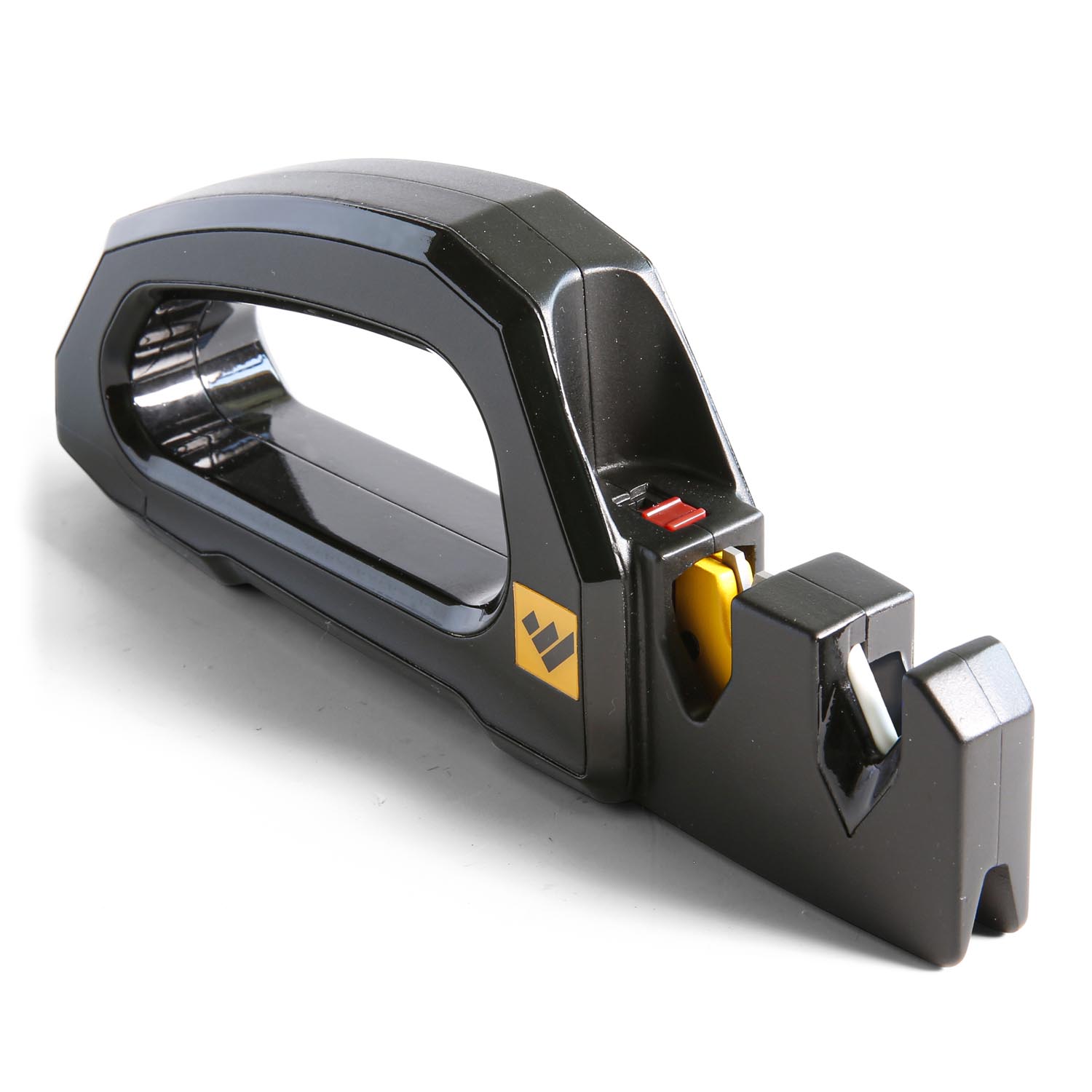
The manual says moving the red button left activates Pivot Response so the convex-carbide mechanism follows the blade curve and increases material removal for heavy sharpening. It is a mechanical change to that slot, not a motor or angle adjustment.
Explore this need in the finder →Does this exact package support serrated edges?
The manual includes a separate light-pressure ceramic routine: lay the flat side of the serration against the side of the honing slot, or nest the serration on the ceramic rod. It does not assign that job the carbide knife slot's stated 25° figure.
Explore this need in the finder →How does its scissor method differ from its knife slots?
The instructions use the rear carbide scissor slot, call for medium pressure and multiple passes, and explicitly say to sharpen only the beveled side. The scissor sharpener can be removed from the handle for convenient use; it is not the same angle or procedure as the knife slots.
Explore this need in the finder →Is its angle suitable for every kitchen knife?
No universal fit follows from the number. Work Sharp states 25° for the carbide slot and about 29°–30° for ceramic honing, but the reviewed manual does not confirm an angle convention or provide an adjustable guide. Compare the knife's bevel specification and choose another method if that fixed geometry is not appropriate.
Explore this need in the finder →Research-based review · current US model WSHHDPVT · checked 29 October 2026
The Work Sharp Pivot Pro is a compact, hand-powered collection of fixed-use sharpening features rather than a conventional adjustable guide. The exact WSHHDPVT package lists Convex-Carbide knife slots, a ceramic hone, a large diamond plate, and dedicated carbide slots for scissors and axes. Its red Pivot Response switch changes how the carbide mechanism follows the blade curve; it does not add a motor or an angle dial.
This is not the same item as Work Sharp’s smaller Pivot sharpener. The model page identifies WSHHDPVT and a specific multi-tool box list. That distinction is easy to lose when product names are similar, so the exact SKU and included parts matter more than a shortened listing title.
Knife maintenance with fixed geometry
Work Sharp gives the Convex-Carbide knife slot a 25° angle. The manufacturer FAQ describes the ceramic side as about 29°–30°, but that is an approximate honing angle, not a setting the user can dial in. The reviewed documentation does not establish whether the 25° number is per-side or included. Neither value should be treated as a recommendation for a knife whose maker specifies a different edge geometry.
The manual says to place the blade heel in the carbide slot, use medium pressure and make multiple passes; it then describes the same general method for honing on ceramic. It also explains that the red switch activates Pivot Response, allowing the carbide mechanism to follow the blade’s curve and increase material removal for heavier sharpening. Since that change affects how aggressively the tool contacts the edge, the control is not just a convenience. Use the instructions and a light, deliberate approach rather than assuming the mechanism will correct an unsuitable angle or stroke.
The product page lists a 400-grit coarse diamond plate for larger or damaged-edge work. The manual’s tool sequence says to swipe the plate across the edge to remove damage and finish with carbide if desired. This is a separate task from the fixed knife slot. Work Sharp also lists the unit at 6.4 ounces and gives a three-year warranty; those are maker-published figures, not independent weighing or warranty testing.
Dedicated routines change the package’s value
The guide documents serration touch-ups on the ceramic: lay the flat side of the serrations against the side of the honing slot using light pressure, or nest the serration on the ceramic rod. The product page’s 25° carbide figure does not describe that operation. Scissors use another dedicated feature at the rear. The manual calls for medium pressure, multiple passes and sharpening only the beveled side; it also notes that the scissor sharpener can be removed from the handle.
Those extras create a wider household and outdoor-tool role than a kitchen-only pull-through. The exact page also describes knife use for kitchen, pocket and hunting blades and lists axes and other edged tools. That breadth still leaves fit questions: a broad use label cannot certify every blade shape, steel, serration pattern, scissor bevel or tool profile. The manual’s procedure is evidence of a supported method, not proof that every individual tool matches it.
Where it differs from other manual choices
Compared with the RKS Rolling Knife Sharpener, Pivot Pro is smaller and adds a scissor route, but it offers a 25° carbide knife slot rather than four magnetic guide positions. The Pull Through Knife Sharpener has a counter-top two-slot kitchen routine and a separate diamond scissor plate; Pivot Pro concentrates multiple fixed-use surfaces in a handheld body. A clamp system such as Guided Field Sharpener brings another kind of guided angle control and setup. These descriptions compare documented arrangements, not measured edge results.
Read the angle limits and exact SKU before choosing
WSHHDPVT makes most sense when portability and the supplied task-specific slots matter more than angle adjustment. Its limited, fixed geometry is a poor match for a buyer who needs an exact custom bevel, a verified per-side convention or an abrasive sequence tailored to a particular steel. The approximate 29°–30° ceramic guidance is intentionally not presented here as an exact selectable range. If a precise angle is essential, check the knife’s specification and compare it with a system that documents that exact setting.
There is no hands-on comparison or performance test in this assessment. Before purchasing, compare the retailer’s SKU and box list with the WSHHDPVT manufacturer page; do not assume a listing for the related Pivot model contains this Pro package’s scissor and axe components.
Sources checked: Work Sharp Pivot Pro product page, PP0004338 Rev. 0 instructions, and model documentation index.
Key specifications
Key details at a glance
| Power | Manual |
|---|---|
| Sharpening format | Handheld convex carbide and ceramic |
| Lowest angle setting | 25° |
| Highest angle setting | 25° |
| Included abrasive surfaces | Convex-carbide sharpening slots / ceramic hone slot / 400-grit coarse diamond plate / carbide axe-sharpening slot / carbide scissor-sharpening slot |
| Strop included | No |
| Angle-guide positions | 25° |
Use the exact model’s instructions for operating limits, supplied equipment and version differences.
Sources for this review
Sources for this assessment
Check the requirements that matter to you
Use the finder to compare documented sharpener formats and limits; an unknown capability is not treated as a match.