
Your needs, this model
Does it fit your priorities?
Does this model document an included method for scissors?
Yes. The box list includes a fine diamond plate for scissors. The exact guide shows right- and left-handed reference guides, placing the beveled scissor edge against the plate, and repeating the same number of strokes on the second blade. It is not the knife-slot procedure.
Explore this need in the finder →Can the Pull Through be used on a pocketknife?
Work Sharp's product FAQ says this model is made for kitchen knives and will not fit pocketknives correctly. The broad word 'knife' on a card is not enough to override that model-specific restriction.
Explore this need in the finder →What angle and sharpening progression does the kitchen routine specify?
The product page gives a fixed 20° guide. The exact guide describes slot 1 as the sharpening stage and slot 2 as the ceramic honing stage, with back-and-forth full-length strokes. Work Sharp does not state on the reviewed page whether that 20° number is per-side or included, so compare the convention with the knife's own specification before changing its bevel.
Explore this need in the finder →How are serrated knives supposed to use the slots?
The manual says to use slot 2 only for serrated knives and provides a separate repeated pull-and-push procedure. The page calls this a ceramic honing slot; it does not assign the serration routine the plain-edge 20° angle, so that number should not be transferred to scallops.
Explore this need in the finder →Research-based review · current US model WSKTNPTS · checked 29 October 2026
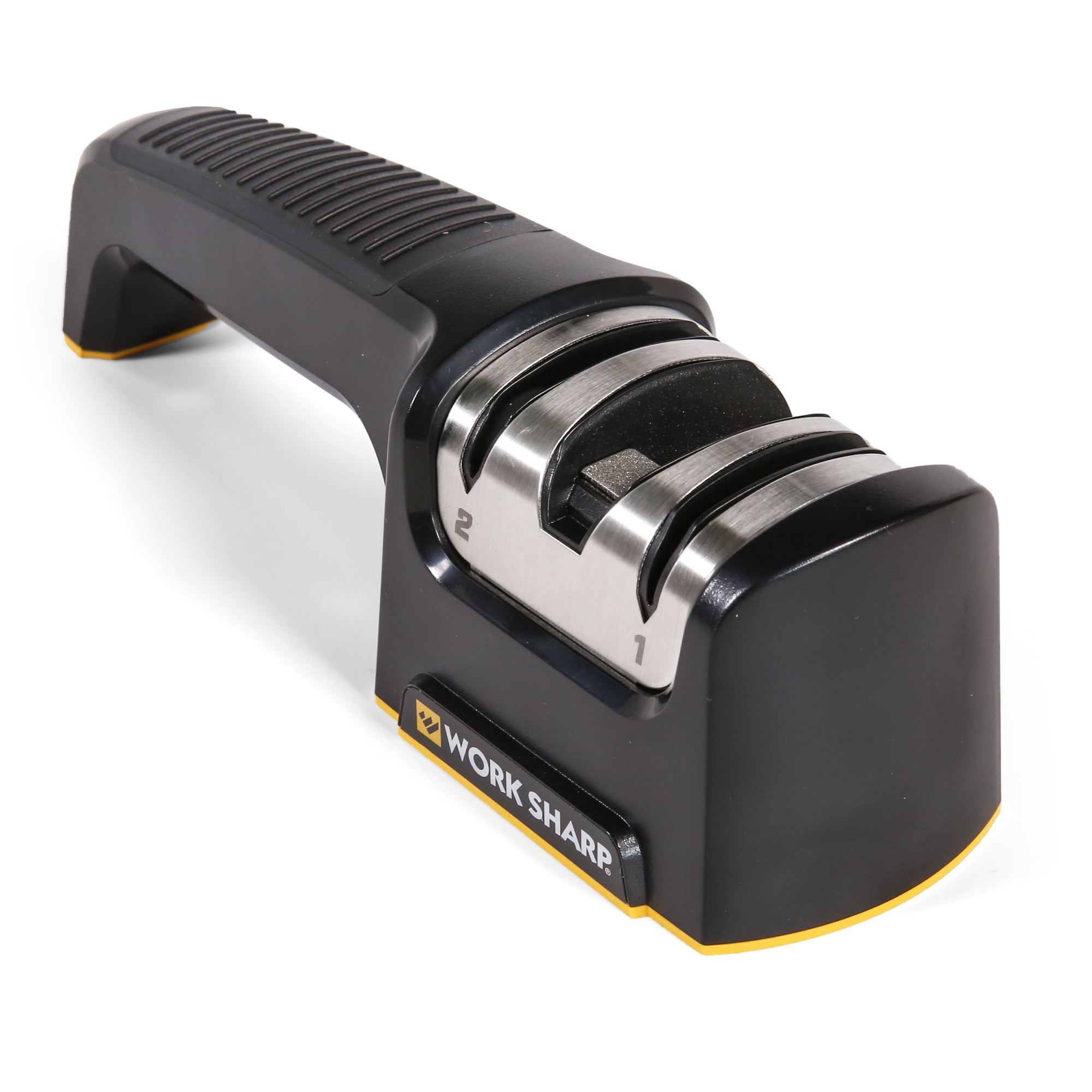
The Work Sharp Pull Through Knife Sharpener is best understood as a compact kitchen routine with a fixed guide, not as a small version of a clamp system or powered belt machine. Its two numbered knife slots use a diamond wheel for sharpening and a ceramic wheel for honing; the maker lists a separate fine-diamond plate for scissors. The motion comes from the user pulling and pushing the blade. There is no motor, angle dial or multi-surface progression to configure.
This assessment is based on the exact WSKTNPTS product page, its linked CP00631 Rev. 0 guide and the manufacturer documentation index. It does not report hands-on testing or an independent measurement of edge quality, speed or abrasive life. Those distinctions matter because the marketing page contains both useful task details and one unresolved grit-description conflict.
A simple two-slot kitchen job
For plain-edge kitchen knives, the manual separates the sharpening stage from the finishing stage: slot 1 is the diamond wheel and slot 2 is the ceramic hone. It directs the user to move the knife back and forth along its full length, follow the curve of the blade and keep it upright rather than rolling it from side to side. It calls for repeated passes and cleaning the blade between stages and before it returns to food preparation. The instructions also tell the user to position the sharpener on a flat surface.
That is a legible sequence for someone who wants a defined routine without assembling a clamp or tracking a long abrasive ladder. But the instructions still require steady motion and pressure. The product FAQ recommends light, even pressure; the printed guide specifies firmer pressure for its prescribed passes. Rather than pretend those phrases are identical, read the complete model-specific directions and use only the pressure they state for the task at hand.
The package includes separate edge and tool procedures
Work Sharp states a fixed 20° knife angle. It does not explain in the reviewed page whether that number is per side or a combined included angle, so it is not safe to compare it directly with another brand’s number or assume it suits every factory bevel. The exact guide also assigns serrated knives to slot 2 only. That is a distinct ceramic touch-up method, not permission to run serrations through the diamond slot or apply the plain-edge 20° claim to each scallop.
For household scissors, the package list adds a fine diamond plate and handed guides. The manual shows laying the beveled side of the scissor blade onto the plate, using the right- or left-handed reference as appropriate, and drawing the tool from heel to tip; it then calls for repeating the process on the other blade. That extra capability is materially different from the ordinary knife slots and makes the included plate worth checking in a seller’s exact box list.
Check the source conflict and kitchen-only boundary
The manufacturer page’s package list and feature text identify a 320-grit diamond sharpening wheel and a fine ceramic honing wheel. A separate answer in its FAQ instead describes 1000-grit and 6000-grit ceramic wheels. The manual confirms the diamond-first, ceramic-second roles but does not resolve that grit discrepancy. This review therefore preserves the listed package description and flags the contradiction rather than presenting the FAQ’s numbers as settled fact. The page also gives a 2.4-pound weight and three-year warranty; these are manufacturer-published details, not measured weight or a prediction of warranty service.
Another boundary is clearer: Work Sharp’s own FAQ says the Pull Through is made for kitchen knives and will not fit pocketknives correctly. That explicit restriction is more useful than the general word “knife.” No leather strop appears in the exact box list, and the reviewed material does not establish whether a seller’s specific offer includes any unlisted replacement wheel or accessory.
How to compare it with other manual formats
The Pull Through favors a fixed kitchen slot and a short sharpening-then-honing sequence. The RKS Rolling Knife Sharpener instead rolls a blade against four discrete guide positions and has no verified scissor method. The Ceramic Honing Rod is narrower still: its manual says it maintains an established edge but is not a complete sharpener. The Precision Adjust asks for more setup and guided abrasive work but allows a different kind of angle control. Those are differences in workflow, not evidence that one produces a better edge.
Consider WSKTNPTS only if the fixed 20° kitchen routine, two-slot movement and separately documented scissor plate fit the actual job. Before changing a knife’s bevel, check its maker’s angle convention and edge guidance. If you need pocket-knife clearance, a custom setting, repair of a badly damaged edge or verified grit progression, this package’s documentation does not establish those requirements.
Sources checked: Work Sharp product page, CP00631 Rev. 0 guide, and model documentation index.
Key specifications
Key details at a glance
| Power | Manual |
|---|---|
| Sharpening format | Fixed angle pull through wheels |
| Lowest angle setting | 20° |
| Highest angle setting | 20° |
| Included abrasive surfaces | 320-grit diamond sharpening wheel / fine-grit ceramic honing wheel / fine diamond plate for scissors |
| Strop included | No |
| Angle-guide positions | 20° |
Use the exact model’s instructions for operating limits, supplied equipment and version differences.
Sources for this review
Sources for this assessment
Check the requirements that matter to you
Use the finder to compare documented sharpener formats and limits; an unknown capability is not treated as a match.